 Skip to content
A qualified electrician can and should install your home EV charger. Specifically, you need an OZEV-approved installer who works to BS 7671 Section 722, the wiring regulation that governs EV charging circuits. For a straightforward 7 kW wallbox on a standard driveway, expect to pay a typical supplied-and-fitted cost in the lower to mid-range. Consumer unit upgrades, long cable runs, or earthing work push that figure higher. Centralec-electrical is NICEIC-approved and carries out EV charger installations across the South West, so the trust signals you need are already in place.
Before you call anyone, do these three things:
- Take photos of your consumer unit, meter, and proposed parking area — most installers will quote from these before visiting.
- Check you have off-street parking; it is a condition of grant eligibility for renters and flat owners.
- Ask every installer for their OZEV registration number and proof of a relevant Level 3 EV qualification before you accept a quote.
Table of Contents
- How much does EV charger installation cost in the UK?
- Who can legally install an EV charger at home?
- What does an electrician actually do on installation day?
- What pushes a quote higher — and what to challenge
- Who qualifies for the OZEV EV Chargepoint Grant?
- How to choose the right electrician for EV charger installation
- Why EV charger installation must be done by a qualified electrician
- Key takeaways
- Why certified local installers are the right call
- Get a fixed-price EV charger installation quote from Centralec-electrical
How much does EV charger installation cost in the UK?
Most homeowners want a number, not a range. Here is the honest picture: a 7 kW smart charger installed on a standard driveway with a short cable run typically costs £800–£1,600 supplied and fitted. Complex jobs — long buried cable runs, consumer unit upgrades, or three-phase supplies — can cost £2,500 or more.
| Scenario | Typical supplied-and-fitted cost |
|---|---|
| Straightforward 7 kW driveway install | £800–£1,600 supplied and fitted |
| Longer cable run (10 m) | Moderate price increase above £1,600 likely |
| Consumer unit upgrade required | Total cost often approaches or exceeds £2,500 |
| Groundworks / trenching needed | High cost, often £2,500+ |
| Three-phase or supply upgrade | Substantially higher cost expected |
What makes up the total price?
The charger unit itself (a myenergi Zappi, Wallbox Pulsar Plus, or Tesla Wall Connector, for example) typically accounts for a moderate portion of the £800–£1,600 total cost. Labour for a standard install is a significant part, with additional costs for ancillary items such as an earth rod if needed, surge protection, cable containment, and any consumer unit work.
Common cost drivers and their approximate impact:
- Earth rod and TT earthing work is a known cost element and may increase the price accordingly.
- Consumer unit upgrades involve additional expenses that can notably increase total cost.
- Long or buried cable runs add incremental labor and material costs.
- Deep trenching through paving or garden is labor-intensive and adds considerable cost.
- DNO supply upgrades, though rare, require extra time and may significantly increase costs.
The OZEV EV Chargepoint Grant provides a financial contribution at point of sale for eligible renters, flat owner-occupiers, and landlords — it does not apply to most homeowners with a private driveway. So if you rent or own a flat, your net cost may be notably reduced for a standard install.
Pro Tip: Ask whether smart-charging features, OCPP compatibility, and load balancing are included in the unit price. A Zappi or Wallbox with solar integration costs more upfront but can cut your per-kWh charging cost from roughly 28–30p to around 7p/kWh when paired with an off-peak tariff — the payback is real.
Who can legally install an EV charger at home?
Not every electrician is qualified for this work. A general domestic electrician may be competent at rewires and consumer units, but EV charging circuits have specific requirements under BS 7671 Section 722 that demand specialist knowledge. Here is what to check.

Accreditations that actually matter
OZEV-approved installer status is the most important credential if you want to claim the EV Chargepoint Grant. OZEV maintains a list of approved installers on GOV.UK, and only installers on that list can apply the grant discount at point of sale. Ask for their OZEV registration number before you book.
NICEIC or NAPIT membership confirms the electrician is registered with a competent person scheme and can self-certify electrical work under Part P of the Building Regulations. This means you get a proper Electrical Installation Certificate (EIC) without needing a separate building control notification. Both schemes carry out regular technical assessments of their members.
Level 3 EV installation qualification is now a formal requirement. From October 2026, the Electrotechnical Assessment Specification (EAS) requires electricians installing EV equipment to hold a relevant Level 3 qualification. Ask to see the certificate — a competent installer will have it to hand. The LCL Awards Level 3 Award in the Installation and Commissioning of Electric Vehicle Charging Equipment is one recognised route.
Manufacturer-specific accreditation is worth asking about too. Installers accredited by the charger manufacturer (for units such as the myenergi Zappi, Wallbox, or Tesla Wall Connector) have completed product-specific training and can often handle warranty registration more smoothly.
Documents to request before and after the job
Before booking: written fixed-price quote, evidence of OZEV approval, Level 3 qualification certificate, and proof of public liability insurance.
On completion: a full Electrical Installation Certificate for the new circuit, photographic evidence of the installation (required for grant claims), and any DNO notification reference where applicable. Incomplete paperwork is the most common reason grant claims fail, so confirm this in writing before work starts.
What does an electrician actually do on installation day?
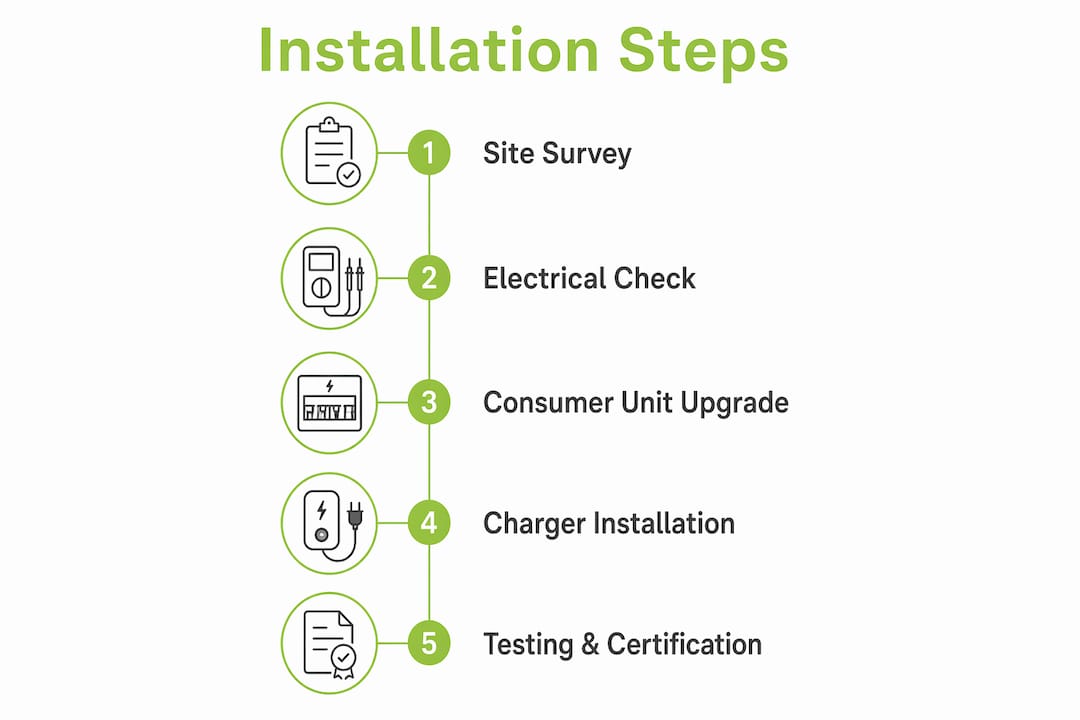
The process is more involved than fitting a socket. Here is the typical sequence from first contact to driving away with a charged car.
- Initial enquiry and photos. You send photos of your consumer unit, meter tails, and parking area. A good installer will assess load capacity and earthing arrangements from these before visiting.
- Site survey (for complex jobs or where photos are inconclusive). The electrician checks consumer unit headroom, cable route options, earthing type, and whether DNO notification is needed.
- DNO notification. For most 7 kW single-phase installs, a G100 notification to your Distribution Network Operator is required. The installer handles this; it rarely delays a straightforward job.
- Consumer unit assessment. On the day, the electrician checks available ways, existing load, and whether the board can accommodate a dedicated 32 A circuit without nuisance tripping or overloading.
- Cable routing and installation. The cable run from the consumer unit to the charger location is planned, clipped, or buried. Containment (trunking or conduit) is fitted where the cable is surface-run.
- Earthing and earth rod installation. If your property is on a PME (TN-C-S) supply, a separate TT earth electrode is often required for the EV circuit. The electrician drives the rod, runs the earth conductor, and selects the correct RCD type.
- Protective devices. A dedicated RCBO or RCD/MCB combination is fitted in the consumer unit. For EV circuits, a Type A RCD with 6 mA DC detection is typically the minimum; some installations require a Type B device.
- Mounting and commissioning the wallbox. The charger (Zappi, Wallbox, Tesla Wall Connector, or similar) is fixed, wired, and commissioned. The installer connects it to the manufacturer’s app and confirms communication.
- Testing. Earth electrode resistance, continuity, insulation resistance, and RCD operation tests are all carried out. These are not optional — they are required by BS 7671 and by the grant scheme.
- Certification and handover. You receive a full EIC, any Part P self-certification paperwork, and photographic evidence. The installer walks you through the app and, ideally, recommends an off-peak EV tariff to pair with the smart charger.
A simple install typically takes half a day on site. Jobs requiring consumer unit upgrades, groundworks, or DNO supply changes (which may push the total cost above £2,500) can stretch to a full day or longer, with DNO-led work sometimes adding weeks to the overall timeline. For a deeper look at what the hardwired installation process involves, including typical cable routes and consumer unit considerations, that guide covers the specifics.
What pushes a quote higher — and what to challenge
Some cost increases are entirely legitimate. Others are worth questioning. Knowing the difference saves money and prevents you from being upsold on work you do not need.
Legitimate cost drivers
Long or buried cable runs are the most common reason a quote exceeds the standard band. Every additional metre of cable, containment, and labour adds cost. Trenching through a paved driveway or garden is labour-intensive: expect £500–£1,200 for significant groundworks.
Consumer unit upgrades are sometimes necessary — older boards with no spare ways, or boards that cannot safely accommodate a continuous 32 A load, need replacing before the charger can be installed. This adds £400–£900 to the job. If you are unsure whether your board needs upgrading, a consumer unit assessment before quoting is sensible.
TT earthing electrode work on PME supplies adds £120–£300 and is a genuine regulatory requirement, not an upsell. Many UK properties have PME supplies where the EV circuit cannot use the existing earth.
Three-phase supply or supply upgrades are rare for domestic installs but do occur on older properties or where the homeowner wants a 22 kW charger. These involve the DNO and can add significant cost and lead time.
What to challenge
Vague line items with no specification — “electrical works” or “additional materials” without detail — are a red flag. So is a quote that omits the charger model, cable route, protective devices, and certification. If an installer cannot tell you exactly which RCD type they plan to fit, that is a problem.

Cash-only requests and quotes significantly below market rate without explanation deserve scrutiny. A quote of £400 for a supplied-and-fitted 7 kW charger is not a bargain; the typical market rate is £800–£1,600 for a standard installation.
Compare quotes on these five points: charger model and specification, cable route and containment, protective devices (RCD type), testing and EIC included, and whether grant handling is part of the service.
Who qualifies for the OZEV EV Chargepoint Grant?
The grant situation catches many homeowners out. The short version: if you own a house with a private driveway, you almost certainly do not qualify. The £350 EV Chargepoint Grant is aimed at renters, flat owner-occupiers, and landlords.
| Property type | Grant eligibility |
|---|---|
| Homeowner, house with private driveway | Generally not eligible |
| Renter (flat or house) with off-street parking | Usually eligible (£350) |
| Flat owner-occupier with off-street parking | Usually eligible (£350) |
| Landlord installing for tenants | Usually eligible (£350 per socket, up to certain limits) |
| Homeowner, no off-street parking | Not eligible (separate on-street scheme may apply) |
How to claim the grant
- Check your eligibility on GOV.UK before approaching installers.
- Choose an OZEV-approved installer — only they can apply the discount at point of sale.
- The installer applies the grant on your behalf; you pay the reduced amount upfront rather than claiming a rebate later.
- Provide the required documentation: proof of vehicle ownership or order, tenancy agreement or lease (where applicable), and photographs of the completed installation.
- The installer submits the claim to the grant administrator. Incomplete or missing photographs are the most common reason claims are rejected.
For landlords installing multiple charge points, the landlord-specific grant guidance covers the per-socket limits and tenancy permission requirements in detail.
How to choose the right electrician for EV charger installation
The checklist below covers everything worth verifying before you hand over a deposit.
Hire checklist:
- OZEV-approved installer registration (ask for the registration number)
- NICEIC or NAPIT membership (verify on the scheme’s public register)
- Level 3 EV installation qualification (EAS-compliant from October 2026)
- Public liability insurance (ask for the certificate, not just a verbal confirmation)
- Written fixed-price quote specifying charger model, cable route, protection devices, and certification
- Willingness to provide an EIC on completion and handle grant paperwork if applicable
Questions worth asking on the phone
“What earthing arrangement does my property have, and will you need to fit an earth rod?” A competent installer will explain PME versus TT earthing without hesitation.
“Will you need to notify the DNO, and does that affect the installation date?” For most 7 kW installs, G100 notification is required but does not delay the job.
“Who handles the OZEV grant paperwork — me or you?” OZEV-approved installers apply the discount directly; you should not be chasing a rebate yourself.
“Is load balancing included, and which charger models do you recommend for my setup?” This reveals whether the installer is thinking about your whole electrical system or just fitting a box.
Red flags to walk away from
A quote with no itemised breakdown. Refusal to show qualifications or a sample EIC. Pressure to decide quickly or pay cash. An installer who cannot name the RCD type they plan to fit. These are not minor oversights; they indicate either inexperience or an intent to cut corners on a job where the safety margins genuinely matter.
For a structured comparison of what separates good installers from poor ones, that resource covers the questions and red flags in more depth.
Why EV charger installation must be done by a qualified electrician
The electrical demands of a home EV charger are unlike almost anything else in a domestic property. A 7 kW charger draws approximately 32 A continuously, with no diversity applied — meaning the circuit is treated as if it runs at full load indefinitely. That is why BS 7671 Section 722 and the IET Code of Practice for Electric Vehicle Charging Equipment Installation exist as distinct technical standards, separate from general wiring rules.
The earthing question is where many DIY attempts and underqualified installs go wrong. Most UK homes are connected via a PME (TN-C-S) supply. Under Regulation 722.411.4.1, the PME earth must not be used for the EV charging circuit in many outdoor situations. A separate TT earth electrode is required, with its own earth conductor and correctly selected RCD to manage touch-voltage limits. An electrician who does not know this rule should not be installing your charger.
On completion, the installer must hand over an earth electrode resistance test result, RCD operation test results, and a full Electrical Installation Certificate. These documents matter for your home insurance, for any future property sale, and for the grant claim. They are also the only way to confirm the job was done correctly. For a full explanation of the technical and regulatory requirements that govern compliant installations, that page covers the specifics in plain language.
Key takeaways
A qualified, OZEV-approved electrician working to BS 7671 Section 722 is the only safe and compliant route to a home EV charger installation in the UK.
| Point | Details |
|---|---|
| Typical cost range | A straightforward 7 kW install costs £800–£1,600 supplied and fitted; complex jobs exceed £2,500. |
| Grant eligibility | Renters, flat owner-occupiers, and landlords can claim a £350 OZEV grant; most house owners with driveways cannot. |
| Key qualifications to verify | Ask for OZEV registration, NICEIC or NAPIT membership, and a Level 3 EV qualification (mandatory from October 2026). |
| Certification on completion | Insist on a full Electrical Installation Certificate and photographic evidence — both are required for grant claims and insurance. |
| Centralec-electrical | NICEIC-approved, 23+ years’ experience, installs Zappi, Wallbox, Tesla Wall Connector, and Autel chargers across the South West with fixed upfront pricing. |
Why certified local installers are the right call
My strong recommendation is to use a NICEIC-approved, OZEV-registered local electrician for any home EV charger installation. The reasoning is straightforward: the electrical risks are real, the regulatory requirements are specific, and the paperwork has direct financial consequences if it is wrong.
What I see too often is homeowners focusing on the charger brand rather than the installer’s qualifications. The myenergi Zappi, Wallbox Pulsar Plus, and Tesla Wall Connector are all good products. But installer competence and a correct load calculation matter far more than which box ends up on the wall. A correctly specified and tested installation on a modest charger will outperform an expensive unit fitted by someone who skipped the earthing assessment.
Centralec-electrical brings over 23 years of electrical experience, NICEIC approval, and a fixed-price, no-hidden-costs approach to every EV charger job. The team installs myenergi Zappi, Wallbox, Tesla Wall Connector, and Autel chargers, handles OZEV grant paperwork where applicable, and issues a full EIC on completion. Readers should still compare like-for-like quotes and verify accreditations independently — that is exactly what a trustworthy installer will encourage you to do.
Get a fixed-price EV charger installation quote from Centralec-electrical
Fixed pricing, no surprises, and a full EIC on completion — that is what Centralec-electrical delivers on every EV charger installation in the South West.
A supplied-and-fitted quote from Centralec-electrical covers the site survey, consumer unit assessment, cable run and containment, earthing work where required, the correct protective devices, commissioning, and full certification. OZEV grant handling is included for eligible customers. The team installs myenergi Zappi, Wallbox, Tesla Wall Connector, and Autel chargers, and will recommend the right unit for your property and charging habits.
What is typically included:
- Site survey and load assessment
- Consumer unit check (upgrade quoted separately if needed)
- Earth rod installation where required by BS 7671
- Dedicated 32 A circuit, cable run, and containment
- Correct RCD/RCBO protection devices
- Charger mounting, wiring, and commissioning
- Full Electrical Installation Certificate
- OZEV grant application (where eligible)
To see a full breakdown of what affects your installation cost, visit the EV charger installation cost page. For technical and regulatory requirements, the installation requirements guide covers everything in plain language. Get in touch with Centralec-electrical to request your written fixed-price quote.
This article provides general information about EV charger installation in the UK. It is not a substitute for professional electrical advice. Confirm current grant eligibility, regulatory requirements, and your property’s specific needs with a qualified electrician or the relevant primary source before proceeding.