 Skip to content
A Tesla-compatible home charger professionally installed in the UK typically costs £800–£1,400 for a straightforward job, covering hardware and labour for a standard driveway installation with a short cable run and no consumer unit work. If you need an electrical upgrade, expect to incur additional costs for necessary consumer unit upgrades.
Two things to do right now: book a site survey with a NICEIC-approved installer and confirm whether your consumer unit meets BS 7671 IET Wiring Regulations requirements or needs upgrading before the charger goes in.
Quick note on grants: As of 2026, homeowners of houses are not eligible for the OZEV EV Chargepoint Grant. The grant (up to 75% of costs, capped at £350) now applies only to renters and flat owners. If you rent or own a flat, check eligibility before ordering hardware.
Centralec-electrical is NICEIC-approved, which means every installation is self-certified under the Competent Person Scheme — no separate Building Control paperwork for you to manage.
Table of Contents
- What does a Tesla charger installation cost in the UK?
- What site factors push your quote up or down?
- Three real-world cost scenarios
- Why UK regulations make a registered installer non-negotiable
- How to get accurate quotes and choose the right installer
- What to expect from survey to switch-on
- How smart features cut your running costs
- Which chargers work for Tesla owners, and what Centralec-electrical installs
- Key takeaways
- Why professional installation is the only sensible route
- Get a quote from Centralec-electrical
- Useful sources for further reading
What does a Tesla charger installation cost in the UK?
The total price has three components: hardware, labour, and any electrical upgrades your property needs. Most homeowners focus on the charger price and underestimate the second two.

| Component | Typical low | Typical high | Notes |
|---|---|---|---|
| Tesla Wall Connector (hardware) | £400 | £500 | Gen 3, purchased separately |
| Comparable smart charger (Wallbox, Zappi, Autel) | £350 | £700 | Varies by model and features |
| Installation labour (supply and fit) | — | £600 | Short run, standard driveway (total installed cost typically £800–£1,400 for standard scenarios) |
| Consumer unit upgrade | £350 | £500 | Only if RCD protection is insufficient |
| Additional earthing / PME work | — | £400 | Site-specific; not always needed |
| Extended or concealed cable run | £100 | — | Per additional 5m+ or hidden route |
Labour for a hardwired EV charger installation on a standard driveway with the consumer unit nearby sits at the lower end. Concealed routes through walls or under paving push that figure up quickly.
Common optional extras that increase cost:
- Smart tariff integration (e.g. Octopus Intelligent or Economy 7 scheduling)
- Cross-pavement ducting for terraced properties without off-street parking
- Additional RCD devices where the existing board is partially compliant
- External weatherproof enclosures for exposed mounting positions
What site factors push your quote up or down?
Cable run length and route complexity are often the single largest variable in the final price. A run under 5m from the consumer unit to the parking spot keeps labour tight. Anything over 10m, or a route that requires chasing through walls or lifting paving, adds meaningful time and materials.
Key factors that affect your quote:
- Property type: — Detached houses with off-street parking are the simplest installs. Terraced properties often need cross-pavement solutions or longer runs. Flats require landlord consent and may involve shared electrical infrastructure.
Pro Tip: If you are building or renovating, position your parking as close to the consumer unit as possible. Even shaving 3–4 metres off the cable run can save £100–£200 in labour.
Three real-world cost scenarios
These scenarios use realistic assumptions to help you map your property to a likely budget range.
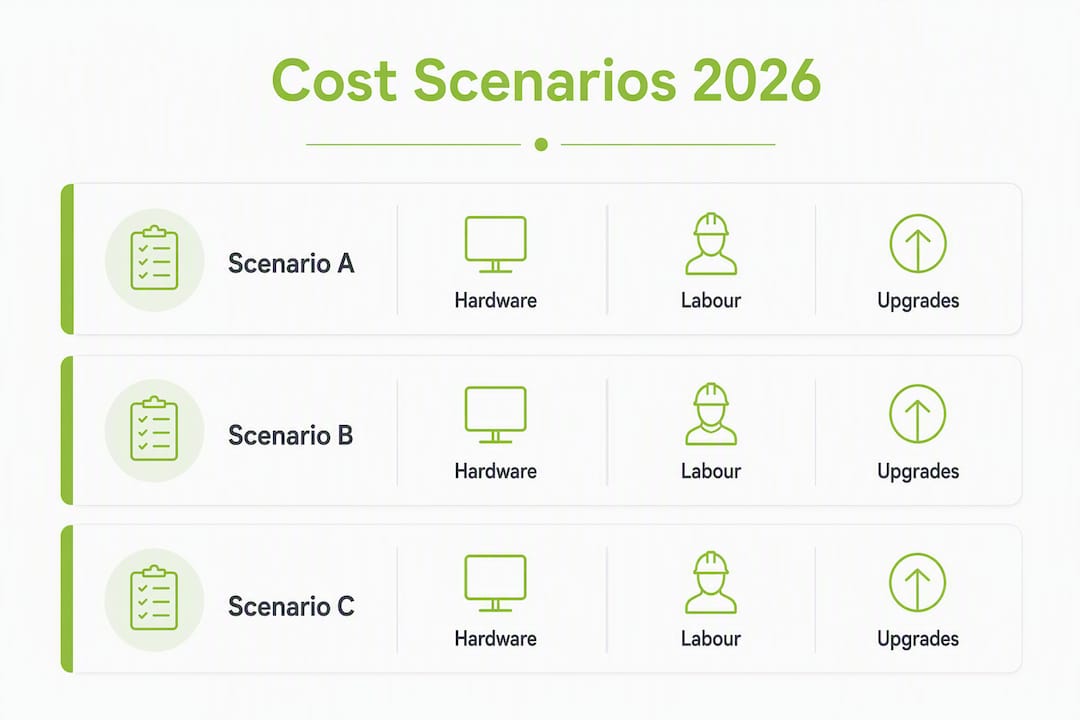
| Scenario | Hardware | Labour | Upgrades | Estimated total |
|---|---|---|---|---|
| A: Simple detached, short run | — | £350 | None | £800 |
| B: Terraced/semi, moderate run | £500 | — | Minor RCD work (—) | — |
| C: Complex install, long run + CU upgrade | £500 | — | CU upgrade £400 + earthing £200 | — |
Scenario A assumptions: Detached house, consumer unit in garage or adjacent utility room, cable run under 5m, existing board compliant with BS 7671, Tesla Wall Connector or equivalent.
Scenario B assumptions: Terraced or semi-detached, consumer unit inside the house, cable run 6–10m, one additional RCD required, standard external mounting position.
Scenario C assumptions: Long cable run (10m+) with concealed route, consumer unit upgrade required, PME earthing solution needed, complex mounting position. This is the upper end of typical residential installs.
Why UK regulations make a registered installer non-negotiable
EV charger installations must comply with BS 7671 IET Wiring Regulations, specifically Section 722, which covers electric vehicle charging installations. Every circuit must be RCD-protected, and the earthing arrangement must be correct for the supply type at your property.
Part S of the Building Regulations, which came into force in England in June 2022, mandates that charging equipment meets Mode 3 dedicated circuit standards. Installers registered with a Competent Person Scheme can self-certify compliance, which removes the need for you to submit a separate Building Control notice. Use an unregistered installer and that paperwork burden falls on you — along with the risk that the work is not properly certified.
What a compliant installation must include:
- Dedicated circuit from the consumer unit to the charger
- RCD protection appropriate to the supply type
- Correct earthing solution (particularly important on PME supplies)
- Electrical installation certificate issued on completion
- Compliance with GOV.UK minimum technical specifications for residential chargepoints
⚠️ Warning: NICEIC advises strongly against DIY EV charger installation-charger-installation-and-maintenance/). Non-compliant work can invalidate your home insurance, void the charger warranty, and create a genuine shock or fire risk. The technical requirements for RCD protection and earthing make professional installation the only safe route.
How to get accurate quotes and choose the right installer
Getting three quotes is standard advice. Getting three useful quotes requires a bit of preparation.
- Photograph your consumer unit — show the make, model, and available space for a new circuit breaker.
- Photograph your parking area — include the wall where the charger would mount and the likely cable route back to the house.
- Note your vehicle model — the Tesla Wall Connector uses a Type 2 connector, compatible with all current UK Tesla models. Confirm connector type if you have a non-Tesla EV or plan to future-proof for a second vehicle.
- Confirm permissions — landlords need written consent; flat owners may need building management approval.
- Request itemised quotes — hardware, labour, and any electrical upgrade costs listed separately. A single lump sum makes comparison impossible.
- Check NICEIC approval — verify the installer’s registration directly on the NICEIC website, not just from their own marketing.
- Ask about OZEV paperwork — if you are a renter or flat owner, confirm the installer is OZEV-approved and will handle grant paperwork.
Red flags to watch for:
- No written quote or a quote that lumps everything into one price
- Requests for large cash payments upfront
- No mention of an electrical installation certificate on completion
- Vague answers about RCD protection or earthing arrangements
- No public liability insurance
Most reputable installers ask for consumer unit photographs before issuing a fixed quote. If an installer quotes without seeing the board or the site, treat that figure as provisional at best.
What to expect from survey to switch-on
Tesla recommends finding an installer and scheduling installation up to two weeks before you need the charger. That is a realistic minimum for a straightforward job; more complex installs or busy periods may extend the wait.
Typical timeline:
- Post-install documentation: — Electrical installation certificate, commissioning test results, and a user briefing on smart features — all issued the same day
If your property’s maximum demand triggers ENA/DNO notification requirements, your installer will handle that contact, but it can add 2–4 weeks to the timeline. Your installer should flag this during the survey. Full details on installation certification are worth reviewing before you book.
How smart features cut your running costs
A smart charger paired with the right tariff can materially reduce what you spend per mile. The installation cost is a one-off; the tariff savings compound every time you plug in.
Scheduled charging lets you draw power during off-peak windows, typically overnight, when rates on tariffs like Octopus Intelligent or Economy 7 are significantly lower than daytime rates. Load management prevents the charger from pushing your home’s total demand above safe limits, which matters if you have other high-draw appliances running simultaneously.
Decisions that affect your running cost:
- Tariff type: a dedicated EV tariff with off-peak rates versus a standard flat-rate tariff
- Meter type: smart meter required for most time-of-use tariffs
- Charger capability: confirm the unit supports scheduled charging and your chosen tariff’s API or OCPP integration
- Vehicle-to-grid readiness: not yet mainstream, but worth considering for future-proofing
A professionally installed smart EV charger plus a favourable off-peak tariff can often recoup the installation outlay through lower per-mile charging costs compared with public rapid charging. Public rapid chargers typically cost considerably more per kWh than home off-peak rates, so the payback case for a home charger is strong for most regular drivers.
Business owners should also note that EV charging costs claimed through a limited company may be treated as a business expense, which changes the effective cost of installation.
Which chargers work for Tesla owners, and what Centralec-electrical installs
The Tesla Wall Connector is the manufacturer’s own home charging solution for UK properties. It delivers up to 7.4kW on a single-phase supply, has a built-in Type A + DC 6mA RCD, and supports load balancing across multiple units. Hardware cost sits at roughly £400–£500, purchased separately from installation.
Three strong alternatives are also widely fitted for Tesla owners:
- Wallbox Pulsar Plus: Compact, app-controlled, supports scheduled charging and load management. Hardware typically £350–£500.
- Myenergi Zappi: The standout choice if you have solar panels, as it can prioritise surplus solar energy for charging. A Myenergi Zappi installation suits homeowners who want to minimise grid draw. Hardware typically £500–£700.
- Autel MaxiCharger Home: Solid build quality, OCPP-compatible, good smart tariff integration. Hardware typically £400–£600.
All four are compatible with Tesla vehicles via the Type 2 connector standard used across the UK.
| Charger | Hardware cost | Smart features | Warranty |
|---|---|---|---|
| Tesla Wall Connector | £400–£500 | Scheduled charging, load balancing | 4 years (hardware) |
| Wallbox Pulsar Plus | £350–£500 | App control, load management | 3 years |
| Myenergi Zappi | £500–£700 | Solar divert, scheduled charging | 3 years |
| Autel MaxiCharger Home | £400–£600 | OCPP, app control, tariff integration | 3 years |
Pro Tip: If you are unsure which charger suits your property and tariff, ask your installer to recommend based on your consumer unit type, meter setup, and whether you have or plan solar panels. The right charger for your situation is not always the manufacturer’s own unit.
Centralec-electrical installs all four of the above. Every job comes with a fixed upfront quote, NICEIC-certified installation, and a satisfaction guarantee. With over 23 years of electrical experience across the South West, the team handles everything from the site survey through to post-install certification and OZEV grant paperwork for eligible customers.
Key takeaways
A Tesla-compatible home charger installed in the UK typically costs £800–£1,400 for a standard job, with consumer unit upgrades and long cable runs the most common reasons a quote exceeds that range.
| Point | Details |
|---|---|
| Typical installed cost | £800–£1,400 for a straightforward install; add £350–£500 if a consumer unit upgrade is needed. |
| Main cost drivers | Hardware (£400–£500 for the Tesla Wall Connector), labour (up to £600), and electrical upgrades (£350–£500) are the three components to budget separately. |
| Grant eligibility | Homeowners of houses are not eligible for the OZEV grant; renters and flat owners can claim up to £350. |
| Compliance requirement | All installations must meet BS 7671 and be RCD-protected; use a NICEIC-registered installer to self-certify and avoid Building Control paperwork. |
| Centralec-electrical | NICEIC-approved, 23+ years’ experience, fixed quotes, and a satisfaction guarantee on every EV charger installation. |
Why professional installation is the only sensible route
There is a version of this decision where someone looks at the Tesla Wall Connector’s straightforward appearance and thinks: how hard can it be? The answer is that the charger itself is not the complicated part. The circuit it connects to is.
Getting the earthing arrangement wrong on a PME supply does not just risk a failed inspection. It creates a live fault path that a standard RCD will not catch. That is not a theoretical risk; it is the specific reason Section 722 of BS 7671 exists. The regulations are written around real failure modes, not hypothetical ones.
The other thing people underestimate is the value of the paperwork. An electrical installation certificate from a registered installer is what your insurer asks for if something goes wrong, and what a buyer’s solicitor will want to see when you sell the property. A receipt from an unregistered tradesperson is not a substitute.
Centralec-electrical’s approach is straightforward: survey first, fixed quote second, certified installation third. No surprises on the day, no ambiguity about what is included. Prepare your consumer unit photos and vehicle details before calling, and the quote turnaround is fast.
Get a quote from Centralec-electrical
Centralec-electrical gives you a fixed, itemised price before any work starts — hardware, labour, and any electrical upgrade costs listed separately, with no hidden additions on the day. For landlords, the team handles the specific permissions and compliance requirements that rental properties involve; see the EV charger installation for landlords page for details.
To get an accurate quote, prepare the following before you make contact:
- Photos of your consumer unit (make, model, available space)
- Photos of your parking area and the likely cable route
- Your vehicle make and model
- Proof of tenancy or landlord consent if you rent or own a flat
Response times are fast. For a full breakdown of what the installation includes and what to expect on the day, visit the EV charger installation cost page or contact Centralec-electrical directly to book your site survey.
Useful sources for further reading
These are the primary references cited throughout this guide. Each covers a specific aspect of EV charger installation in the UK.
- GOV.UK: OZEV EV Chargepoint Grant guidance — eligibility rules, application process, and the £350 cap for renters and flat owners.
- IET: Fifth Edition Code of Practice for EV Charging Equipment Installation — the definitive technical reference covering BS 7671 Section 722, RCD requirements, earthing, and smart charge point regulations.
- IET: BS 7671 EV Charging Installation FAQs — plain-language answers to common compliance questions for homeowners and installers.
- Planning Portal: Approved Document Part S — Building Regulations requirements for EV charging infrastructure and Competent Person Scheme self-certification.
- NICEIC: EV charger installation and maintenance-charger-installation-and-maintenance/) — charger-installation-and-maintenance/) — guidance on why registered installers are required and how to verify credentials.
Centralec-electrical provides all required certification paperwork on completion and can advise on OZEV grant eligibility during the survey for customers who may qualify.