 Skip to content
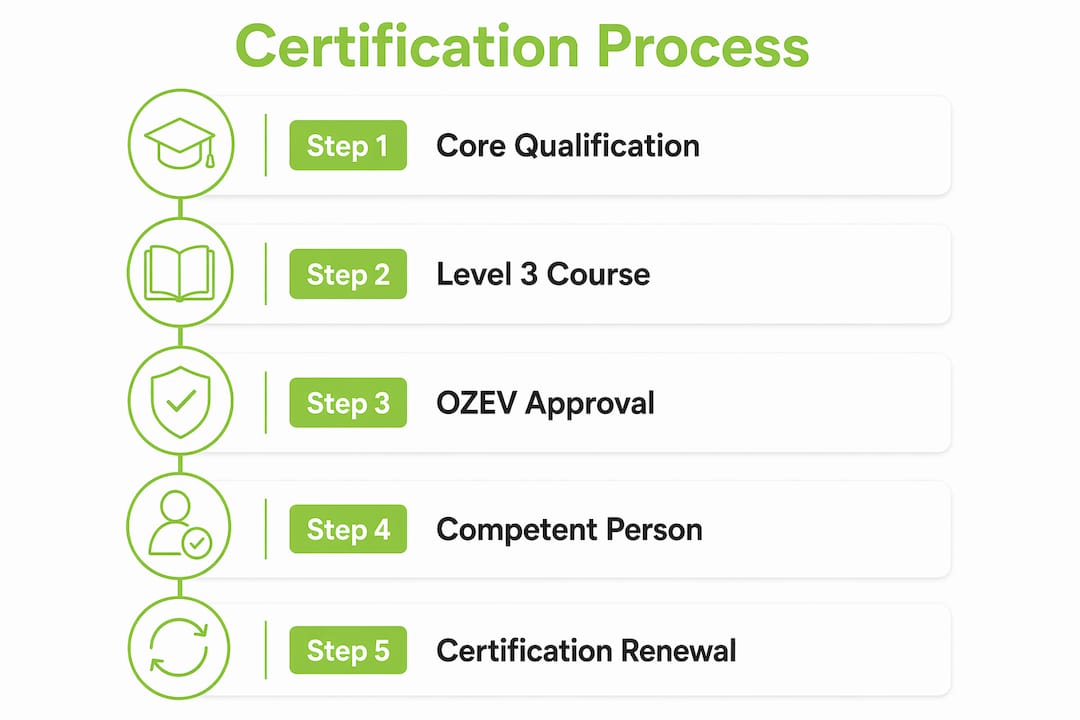
To install EV chargers professionally in the UK, you need a Level 3 electrotechnical qualification, a recognised Level 3 EV charging installation award mapped to BS 7671 and the IET Code of Practice, and registration on an OZEV-recognised Competent Person Scheme. Without all three, you cannot legally self-certify the work, and you will not be eligible for grant-funded installations under OZEV schemes.
Here is what that means in practice:
- Core electrical qualification: Level 3 NVQ/SVQ in electrotechnical technology (or equivalent recognised apprenticeship evidence), plus current knowledge of the 18th Edition wiring regulations (BS 7671:2018+A2:2022).
- Recognised Level 3 EV award: A regulated awarding-body course such as City & Guilds 2921-34 (Level 3 Award in the Requirements for the Design and Installation of Domestic and Small Commercial EV Charging Installations) or the equivalent LCL Awards qualification, both mapped to the IET Code of Practice.
- Competent Person Scheme (CPS) registration: NICEIC, NAPIT, or another OZEV-recognised scheme, which allows you to self-certify installations and access grant-funded work.
- Handover paperwork: An Electrical Installation Certificate (EIC), a commissioning report specific to the EVSE, and test records for earth continuity, insulation resistance, and RCD performance.
- Gather your qualification certificates and ECS card.
- Enrol on a regulated Level 3 EV award with a recognised awarding body.
- Apply to join NICEIC or NAPIT once you hold the award.
Pro Tip: Check your chosen CPS’s enrolment criteria before booking a course. Some schemes require you to be organisationally approved first; others accept individual technician applications. Knowing this upfront saves weeks.
Table of Contents
- What core electrical qualifications do you need before EV training?
- Which Level 3 EV charging courses are recognised in the UK?
- What standards must you design and install to?
- Why do OZEV and Competent Person Schemes matter for your work?
- What practical skills do employers and training bodies expect on site?
- What do EV installation courses teach, and how are you assessed?
- What certification and handover documents must you produce?
- How much does training cost, and how long does an installation take?
- How do you keep your EV certification current as technology evolves?
- Practitioner tips and common pitfalls from experienced installers
- Key takeaways
- Why formal certification pays off more than most electricians expect
- Centralec-electrical: certified EV charger installation in the South West
- Official sources and awarding bodies to check next
What core electrical qualifications do you need before EV training?
EV charger installer training is not a standalone route. Every recognised Level 3 EV award treats a solid electrotechnical background as a hard pre-requisite, not a nice-to-have. Turn up without it and most training providers will turn you away at enrolment.
Accepted baseline qualifications include:
- Level 3 NVQ/SVQ in Electrotechnical Technology (Installation route or equivalent)
- City & Guilds 2357 (Electrotechnical Technology) or 2365 (Electrical Installations) at Level 3
- Apprenticeship completion certificates recognised under the Electrotechnical Apprenticeship Standard
- Equivalent recognised experience with documented workplace evidence, assessed case by case
The 18th Edition wiring regulations (BS 7671:2018+A2:2022) sit at the centre of every EV-specific course. If your BS 7671 knowledge is out of date, an update course (City & Guilds 2382-22 or equivalent) is worth completing before you book EV training. Assessors will test your understanding of protective devices, earthing arrangements, and discrimination, all of which feed directly into EV installation design decisions.
Training providers typically ask for an ECS (Electrotechnical Certification Scheme) card, your Level 3 certificate, and evidence of recent on-site experience. Some will ask for a sample of workplace evidence, such as a completed EIC or inspection record, to confirm you are practising rather than simply qualified on paper.

Pro Tip: Prepare a short portfolio before enrolment: two or three recent EICs, a test schedule, and your ECS card. Providers who ask for pre-enrolment evidence can process your application faster, and it signals to assessors that you are already working to the standard the course builds on.
Which Level 3 EV charging courses are recognised in the UK?
The Level 3 award is the industry-accepted route for electricians who want to work on domestic, commercial, and industrial EV charging installations. It is designed in conjunction with the IET Code of Practice and BS 7671:2018+A2:2022, covering design, installation, inspection, testing, and handover.
City & Guilds 2921-34 is the most widely cited qualification in industry guidance. The full title is the Level 3 Award in the Requirements for the Design and Installation of Domestic and Small Commercial EV Charging Installations. It is offered by a range of approved training centres across the UK, typically delivered as a blended programme combining online theory with a practical assessment day.
LCL Awards offers a comparable regulated Level 3 qualification that is accepted by NICEIC, NAPIT, and other Competent Person Schemes. LCL Awards is a regulated awarding organisation, so its qualifications carry the same weight for CPS registration purposes.
NAPIT Training delivers its own Level 3 award, which is explicitly mapped to the IET Code of Practice and BS 7671. NAPIT recommends prioritising regulated awarding-body courses over short, non-regulated alternatives for liability protection and scheme recognition.
| Dimension | City & Guilds 2921-34 | LCL Awards Level 3 | NAPIT Level 3 Award |
|---|---|---|---|
| Pre-requisites | Level 3 electrotechnical + 18th Edition | Level 3 electrotechnical + 18th Edition | Level 3 electrotechnical + 18th Edition |
| Awarding body | City & Guilds (regulated) | LCL Awards (regulated) | NAPIT (regulated) |
| Typical duration | 1–2 days blended | 1–2 days blended | 1–2 days blended |
| Typical cost range | £200–£400 | £200–£400 | Contact provider |
| OZEV/CPS recognition | Yes | Yes | Yes |
| Scope | Domestic and small commercial | Domestic and small commercial | Domestic, commercial, industrial |
| Assessment method | Theory + practical observed | Theory + practical observed | Theory + practical + workplace evidence |
To verify a course is genuinely mapped to the IET Code of Practice, check that the awarding body is regulated by Ofqual and that the course specification explicitly references BS 7671:2018+A2:2022 and the current edition of the IET Code of Practice for Electric Vehicle Charging Equipment Installation.
Quick-selection criteria to weigh up:
- Is the awarding body regulated by Ofqual?
- Does the course include a practical assessment day, not just online theory?
- Does it cover commissioning and handover documentation?
- Is it explicitly accepted by your target CPS (NICEIC or NAPIT)?
- Does the provider offer CPD recognition for future update courses?
What standards must you design and install to?
EV charger installation is not just about fitting a box on a wall. The design decisions, earthing arrangements, and protective devices you specify are all governed by a layered set of standards, and getting any of them wrong creates liability.
The essential standards for UK installations:
- BS 7671:2018+A2:2022 (IET Wiring Regulations, 18th Edition): the overarching electrical installation standard. All EV charger installations must comply. The A2:2022 amendment introduced specific requirements for EV charging points, including protective measures and load management.
- IET Code of Practice for Electric Vehicle Charging Equipment Installation (current edition): the primary practical reference for UK EV installers. It translates BS 7671 into installation-specific guidance covering earthing, PME, cable selection, and commissioning.
- BS EN/IEC 61851: covers the charging system requirements including charging modes (Mode 1 through Mode 4), control pilot signalling, and safety functions. Relevant for understanding how the EVSE communicates with the vehicle.
- BS EN/IEC 62196: the connector standard family. IEC 62196 defines the physical plugs and sockets (Type 1, Type 2, CCS, CHAdeMO). Knowing which connector type applies to a given installation is a basic design decision.
- Building Regulations Part P: applies where the installation involves notifiable electrical work in a dwelling. CPS registration allows self-certification under Part P, removing the need for a building control application.
The practical implications are significant. PME earthing conditions, for example, require careful assessment before specifying a charger. Where a PME supply is present and the risk of a broken neutral cannot be adequately managed, the IET Code of Practice requires the installer to prescribe a separate earth electrode. This is one of the most frequently tested topics in Level 3 EV course assessments, and it is also one of the most commonly mishandled on site.
International standards such as IEC 61851 and IEC 62196 cover device-level certification as well as installation requirements. The distinction matters: a charger can be IEC 61851-compliant as a product yet still be installed incorrectly if the installer has not addressed earthing, protective bonding, and cable sizing correctly.
Where to check for updates:
- IET (iet.org) for Code of Practice revisions and BS 7671 amendments
- BSI (bsigroup.com) for BS EN/IEC standard updates
- OZEV guidance pages (gov.uk) for grant-scheme technical requirements
BS 7671 amendments directly affect required practice. The A2:2022 amendment is not optional reading; it is the current standard, and any installation certified against an earlier version is out of date.
Why do OZEV and Competent Person Schemes matter for your work?
OZEV (the Office for Zero Emission Vehicles) administers the grant schemes that fund domestic and workplace EV charger installations in the UK. To carry out grant-funded work, your employer must be registered on an OZEV-recognised Competent Person Scheme, and you as the technician must hold a recognised qualification. Without CPS registration, you cannot access this work, and the client cannot claim the grant.
The two most widely used schemes for electricians are NICEIC and NAPIT. Both are OZEV-recognised and both allow registered members to self-certify electrical installation work under Part P of the Building Regulations.
Steps to join a Competent Person Scheme:
- Confirm your employer (or your own business) is eligible for organisational approval with the chosen scheme.
- Gather workforce competence evidence: Level 3 electrotechnical qualifications, the recognised Level 3 EV award certificate, and current BS 7671 knowledge evidence.
- Submit an application to NICEIC or NAPIT, including all qualification certificates and evidence of recent on-site work.
- Pass the scheme’s technical assessment or audit, which typically includes a site inspection of recent work and a review of your documentation practices.
- Pay the annual scheme fee and maintain your registration through ongoing CPD and audit compliance.
Why CPS registration matters beyond grant access:
- Allows self-certification under Part P, removing the need for local authority building control sign-off on domestic work
- Provides an audit trail of compliant installations, which protects you if a dispute arises
- Increases consumer confidence: homeowners and commercial clients increasingly ask for CPS-registered installers
- Required by most commercial clients and housing associations for EV charging contracts
For context, government-funded infrastructure programmes in other jurisdictions follow a parallel logic. The NEVI final rule in the United States requires that technicians hold recognised training or certifications (such as EVITP or registered apprenticeship certificates) to work on federally funded sites. The UK’s CPS requirement serves the same purpose: it ties grant funding to demonstrable installer competence. The EVITP model, referenced in US and California funding criteria, is a useful comparator for understanding why scheme-linked certification is the direction of travel internationally.
What practical skills do employers and training bodies expect on site?
EV charger installation is not just plug and play. Industry specialists stress that it requires detailed design decisions, particularly around load management and earthing, that only regulated training reliably covers. The practical skills expected during both course assessments and live jobs reflect this.
Core practical competencies:
- Load assessment: calculating existing demand, identifying spare capacity at the consumer unit, and specifying load management devices where needed
- Consumer unit assessment and, where required, upgrades to accommodate the additional circuit
- RCD selection, type (Type A or Type B where specified), and discrimination with upstream devices
- PME earthing assessment: identifying supply type, assessing broken-neutral risk, and prescribing earth electrodes where the IET Code of Practice requires them
- Cable selection, sizing, and routing, including derating for thermal insulation and grouping
- Containment and mechanical protection for cables running through garages, outbuildings, or external routes
- Configuration and operational testing of smart-charging functionality, including load management and scheduling features
Test procedures you must be able to perform and record:
- Earth fault loop impedance testing (Ze and Zs)
- Insulation resistance testing of the new circuit
- RCD trip-time testing (30mA and, where fitted, 100mA or higher thresholds)
- Functional verification of EVSE communications (control pilot signal, Mode 3 handshake)
- Earth continuity and protective bonding checks
Soft skills and documentation:
- Explaining smart-charging features clearly to the client at handover
- Producing a commissioning report that is legible and complete enough for a CPS auditor
- Photographing key connections and earthing arrangements as part of the installation record
Pro Tip: PME conditions are the most common on-site surprise. Before quoting, check the supply type from the DNO cut-out label or by asking the client’s network operator. If you find a TN-C-S supply with a high Ze, price in the earth electrode and associated works upfront rather than discovering the issue on installation day. Clients rarely object to a transparent quote; they always object to a surprise invoice.
What do EV installation courses teach, and how are you assessed?
A regulated Level 3 EV award typically runs across one to two days of blended delivery: online theory modules completed before the practical day, followed by a centre-based practical assessment. Some providers structure the evidence collection differently, requiring workplace logbook entries from live jobs alongside the practical day.
Typical syllabus elements:
- Legislative and regulatory overview: Building Regulations Part P, the Electricity at Work Regulations 1989, and the relevant BS/IEC standards
- Modes of charging (Mode 1 through Mode 4) and EVSE types (tethered vs untethered, AC vs DC)
- Design for dwellings: load assessment, consumer unit considerations, cable sizing, earthing and bonding
- Design for small commercial premises: three-phase supplies, load management systems, and multiple-point installations
- Installation practices: cable routing, containment, mechanical protection, and connection to the EVSE
- Inspection and testing: the full test sequence from insulation resistance through to functional EVSE verification
- Commissioning and handover: completing the EIC, the commissioning report, and the client briefing
- Health and safety: working near vehicles, handling live conductors, and lone-working considerations
Assessment methods by provider type:
| Assessment element | Classroom-led provider | Blended/online provider |
|---|---|---|
| Theory | Multiple-choice exam on assessment day | Online multiple-choice, pre-day |
| Practical | Observed practical on assessment day | Observed practical on assessment day |
| Workplace evidence | Optional supplementary logbook | Required logbook from live jobs |
| Commissioning paperwork | Completed during practical | Completed during practical + live job evidence |
Evidence from live jobs strengthens both your course assessment and your CPS registration application. Photograph key stages: the consumer unit before and after, the cable route, the earth electrode (if fitted), and the completed EVSE. A test schedule completed on a real installation carries more weight with a CPS auditor than a centre-based exercise alone.
What certification and handover documents must you produce?
A professional handover process is a frequent differentiator between low-risk, durable installs and those that generate call-backs or liability exposure. The paperwork is not a formality; it is the evidence trail that protects you if a fault develops or a grant claim is queried.
Mandatory documents for a compliant EV charger installation:
- Electrical Installation Certificate (EIC): required for any new circuit. Must be signed by the designer, installer, and inspector (which may be the same person for a sole trader). Issued to the client and a copy retained for your records.
- EVSE commissioning report: specific to the charger unit, recording the make, model, serial number, firmware version, and all functional test results.
- Test schedule: recording Ze, Zs, insulation resistance, RCD trip times, and earth continuity results, with pass/fail criteria noted.
- Minor Works Certificate: applicable only where the installation is a minor addition to an existing circuit, which is rarely the case for a dedicated EV charger circuit.
Commissioning steps to record:
- Confirm supply voltage and frequency at the EVSE terminals.
- Verify earth continuity from the EVSE earth terminal back to the main earthing terminal.
- Test RCD operation at 30mA (and higher thresholds where fitted).
- Verify Mode 3 control pilot handshake by connecting a test vehicle or pilot signal simulator.
- Confirm load management or scheduling settings are configured per the client’s requirements.
- Record all results on the test schedule and commissioning report.
Client handover checklist:
- Demonstrate charging operation to the client, including how to start and stop a session
- Leave the manufacturer’s user guide and any app setup instructions
- Supply copies of the EIC and commissioning report to the client
- Explain the smart-charging features and any tariff-scheduling options
- Record the client’s signature or acknowledgement on the handover document
Accurate paperwork also reduces future call-backs. A client who has a clear commissioning report and user guide is far less likely to call you back because they cannot work out how to use the scheduler.
How much does training cost, and how long does an installation take?
Training costs for a regulated Level 3 EV award typically fall in the range of £200–£400 for the course and assessment, depending on the provider and delivery format. Some providers bundle the course fee with the practical assessment day; others charge separately. Factor in travel to the assessment centre if your nearest approved centre is not local.
For a standard domestic wall-mounted AC charger installation, the timeline from initial enquiry to commissioned unit typically runs as follows:
- Site survey: half a day, often combined with the installation visit for straightforward jobs
- Material lead time: one to five working days for the charger unit, depending on the model (Wallbox, Zappi, Tesla Wall Connector, Autel, and similar units are generally available from electrical wholesalers within a few days)
- Installation and commissioning: three to five hours for a straightforward single-phase installation with no consumer unit upgrade required
For detailed cost breakdowns, the figures vary significantly depending on site conditions.
Factors that extend timelines and costs:
- Consumer unit upgrade or replacement: adds one to two hours of labour and the cost of a new board
- Earth electrode installation for PME supplies: adds materials and typically one to two hours
- Long cable runs or external containment: materials and labour scale with distance
- Network operator permission (G99 or G100 notification for larger installations): can add two to four weeks if a formal application is required
- Three-phase supply installations for commercial premises: significantly more complex and priced accordingly
When quoting, always include a contingency line for earthing works. PME conditions are common enough in UK domestic properties that pricing them in as a conditional item, rather than an afterthought, protects both your margin and your client relationship. A transparent quote that explains the contingency builds more trust than one that looks artificially low.
How do you keep your EV certification current as technology evolves?
Standards, smart-charging features, and manufacturer firmware evolve faster in the EV sector than in most areas of electrical work. Certification competence is not a one-time event: installers must keep up with amendments to BS 7671 and the IET Code of Practice, and training providers commonly recommend periodic refresher sessions focused on smart-charging and interoperability.
Recommended CPD activities:
- BS 7671 amendment update courses when new amendments are published (City & Guilds 2382 series or equivalent)
- IET Code of Practice update sessions when a new edition is released
- Manufacturer commissioning refreshers for the charger brands you install most frequently (Wallbox, Zappi, Autel, Tesla Wall Connector each have their own commissioning procedures and firmware update cycles)
- Smart-charging interoperability updates: OCPP (Open Charge Point Protocol) versions and how they affect networked EVSE configuration
- Networked EVSE cybersecurity awareness, increasingly relevant as smart-charging mandates expand
Logging CPD for scheme audits:
- Record the course title, provider, date, duration, and learning outcomes for each activity
- Keep certificates and completion records in a dedicated CPD folder, physical or digital
- Review your CPD log before your annual CPS renewal to confirm you meet the scheme’s minimum hours requirement
- Cross-reference your CPD against the standards most likely to affect your current workload
Pro Tip: Prioritise CPD on the topics most likely to affect your next ten jobs, not the most interesting ones. For most domestic installers, that means BS 7671 amendments and manufacturer commissioning updates. Smart-charging interoperability and OCPP are worth understanding, but a refresher on the latest Zappi firmware changes will save you more time on site next month than a deep dive into DC fast-charging protocols.
Practitioner tips and common pitfalls from experienced installers
The gap between a technically compliant installation and one that is genuinely professional often comes down to preparation and documentation, not technical knowledge. These are the issues that create rework, disputes, and failed CPS audits.
Pro Tip: Build a standard commissioning pack before your first EV installation and refine it after each job. Include a pre-formatted EIC, a commissioning report template with fields for EVSE make, model, serial number, firmware version, and all test results, plus a photographic checklist. A consistent pack means you never leave a job without the paperwork the client and your CPS auditor need.
Common on-site pitfalls and how to avoid them:
- Incorrect earthing assumptions: assuming TN-S when the supply is TN-C-S (PME) is the most common earthing error. Always verify the supply type at the cut-out before designing the earthing arrangement.
- Undocumented consumer unit constraints: discovering a full consumer unit or a non-compliant board on installation day delays the job and erodes your margin. A pre-installation survey, even a brief one, prevents this.
- Insufficient cable containment: cables running through garages or externally need mechanical protection. Skimping on containment creates a future liability if the cable is damaged.
- Incomplete RCD documentation: recording only the trip time without noting the test current and the pass/fail threshold leaves your test schedule open to challenge.
- Missing smart-charging configuration: leaving the charger in default settings without configuring load management or scheduling is a common oversight that generates call-backs.
Building a handover pack that satisfies CPS audits:
Installers should build a commissioning pack as standard practice, including the EIC, EVSE test records, photographic evidence of key connections, and client sign-off. This pack is frequently examined during CPS audits and improves your defensibility as an installer. For installation requirements that go beyond the basics, a well-documented pack is the difference between a smooth audit and a corrective action notice.
Key takeaways
To work as a certified EV charger installer in the UK, you need a Level 3 electrotechnical qualification, a regulated Level 3 EV award mapped to BS 7671 and the IET Code of Practice, and OZEV-recognised CPS registration through NICEIC or NAPIT.
| Point | Details |
|---|---|
| Core qualification required | Hold a Level 3 electrotechnical NVQ/SVQ and current 18th Edition (BS 7671:2018+A2:2022) knowledge before enrolling on EV training. |
| Recognised Level 3 EV award | City & Guilds 2921-34 or LCL Awards equivalent; both must be mapped to the IET Code of Practice and accepted by your target CPS. |
| CPS registration for grant work | Register with NICEIC or NAPIT to self-certify under Part P and access OZEV grant-funded installations. |
| Mandatory handover paperwork | Produce an EIC, EVSE commissioning report, and full test schedule for every installation; retain copies for CPS audits. |
| Centralec-electrical | NICEIC-approved, with over 23 years of experience delivering compliant EV charger installations across the South West. |
Why formal certification pays off more than most electricians expect
There is a tendency in the trade to view EV charger certification as a box-ticking exercise: do the course, get the certificate, move on. That framing misses what the qualification actually does for your business.
The regulated Level 3 award is not just a licence to install a charger. It is the credential that unlocks OZEV grant work, which represents a significant and growing portion of domestic EV charger demand. Without CPS registration, you are competing only for the self-funded segment of the market. With it, you can quote for every job, including the ones where the client’s grant eligibility makes your price look considerably more attractive.
The documentation requirements, which feel burdensome at first, serve a second purpose: they make your work defensible. An installer who produces a complete commissioning pack, with test results, photographs, and a signed handover document, is in a fundamentally different position if a dispute arises than one who handed over a charger with a verbal explanation and a handshake. The paperwork is not bureaucracy; it is professional protection.
The market is also moving in one direction. UK EV uptake and government targets continue to drive demand for reliable charging infrastructure. Electricians who invest in regulated training now are positioning themselves for a category of work that will only grow. Those who skip the formal route will find themselves locked out of the funded work and, increasingly, out of the commercial contracts that specify CPS-registered installers as a minimum requirement.
Centralec-electrical: certified EV charger installation in the South West
If you are a homeowner or business looking for a certified EV charger installer rather than navigating the training route yourself, Centralec-electrical delivers exactly what this article describes: NICEIC-approved installations, complete commissioning paperwork, and transparent upfront pricing with no hidden costs.
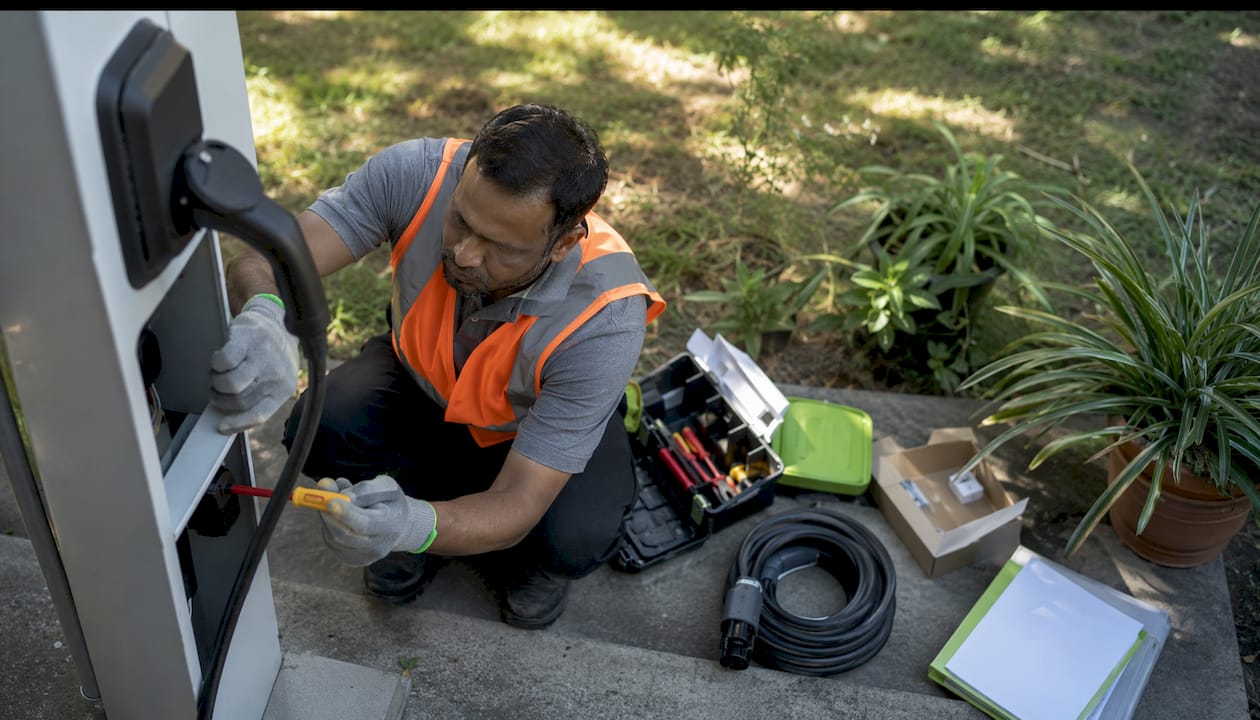
With over 23 years of electrical experience and a specialist focus on EV charger installations, Centralec-electrical installs leading brands including Wallbox, Zappi, Tesla Wall Connector, and Autel across the South West. Every installation is backed by a full EIC, EVSE commissioning report, and client handover pack, the same documentation standard this article outlines. NICEIC approval means every job is self-certified under Part P, and OZEV recognition means clients can claim applicable grants without a second thought.
For a clear, fixed quote on a domestic or commercial EV charger installation, visit the EV charger installation page or get in touch directly. No obligation, no vague estimates.
Official sources and awarding bodies to check next
Standards and regulatory bodies:
- IET (iet.org): the primary source for the Code of Practice for Electric Vehicle Charging Equipment Installation and BS 7671 amendment updates. The Code of Practice is the essential reference document for any UK EV installer.
- BSI (bsigroup.com): for BS EN/IEC 61851 and BS EN/IEC 62196 standard updates and purchase.
- OZEV / GOV.UK (gov.uk/electric-vehicle-chargepoint-installers): the official page listing OZEV-recognised Competent Person Schemes and the requirements for installer eligibility for grant-funded work.
- GOV.UK grant guidance (gov.uk/guidance/electric-vehicle-chargepoint-grants): details of current OZEV grant schemes, eligible vehicles, and installer requirements.
Awarding bodies and training providers:
- City & Guilds (cityandguilds.com): for the 2921-34 qualification specification, approved centre finder, and related EV awards.
- LCL Awards (lclawards.com): regulated awarding organisation offering Level 3 EV installation qualifications accepted by major CPS providers.
- NAPIT Training (napit.org.uk): Level 3 award in EV charging equipment installation and commissioning, with guidance on how the qualification maps to CPS registration.
- NICEIC (niceic.com): CPS registration information, technical guidance, and the approved contractor finder for consumers.
Verifying a course is regulated:
Check that the awarding body appears on the Ofqual Register of Regulated Qualifications (register.ofqual.gov.uk) and that the course specification explicitly references BS 7671:2018+A2:2022 and the current IET Code of Practice. A course that does neither is not a regulated qualification, regardless of what the marketing says.
For smart-charging and CPD context:
- SAE International offers EVSE technician certificate programmes addressing technician competence and continuing development, useful for installers working across international projects or seeking additional credentials.
- EVITP provides a structured certification programme for electricians installing EVSE, widely referenced in US and international funding criteria as a comparator to UK CPS requirements.
Centralec-electrical resources:
- Smart EV charger installation guide: practical guidance on smart-charging integrations and certification pathways.
- Can you install an EV charger yourself?: a clear explanation of the legal and practical limits of homeowner self-installation, useful to share with clients who ask.
- EV charger installation cost guide: realistic cost ranges for domestic and commercial installations, including contingency factors.