 Skip to content

Yes, you can hire a local NICEIC or NAPIT-registered electrician to rewire your home with a fixed price, a clear timescale, and full certification. For most UK homeowners searching for house rewiring near me, the practical facts are these: a 3-bed semi typically costs several thousand pounds for the electrical work alone and takes several working days on site, and must be completed to BS 7671 (the IET Wiring Regulations) with an Electrical Installation Certificate (EIC) issued at completion.
TL;DR:
- Typical cost for a 3-bed semi: £3,500–£6,000 for wiring; expect additional cost for plastering
- On-site wiring duration: several working days; total project including plastering and drying often takes multiple weeks
- Insist on: EIC at completion, BS 7671 compliance, and a contractor registered with NICEIC or NAPIT
Table of Contents
- What does a full house rewire actually include?
- How long does a rewire take, and what affects the timeline?
- How much does rewiring a house cost in the UK?
- What compliance and certification must you insist on?
- How do you choose the right local rewiring electrician?
- How Centralec-electrical manages a rewire from survey to sign-off
- Key takeaways
- The thing most homeowners get wrong about rewiring
- Get a fixed rewiring quote from Centralec-electrical
What does a full house rewire actually include?
A full home electrical rewire is not simply swapping cables. It covers every fixed electrical circuit in the property, from the consumer unit to the final socket or light fitting. Understanding the scope helps you spot a thin quote before you sign anything.
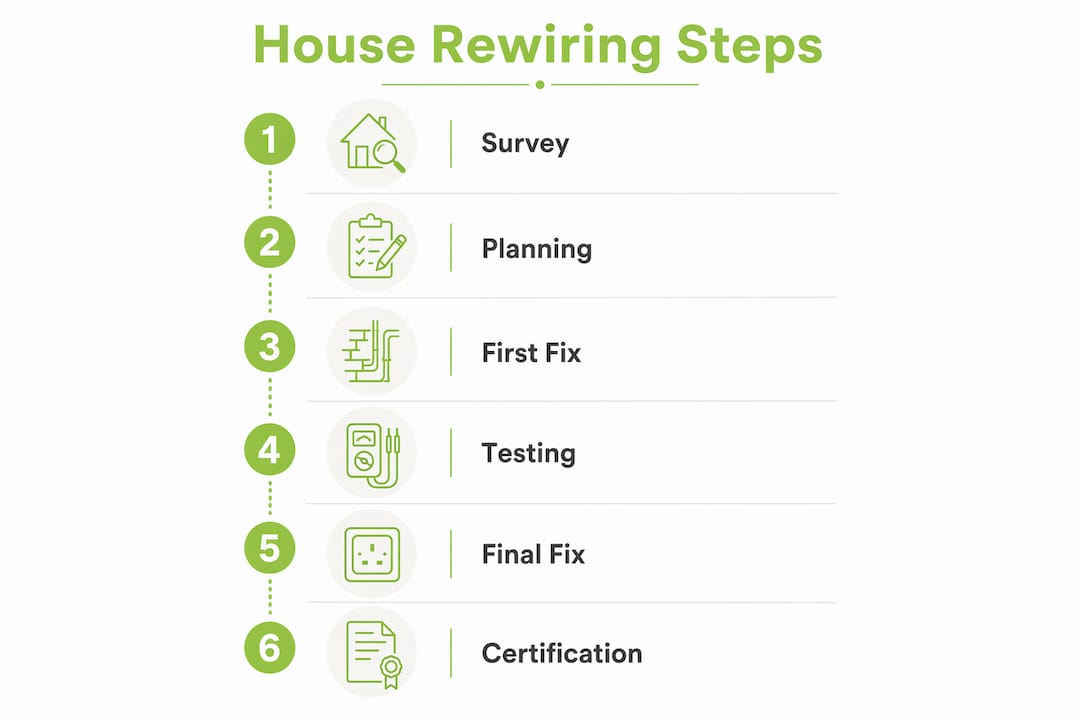
The stepwise process:
- Site survey and EICR trigger: A reputable electrician starts with a site visit. If your property is over 25 years old or shows warning signs, an EICR inspection confirms the extent of work needed before a price is agreed.
- Design and written scope: Circuit layout, cable routes, consumer unit specification, and socket/switch positions are agreed in writing before work starts.
- First fix: Cables are run through walls, floors, and ceilings; back boxes are set; the consumer unit position is prepared. This is the disruptive phase — walls are chased, floorboards lifted, and dust is unavoidable.
- Second fix: Once plastering is complete and surfaces are dry, switches, sockets, and light fittings are connected and the consumer unit is fitted and wired.
- Testing and commissioning: Every circuit is tested to BS 7671 standards. This includes insulation resistance, continuity, polarity, and RCD trip-time tests.
- Certification: An Electrical Installation Certificate (EIC) is issued. This is the legal document confirming the installation meets current regulations. Without it, the work is unverifiable for insurance or sale purposes.
- Circuit labelling: Every circuit in the consumer unit must be clearly labelled — a modern rewire should include a metal-enclosure consumer unit with appropriate RCD or RCBO protection and surge protection devices where BS 7671 recommends them.
What a fixed-price package usually includes:
- All new cabling throughout
- New consumer unit (fuse board) with RCD/RCBO protection
- New sockets, switches, and light fittings (to agreed specification)
- Testing, commissioning, and the EIC
What is frequently charged separately:
- Plastering and making good after wall chasing
- Redecorating
- Asbestos surveys or removal (mandatory if suspected in older properties)
- Additional circuits beyond the agreed scope (e.g. EV charger circuit, outbuilding supply)
Checklist for comparing quotes: written scope of works, parts grade and consumer unit specification, making-good terms, insurance confirmation, guarantee period, and whether the EIC is included in the price.
How long does a rewire take, and what affects the timeline?
Realistic scheduling matters. A rewire is not a weekend job, and the total project time is almost always longer than the electrical work alone. Here is what to expect, by property size:
- 1-bed flat: a few days on site for wiring; allow about one to two weeks total including plastering and drying
- 2-bed house: several days on site; about one to two weeks total
- 3-bed semi: several days on site; a few weeks total project time
- 4-bed detached: about one to two weeks on site; several weeks total
- 5-bed or larger: up to two or more weeks on site; several weeks total depending on plastering schedule
The two-phase structure explains the gap. First fix runs cables and sets back boxes — power to parts of the property will be limited or off during this phase. Once plastering is done and surfaces have dried (typically 5–7 days for plaster to cure), second fix connects everything and restores full power. You can often remain in the property during a rewire, but expect significant disruption, dust, and restricted access to rooms being worked on. For more detail on rewiring project durations, the factors below are the main culprits for overruns.
Factors that add time:
- Solid concrete floors (cables cannot be fished; chasing or surface trunking is required)
- Limited loft or underfloor access
- Concealed or unknown services (old wiring routes that need tracing)
- Asbestos present in walls or ceilings (work stops until a licensed contractor removes it)
- Bespoke lighting schemes or additional circuits
- Plastering contractor availability and drying time in cold or damp conditions
Pro Tip: Book your plasterer before the electrician starts first fix, not after. The most common cause of a 3-week rewire stretching to 6 weeks is waiting for a plasterer to become available. Confirm the plastering slot when you confirm the electrical start date.
How much does rewiring a house cost in the UK?
Cost is the question every homeowner asks first, and the honest answer is that it varies more than most guides admit. Property size, regional labour rates, access, and specification all shift the final figure.
| Property size | Typical wiring cost | On-site duration |
|---|---|---|
| 1-bed flat | £2,000–£3,500 | a few days |
| 2-bed house | £2,500–£5,000 | several days |
| 3-bed semi | £3,500–£6,000 | several days |
| 4-bed detached | £5,000–£9,000 | about one to two weeks |
| 5-bed / period home | £7,000–£12,000+ | up to two or more weeks |

Prices include new wiring, consumer unit, sockets, switches, and lights. Plastering after chasing is separate: budget £800–£2,500 depending on how much wall is opened.
Labour costs tend to be higher in London and the South East, with electrician day rates varying depending on region and job complexity. Properties with solid concrete floors cost more because cables must be chased into the floor or run in surface trunking rather than fished through cavities.
Pricing factors to check in any quote:
- Is the consumer unit included, and what specification (metal enclosure, RCBO per circuit, surge protection device)?
- Are wiring accessories (sockets, switches) included or priced separately?
- Does making good (filling, patching) form part of the price, or is it excluded?
- Is testing, commissioning, and the EIC included?
- Is VAT shown separately?
- What is the deposit policy, and what are the payment milestones?
- Is there a contingency clause for unforeseen work (e.g. discovering asbestos or additional circuits)?
A partial rewire is sometimes appropriate where only certain rooms or circuits are in poor condition. Room-level estimates give a sense of scale: a kitchen rewire typically runs £1,500–£3,500 and a living room £600–£1,200, though a partial approach only makes sense when an EICR confirms the remaining circuits are satisfactory.
What compliance and certification must you insist on?
Rewiring is a safety-critical, regulated activity — not a job where paperwork is optional. Uncertified work can void your home insurance, complicate a sale, and leave your family at risk.
The controlling standards and schemes:
- BS 7671 (IET Wiring Regulations): The national standard for all UK electrical installations. Every rewire must comply with the current edition and applicable amendments.
- Building Regulations Part P: Requires that notifiable electrical work in dwellings is either inspected by a building control body or carried out by a registered competent person.
- Competent person schemes: NICEIC and NAPIT are the two principal schemes. A registered contractor self-certifies their work, notifies the local authority on your behalf, and issues the EIC. Without scheme registration, the homeowner must apply separately to building control.
Documents you must receive at completion:
- Electrical Installation Certificate (EIC) — confirms the installation meets BS 7671
- Minor Electrical Installation Works Certificate (for smaller additions, if applicable)
- Evidence of competent person scheme registration (NICEIC or NAPIT certificate number)
- Full test records (schedules of test results)
An EICR (Electrical Installation Condition Report) is an inspection of an existing installation, not a certificate for new work. It is the right starting point before a rewire quote on an older property, and it is what a buyer’s solicitor or insurer may request on resale. The difference between an EICR and an EIC is worth understanding before you speak to any contractor — confusing the two is a common source of misunderstanding at quote stage.
Amendment 4 (2026) note: BS 7671:2018 with Amendment 3 was published in 2024, and Amendment 4 is being introduced in 2026. Ask any prospective electrician which edition they are working to and whether they have the current IET publication. A contractor unaware of recent amendment changes is a contractor whose work may not meet current standards.
How do you choose the right local rewiring electrician?
The difference between a smooth rewire and a costly dispute usually comes down to the vetting you do before anyone picks up a cable. Work through this in order.
Pre-shortlist criteria:
- Confirm NICEIC or NAPIT registration — check the scheme’s online register directly, not just the contractor’s word
- Ask for proof of public liability insurance (minimum £2 million is standard)
- Request two or three trade references from comparable rewiring projects
- Ask for a sample contract or written scope from a previous job
Questions to ask at quote stage:
- Who carries out the survey, and will the same electrician do the work?
- Which wiring accessories are included, and to what specification?
- What consumer unit are you specifying — metal enclosure, RCBO per circuit, SPD?
- What is your testing regime, and will I receive full test schedules with the EIC?
- What is your timescale from start to EIC issue?
- What is the deposit, and what are the payment milestones?
- Do you subcontract any part of the work, and if so, who?
- How is waste and debris removed from site?
Red flags to walk away from:
- Unsolicited offers of a “free rewire” — there is no government scheme that pays for standard domestic rewires; these are almost always lead-generation tactics
- Vague scope with no written breakdown
- Refusal to provide insurance documents or scheme registration details
- Unusually low price with no explanation of what is excluded
- Pressure to pay a large deposit before a survey is completed
Simple scoring checklist for comparing three quotes:
| Criterion | Quote A | Quote B | Quote C |
|---|---|---|---|
| Fixed price with written scope | ✓ / ✗ | ✓ / ✗ | ✓ / ✗ |
| NICEIC or NAPIT registered | ✓ / ✗ | ✓ / ✗ | ✓ / ✗ |
| Consumer unit spec confirmed | ✓ / ✗ | ✓ / ✗ | ✓ / ✗ |
| Making good included or priced | ✓ / ✗ | ✓ / ✗ | ✓ / ✗ |
| EIC included in price | ✓ / ✗ | ✓ / ✗ | ✓ / ✗ |
| Timescale confirmed in writing | ✓ / ✗ | ✓ / ✗ | ✓ / ✗ |
| Guarantee / warranty period | ✓ / ✗ | ✓ / ✗ | ✓ / ✗ |

Any quote that scores fewer than five ticks deserves a direct conversation before you proceed.
How Centralec-electrical manages a rewire from survey to sign-off
Centralec-electrical has carried out domestic rewires across the South West for over 23 years, and the process follows a consistent, documented flow designed to remove uncertainty for the homeowner.
The process:
- Site survey: A qualified electrician visits the property, assesses the existing installation, and identifies any immediate safety concerns. If an EICR has not been carried out, this is the point to commission one.
- Written scope and fixed quote: Every rewire is priced with a written scope of works before any agreement is signed. No hidden costs, no provisional sums for items that should be foreseeable.
- First fix: Cables are run, back boxes set, and the consumer unit position prepared. Centralec-electrical coordinates with plastering trades to minimise idle days between phases.
- Consumer unit and secondary trades: The new consumer unit is installed to current BS 7671 specification — metal enclosure, appropriate RCD/RCBO protection, and surge protection where required.
- Second fix: Switches, sockets, and fittings are connected once surfaces are ready.
- Full testing and EIC: Every circuit is tested to BS 7671 standards. The homeowner receives the full EIC and test schedules at handover.
- Registration: As a NICEIC-approved contractor, Centralec-electrical notifies the relevant authority on the homeowner’s behalf — no separate building control application required.
Trust signals:
- NICEIC-approved (verifiable on the NICEIC register)
- Over 23 years’ experience in domestic electrical installations
- Fully insured electricians on every job
- Fixed, transparent pricing with no hidden costs
- Satisfaction guarantee on completed work
- Full EIC and test records issued at completion
If you are also planning an EV charger as part of a wider renovation, Centralec-electrical can integrate that circuit into the rewire scope from the outset, avoiding a second round of chasing and making good later.
Key takeaways
A full house rewire by a NICEIC-registered electrician, priced on a fixed written scope and completed to BS 7671, is the only approach that protects your insurance, your sale value, and your family’s safety.
| Point | Details |
|---|---|
| Cost band for a 3-bed semi | Typically £3,500–£6,000 for wiring; add £800–£2,500 for plastering. |
| Realistic total timeline | Allow 2–3 weeks from first fix to decoration for a 3-bed property. |
| Certification to insist on | An EIC must be issued at completion; NICEIC or NAPIT registration is non-negotiable. |
| Amendment 4 awareness | Ask your electrician which BS 7671 edition they are working to before agreeing a contract. |
| Centralec-electrical | NICEIC-approved, fixed-price rewires across the South West with full EIC and satisfaction guarantee. |
Next steps:
- If your property is over 25–30 years old, book an EICR before requesting rewiring estimates — it defines the scope and prevents surprises mid-job
- If you see signs of faulty wiring (burning smells, flickering lights, discoloured sockets), treat it as urgent and contact a registered electrician the same day
- Prepare for a survey by listing every room, noting any known problem circuits, and deciding on socket/switch positions in advance
- Request a fixed quote with a written scope from at least three NICEIC or NAPIT-registered contractors before committing
The thing most homeowners get wrong about rewiring
The most common mistake is treating a rewire as a purely financial decision and delaying it until something fails. An EICR with C1 or C2 findings means danger or potentially dangerous conditions are present right now. Waiting until a sale forces the issue, or until an insurer queries the installation, is not a cost-saving strategy.
The second mistake is focusing on the headline price without checking the specification. A quote that omits RCBO protection per circuit, skips surge protection, or uses a plastic consumer unit is not a like-for-like comparison with one that includes them. The difference in materials cost between a dual-RCD board and a fully RCBO-protected metal consumer unit with an SPD is modest relative to the total job cost. The difference in protection is not modest.
One scenario that comes up regularly: a homeowner gets three quotes, picks the lowest, and discovers mid-job that making good is not included. The plasterer they then have to find at short notice costs more than the saving on the electrical quote. A renovation project that coordinates electrical and finishing work from the start, including thinking about post-rewire decoration, almost always runs more smoothly and costs less in total than one where trades are booked reactively.
The right question is not “who is cheapest?” but “who has given me a complete written scope, confirmed their NICEIC registration, and told me exactly what I will receive at the end?”
Get a fixed rewiring quote from Centralec-electrical
Centralec-electrical offers fixed-price house rewires across the South West, carried out by NICEIC-approved, fully insured electricians with over 23 years of experience. Every rewire includes a written scope before work starts, a new BS 7671-compliant consumer unit, full circuit testing, and an EIC issued at handover. There are no hidden costs and no provisional sums for foreseeable work.

The process starts with an onsite survey, typically arranged within a few days of your enquiry. You will receive a fixed written quote before any commitment is made. If you are also considering an EV charger installation as part of the project, this can be scoped and priced at the same time, saving a second round of disruption later. To book a survey or request a rewiring estimate, visit Centralec-electrical’s domestic services page or call directly. NICEIC registration is verifiable on the NICEIC public register.