 Skip to content
How much does an electrical installation condition report cost in the UK?
A domestic electrical installation condition report in the UK typically costs between £100 and £250, depending on property size, location, and how many circuits the electrician needs to test. Larger or more complex properties can push that figure above £300. For commercial premises, pricing works differently: expect to pay £30–£50 per circuit rather than a flat fee.
Regional pricing varies, with properties in London and the South East generally at the higher end due to labour costs, and properties in the Midlands, North West, and Scotland typically lower. Costs depend on property size and type, and commercial pricing is based on circuits rather than flat fees.
Key cost elements that shape your quote at a glance:
- Number of electrical circuits in the property
- Age and condition of the existing wiring
- Property location and local labour rates
- Accessibility of the consumer unit and wiring routes
- Qualifications and registration status of the electrician
Pro Tip: Get at least three quotes before booking. Prices vary considerably between providers, and a quote that seems unusually low often signals a rushed or incomplete inspection rather than a bargain.
What factors affect the price of an EICR?
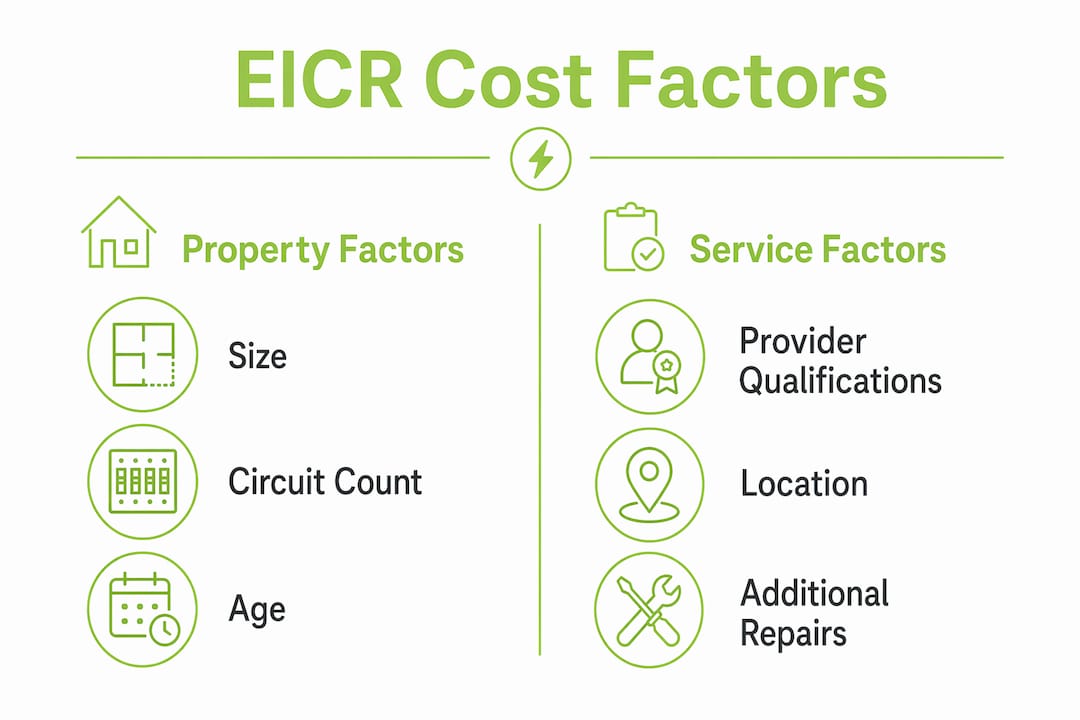
Property size is the single biggest driver of EICR pricing, but it is not the whole story. A small flat with a complex consumer unit and multiple sub-circuits can cost more to inspect than a larger house with straightforward wiring. Electricians price by circuit count, not bedroom count, so the actual layout of your installation matters more than the square footage.

Older properties take longer to inspect. Pre-1970s wiring, rubber-insulated cables, or installations that have been extended piecemeal over the decades all require more careful examination. That extra time shows up in the final price, and it is also where inspectors are most likely to find C1 or C2 issues that trigger further work.
Several other factors push costs up or down:
- Location: London and South East electricians typically charge more, reflecting higher regional overheads.
- Accessibility: A consumer unit tucked behind a fitted kitchen or wiring routed through a loft with poor access adds inspection time.
- Multiple consumer units: Properties with more than one distribution board require additional testing at each board.
- Electrician qualifications: A fully registered, NICEIC-approved contractor may charge slightly more than an unregistered tradesperson, but the report carries legal weight and the inspection is thorough.
- Urgency: Last-minute bookings or same-day requests often attract a premium.
One point worth understanding: pricing by circuit count is more precise than a simple bedroom-based estimate. A smaller flat with a complex consumer unit can genuinely cost more to inspect than a larger property with fewer circuits and accessible wiring.
What are the legal requirements for EICRs in the UK?
Landlords in England and Wales have a clear legal obligation. Under the Electrical Safety Standards in the Private Rented Sector Regulations 2020, all private landlords must have a valid EICR carried out every five years, and fines for non-compliance reach up to £30,000. That is not a theoretical penalty; local authorities actively enforce it.
Homeowners face no equivalent legal requirement. The general recommendation is an inspection every ten years, or before putting a property on the market. Mortgage lenders and conveyancers increasingly ask for a current EICR as part of the sale process, so waiting until exchange is rarely a good idea.
Key legal facts for landlords:
- EICRs must be carried out every five years for all private rental properties in England and Wales.
- The inspection must be conducted by a competent, registered electrician, such as one approved by NICEIC.
- Landlords must provide a copy of the EICR to existing tenants within 28 days of the inspection.
- New tenants must receive a copy before they move in.
- Prospective tenants can request a copy, which must be supplied within 28 days.
- Local authorities can request a copy and must receive it within seven days.
- Where an Unsatisfactory report is issued, remedial works must be completed within 28 days (or sooner if specified in the report).
Pro Tip: Do not wait until a tenancy ends to book an EICR. If the report comes back Unsatisfactory, you have 28 days to complete remedial works — and that clock starts from the inspection date, not from when you read the report.
Scotland operates under separate legislation through the Housing (Scotland) Act 2006, which requires landlords to carry out electrical safety inspections at least every five years. Northern Ireland has its own framework, so always check the specific rules for your jurisdiction.
What does an EICR inspection actually cover?
Think of an EICR as the electrical equivalent of an MOT. It does not test your appliances or portable equipment; it examines the fixed wiring, consumer unit, sockets, switches, and earthing arrangements that are built into the fabric of the building. The goal is to identify fire and shock hazards that are invisible to the naked eye during normal use.
A typical inspection covers:
- The condition and rating of the consumer unit (fuse box)
- Earthing and bonding connections throughout the property
- Wiring condition, including insulation integrity
- Sockets, switches, and light fittings
- Residual current devices (RCDs) and circuit breakers
- Any visible signs of overheating, damage, or deterioration
- Compliance with the current edition of BS 7671 (the IET Wiring Regulations)
The inspection typically takes 2–4 hours for an average domestic property. Larger homes, older installations, or properties with multiple consumer units will take longer. The electrician works through each circuit methodically, testing insulation resistance, polarity, and earth continuity before compiling the report.
Once complete, the report classifies every observation using a standard coding system, and the installation receives an overall verdict of either Satisfactory or Unsatisfactory.
| Code | Meaning | Action required |
|---|---|---|
| C1 | Danger present | Immediate action required |
| C2 | Potential danger | Urgent remedial work needed |
| C3 | Improvement recommended | No immediate action required |
| FI | Further investigation required | Investigation before a verdict can be given |
A Satisfactory certificate is only issued when there are no C1 or C2 observations on the report. C3 items are noted as recommendations but do not prevent certification.
What do EICR report codes mean for you?
The coding system is where many property owners get confused, so it is worth being clear about what each classification actually means in practice.
C1 and C2 findings both result in an Unsatisfactory report, but they differ in urgency. A C1 means danger is present right now, and the electrician may disconnect the affected circuit on the spot to prevent immediate risk. A C2 means the installation is not yet dangerous but will become so without remedial work. Both must be rectified before the installation can be certified as Satisfactory.
- C1 (Danger present): Live parts exposed, missing earth connections, or wiring that poses an immediate shock or fire risk. Remedial work is required before the property can be certified.
- C2 (Potential danger): Defects that are not immediately dangerous but carry a real risk if left unaddressed. Examples include inadequate earthing or deteriorating insulation.
- C3 (Improvement recommended): The installation meets minimum safety standards but would benefit from upgrading. A C3 alone does not prevent a Satisfactory outcome.
- FI (Further investigation): The inspector cannot reach a conclusion without additional testing. This is common where wiring is concealed or where access is restricted.
Remedial costs are entirely separate from the inspection fee. The EICR tells you what is wrong; fixing it is a separate job, quoted and charged independently. Underestimating this is one of the most common budgeting mistakes landlords make, particularly with older properties where a single inspection can surface multiple C2 observations.
You can find a detailed breakdown of what an EICR checks in a property, including which elements are most likely to generate observations in older homes.
How long is an EICR valid, and when do you need a new one?
For rental properties in England and Wales, the law is clear: EICRs are valid for five years, and landlords must renew before that period expires. There is no grace period. If your current report expires mid-tenancy, you need a new inspection before the five-year mark, not after.
For homeowners, the standard recommendation is every ten years, or when you buy a property, carry out significant electrical work, or plan to sell. A current EICR is increasingly expected by buyers and their solicitors, and some mortgage lenders require one for older properties.
Certain circumstances shorten the effective validity of a report regardless of its date:
- Significant electrical alterations or additions since the last inspection
- Remedial works completed following an Unsatisfactory report (a retest is required to confirm the installation is now Satisfactory)
- Change of use or significant renovation affecting the electrical installation
- Any incident such as flood damage or fire that may have affected the wiring
The five-year rule for landlords applies to the inspection interval, not to the date of the certificate. If an inspection reveals issues and remedial works are carried out, a retest must follow to issue a fresh Satisfactory certificate. That retest carries its own fee, separate from both the original inspection and the repair costs.
How to choose a qualified EICR provider and manage costs
Not every electrician is qualified to carry out an EICR. The inspection requires specific competence in testing and assessment, and the resulting certificate only carries legal weight when issued by a registered competent person. For landlords, an EICR from an unregistered electrician is not legally valid, regardless of how thorough the inspection was.

The most reliable way to verify an electrician’s credentials is to check their registration with a recognised competent person scheme. NICEIC is one of the most widely recognised in the UK, and registered contractors are assessed regularly against industry standards. You can verify registration directly on the NICEIC website before booking.
Practical steps to manage your EICR costs:
- Verify registration: Confirm the electrician is registered with NICEIC or an equivalent scheme before accepting any quote.
- Get multiple quotes: Prices vary between providers, and comparing three quotes gives you a realistic market rate for your area.
- Do not choose on price alone: A low quote can mean a faster, less thorough inspection. An incomplete report may not satisfy your legal obligations.
- Budget for remedial works: Repairs and retests are charged separately from the inspection fee. Older properties in particular can generate unexpected repair costs.
- Prepare the property: Clear access to the consumer unit, loft spaces, and under-floor areas before the electrician arrives. Restricted access extends inspection time and can increase the fee.
- Book ahead of tenancy changes: Scheduling an EICR well in advance of a new tenancy avoids last-minute rush fees and gives you time to address any issues before the tenant moves in.
Understanding the professional standards that qualified electricians work to is useful context when evaluating quotes. The MOGHQ electrician’s guide covers the professional landscape in useful detail, including what separates registered contractors from unregistered ones.
Pro Tip: Ask any electrician for proof of their NICEIC registration and public liability insurance before they start work. A reputable contractor will provide both without hesitation. If they cannot, find someone who can.
Homeowner vs landlord EICR costs: what is the difference?
The inspection process itself is identical whether you own the property or rent it out. The difference lies in the legal context, the documentation requirements, and the consequences of an Unsatisfactory result.
For homeowners, an EICR is advisory. There is no legal deadline, no fine for skipping it, and no obligation to share the report with anyone. The cost is the same as for a rental property of equivalent size, and the report codes carry the same meaning. The practical difference is that a homeowner can choose to act on C3 recommendations at their own pace, whereas a landlord cannot.
For landlords, the stakes are considerably higher. The legal obligation to inspect every five years, share the report with tenants, and complete remedial works within 28 days of an Unsatisfactory result means that an EICR is not simply a safety exercise. It is a compliance document. Failing to have a valid EICR in place can result in fines up to £30,000, and it can also affect a landlord’s ability to serve a valid Section 21 notice in some circumstances.
The cost difference between a homeowner inspection and a landlord inspection is typically minimal for the same property. Where landlord costs tend to be higher overall is in the remedial works. A landlord cannot defer repairs the way a homeowner might; the 28-day deadline applies regardless of cost or convenience. Properties that have been let for many years without an inspection often carry a backlog of deferred maintenance that surfaces all at once when the EICR is finally carried out.
Landlords with multiple properties should also factor in the administrative overhead of tracking inspection dates, distributing reports to tenants, and managing remedial works across a portfolio. The landlord electrical responsibilities framework covers these obligations in full, including the documentation requirements that local authorities expect to see.
Key takeaways
A domestic EICR in the UK costs £100–£250 for most properties, but landlords must also budget for remedial works and retests, which are charged separately and can significantly exceed the inspection fee itself.
| Point | Details |
|---|---|
| Typical domestic cost | The average cost for a domestic EICR in the UK ranges from £100 to £250. Larger or complex properties can exceed £300. |
| Commercial pricing | Commercial EICRs are typically priced at £30–£50 per circuit rather than a flat fee. |
| Landlord legal obligation | Landlords in England and Wales must renew EICRs every five years or face fines up to £30,000. |
| Report codes | C1 and C2 findings result in an Unsatisfactory report; remedial works must be completed before certification. |
| Remedial costs are separate | Repairs, retests, and any call-out fees are charged independently of the inspection fee. |
Work with Centralec-electrical for your EICR

Centralec-electrical has carried out electrical condition reports for homeowners and landlords across the South West for over 23 years. Every inspection is carried out by a NICEIC-approved electrician, with upfront fixed pricing and no hidden costs. If the report identifies remedial works, you receive a clear, itemised quote before any repair work begins.
Whether you need a straightforward domestic inspection or a full electrical safety compliance check for a rental portfolio, Centralec-electrical provides the documentation your insurer, local authority, or tenant needs. Contact the team directly for a fixed quote based on your property size and location.