 Skip to content

A full rewire for a typical 3-bed UK house costs roughly £4,450–£8,000, and every penny of it must be signed off under Part P of the Building Regulations by a registered electrician. Before you commit to anything, order an EICR first — it costs £150–£375 and can reveal whether a targeted partial rewire is all you actually need.
Quick cost snapshot:
- Full rewire: £3,000–£12,500 overall range; typical 3-bed £4,450–£8,000 (see table below)
- Partial rewire: typically £1,500–£4,000 for selected circuits
- Consumer unit upgrade only: around £400–£900 fitted (RCBO boards cost more)
- Disruption: plan to vacate for 5–10 days on a 3-bed; add 2–4 days if making good is included
Next step: request three like-for-like quotes from NICEIC– or NAPIT-registered electricians. If you are unsure whether you need a full rewire, check for signs of faulty wiring before calling anyone.
Table of Contents
- What does house rewiring cost in the UK by property size?
- What drives the price of a rewiring quote?
- Which upgrades are worth adding while the walls are open?
- How long does rewiring take, and what disruption should you expect?
- What are the legal requirements, and who should you hire?
- How should you budget and plan payments?
- How do you request and compare rewiring quotes properly?
- Why a registered electrician is always worth the premium
- Key takeaways
- What Centralec-electrical sees on rewires: a practical perspective
- Centralec-electrical: fixed-price rewires with NICEIC sign-off
- Useful sources and further reading
What does house rewiring cost in the UK by property size?
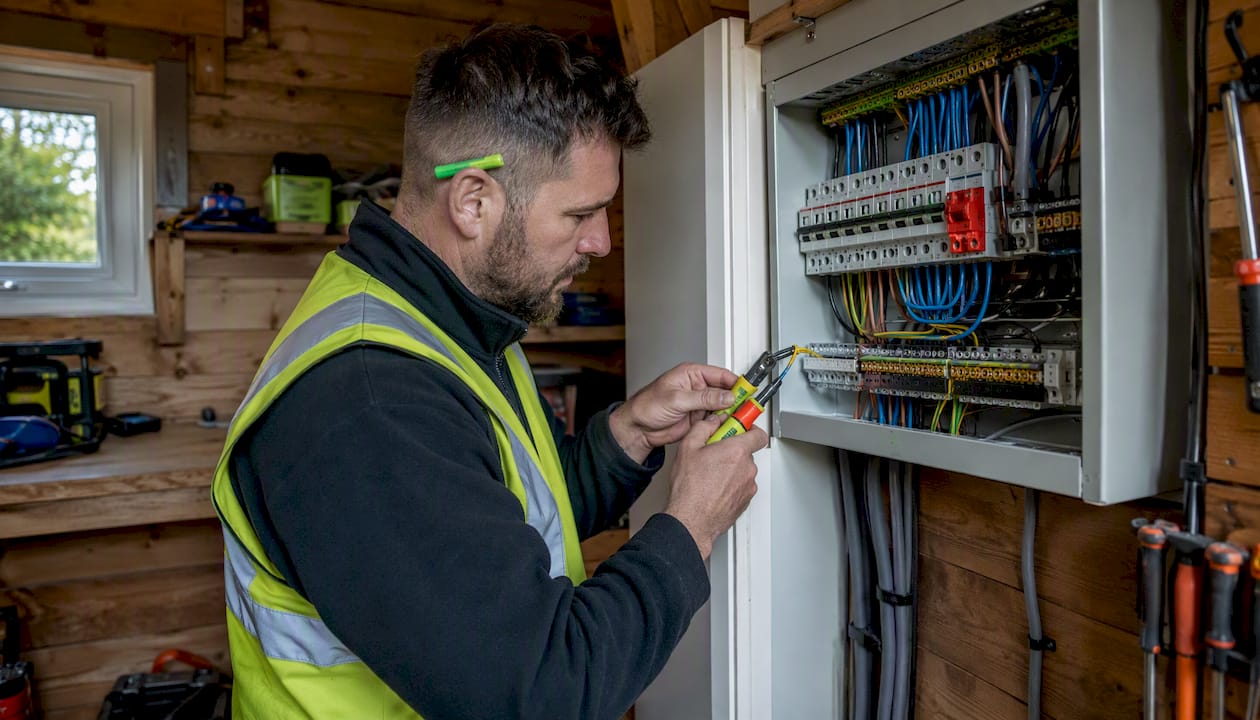
The table below uses sourced UK market ranges as a starting point. Treat them as a budgeting guide, not a fixed quote.
| Scope | 1-bed flat | 2-bed house | 3-bed house | 4-bed house | 5-bed house |
|---|---|---|---|---|---|
| Full rewire | £3,000–£4,800 | £3,500–£7,000 | £4,450–£8,000 | £6,000–£10,000 | £7,500–£12,500 |
| Partial rewire | £1,500–£4,000 | £1,500–£3,000 | £2,000–£4,000 | £1,500–£4,000 | £3,000–£6,000 |
| Consumer unit only | £400–£900 | £400–£900 | £500–£900 | £500–£1,200 | £500–£1,200 |
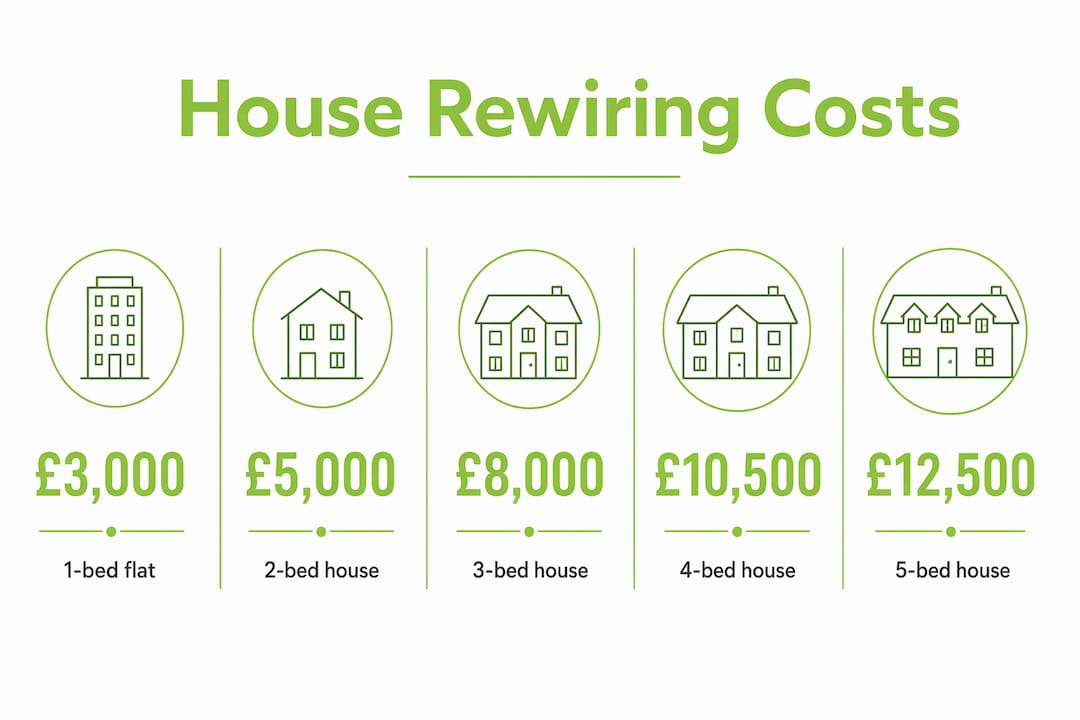
A typical full rewire breaks down roughly as: labour £2,500–£6,000, materials £1,500–£3,500, consumer unit £500–£1,200, and testing/certification £150–£400. Labour is usually the biggest single line item.
What a full rewire normally includes:
- First and second fix wiring throughout
- New consumer unit (specification varies — confirm RCBO or dual RCD)
- Sockets, switches, and light fittings to agreed spec
- Basic testing and an Electrical Installation Certificate
- Part P self-certification by the registered electrician
Regional note: London and the South East typically run 25–30% above the rates you would pay in the North, Scotland, or Wales. The same 3-bed job that costs £5,500 in Somerset could reach £7,000 in Surrey.
What drives the price of a rewiring quote?
Most of the variation between quotes comes down to a handful of factors, and understanding them helps you spot whether two quotes are genuinely comparable.
- Property age and wiring type. Rubber-insulated or aluminium wiring needs full replacement; it cannot be partially retained. Pre-1970s properties almost always need a full rewire.
- Access. Solid walls, tiled floors, and lath-and-plaster ceilings slow the job considerably. Hard-to-reach wiring can add £500–£2,000 to the total.
- Number of circuits and sockets. More circuits mean more cable, more time, and a larger consumer unit.
- Consumer unit specification. A fully RCBO-protected board with surge protection costs more than a basic dual-RCD unit, but offers better fault discrimination.
- Making good. Plastering and redecoration are almost never included in an electrician’s quote. Budget separately: making good typically adds £300–£2,500 depending on the extent of the work.
- Additional safety work. Once walls are open, electricians sometimes find bonding deficiencies or non-compliant cables that must be corrected before sign-off.
Pro Tip: Add a contingency of 10–20% on top of your quoted price. Older properties routinely reveal hazardous wiring once floors and ceilings are opened, and the cost of correcting it mid-job is always higher than budgeting for it upfront.
Which upgrades are worth adding while the walls are open?
Retrofitting any of these after plastering is finished costs significantly more in labour alone. Adding them during a rewire is the cheapest window you will ever have.
- Dedicated kitchen circuits. A modern kitchen needs separate circuits for the oven, hob, dishwasher, and fridge-freezer. Marginal cost during a rewire: typically £150–£400 extra.
- EV circuit provisioning. Running a 7kW-ready cable to the garage or driveway during first fix adds relatively little to the bill. Adding EV provisioning after plastering means chasing new channels and redecorating again.
- Smart lighting pre-wiring. Neutral wires at every switch position cost almost nothing to add at first fix but are required for most smart switches.
- Additional RCBOs or surge protection. Upgrading to a fully RCBO-protected board during a rewire adds perhaps £200–£400 but gives each circuit individual protection.
- Data and media cabling. Cat 6 or coaxial runs are trivial to add before walls close; they are a significant job afterwards.
Pro Tip: Prioritise in this order: safety-critical circuits first (consumer unit, bonding, smoke alarm wiring), then high-load circuits (kitchen, EV), then convenience features (smart pre-wiring, data). If budget is tight, at least get the cable routes in place for EV and smart lighting — the EV charger installation cost drops sharply when the cable is already run.
How long does rewiring take, and what disruption should you expect?
| Scope | 1-bed flat | 2-bed house | 3-bed house | 4-bed house | 5-bed house |
|---|---|---|---|---|---|
| Full rewire (first + second fix) | 2–4 days | 3–5 days | 5–7 days | 5–10 days | 8–12 days |
| Partial rewire | 1–2 days | 1–3 days | 2–4 days | 3–5 days | 4–6 days |
| Consumer unit only | Half day | Half day | 1 day | 1 day | 1–2 days |
Making good adds 2–4 days on top for a typical 3-bed, and that is before a plasterer and decorator are booked. For more detail on how long rewiring takes by property type, including staging advice, see the dedicated guide.
What to expect during the work:
- Power will be off for extended periods during first fix — plan for it, not around it
- You will need to vacate for most of a full rewire; staying in a property with no power or partial power is impractical
- Coordinate your plasterer before the job starts so second fix is not delayed by weeks waiting for plaster to dry
- Redecoration comes last — budget for it separately and do not start it until the electrician has completed second fix and testing
What are the legal requirements, and who should you hire?
Part P of the Building Regulations applies to all notifiable electrical work in dwellings in England and Wales. A registered electrician — NICEIC, NAPIT, or a scheme member — can self-certify the work, which means they notify the local authority on your behalf. If you use an unregistered electrician, you must apply for a building regulations inspection separately, which adds cost and delays.
Legal checklist:
- Part P notification completed by a registered electrician or via a building control application
- Electrical Installation Certificate issued on completion
- EICR if the property is a rental or if the installation’s condition is unknown before work starts
- All paperwork kept safely — you will need it for future property sales and insurance queries
Trust signals to insist on before signing anything:
- NICEIC or NAPIT registration (verify on their respective online registers)
- Written, fixed-price quote with scope clearly defined
- Consumer unit brand and specification listed
- Testing and certification explicitly included in the price
- Public liability insurance confirmed
- Satisfaction guarantee or defects liability period stated
Questions to ask during quoting:
- Who will sign the Part P certificate, and are they registered with NICEIC or NAPIT?
- Is making good included, or is that a separate cost?
- What consumer unit are you supplying — dual RCD or fully RCBO-protected?
- Does the price include surge protection?
- What happens if additional faults are found once walls are opened?
Pro Tip: Ask each electrician to quote to the same specification — same consumer unit type, same number of circuits, same finish. Without a like-for-like spec, comparing prices is meaningless.
How should you budget and plan payments?
Build your budget in layers, not as a single lump sum.
- Base quote: the electrician’s fixed price for labour, materials, consumer unit, and certification
- Making good: budget £300–£2,500 for plastering; get a separate quote from a plasterer before work starts
- Redecoration: not included by any electrician — price it separately
- Contingency: 10–20% of the total project cost, held in reserve for hidden faults or scope changes
- Upgrades: price any extras (EV circuit, smart pre-wiring) as a separate line so you can add or remove them without renegotiating the whole quote
For finance, homeowners commonly use personal loans, 0% purchase credit cards for smaller amounts, or spread-payment arrangements offered by some contractors. Home equity or remortgage options suit larger projects. Whichever route you take, keep every certificate, invoice, and Part P completion notice. They are material documents for future property sales and for notifying your insurer that the installation has been upgraded.
Pro Tip: Notify your home insurer once the rewire is complete. An upgraded installation can affect your premium, and failing to notify them of significant electrical work could affect a future claim.
How do you request and compare rewiring quotes properly?
Getting three quotes is the minimum; getting three comparable quotes is what actually matters.
When requesting quotes, provide:
- Full property details — size, age, construction type, number of floors
- Scope required — full rewire, partial, or consumer unit only
- Consumer unit specification — RCBO board or dual RCD, surge protection yes/no
- Any extras — EV circuit, kitchen circuits, smart pre-wiring
- Finish expectation — who is responsible for making good
- Certification required — Part P self-certification, EICR, or both
What must appear in every written quote:
- Number of labour days and number of electricians on site
- Materials specification (cable type, consumer unit brand and model)
- Testing and certification included or excluded (and at what cost if excluded)
- Warranty or defects liability period
- Payment terms and any staged payment schedule
Red flags that should make you pause:
- A price significantly below all other quotes with no explanation
- Vague scope (“rewire as required” with no circuit count)
- No mention of Part P or certification
- Request for a large cash deposit upfront with no written contract
- No verifiable NICEIC or NAPIT registration
Comparing quotes like-for-like is the single most effective way to avoid being undercharged on paper and overcharged in practice.
Why a registered electrician is always worth the premium
Cutting corners on electrical compliance is not a cost saving — it is a liability. An unregistered electrician who skips Part P leaves you with an uncertified installation that can invalidate your home insurance, complicate a property sale, and in the worst cases, create a genuine fire risk.
Centralec-electrical is a NICEIC-approved contractor based in the South West, with over 23 years of experience in domestic rewires, consumer unit upgrades, EICRs, and EV circuit provisioning. Fixed upfront pricing, written certification on completion, and a satisfaction guarantee are standard on every job.
- Full and partial rewires with Part P self-certification
- Consumer unit upgrades (RCBO and dual-RCD boards)
- EICRs to establish scope before committing to a full rewire
- EV circuit provisioning and smart pre-wiring during rewire
- All work insured, certified, and signed off to BS 7671
Request a like-for-like quote or book an EICR to establish exactly what your property needs before any work begins.
Key takeaways
A full house rewire in the UK costs £3,000–£12,500 depending on property size, must be certified under Part P by a registered electrician, and should always be preceded by an EICR to confirm scope.
| Point | Details |
|---|---|
| Cost by property size | Full rewire ranges from £3,000 (1-bed flat) to £12,500 (5-bed house), with a typical 3-bed house falling between £4,450 and £8,000; consumer unit only costs £400–£900. |
| Budget a contingency | Add 10–20% above the quoted price for hidden faults and making-good costs. |
| EICR before committing | An EICR (£150–£375) can reveal whether a partial rewire is sufficient, saving thousands. |
| Insist on Part P sign-off | Only NICEIC- or NAPIT-registered electricians can self-certify; always get the Electrical Installation Certificate on completion. |
| Centralec-electrical | A NICEIC-approved South West contractor offering fixed upfront pricing, satisfaction guarantee, and full certification on every rewire. |
What Centralec-electrical sees on rewires: a practical perspective
The gap between a quoted price and a final bill almost always comes down to one thing: what was hiding behind the plaster. On properties built before 1970, it is common to find rubber-insulated cables that have become brittle, inadequate earthing arrangements, or supplementary bonding that was never installed in the first place. None of that is visible during a quote walkthrough, and all of it must be corrected before an Electrical Installation Certificate can be issued.
The other surprise that catches homeowners off guard is the making-good timeline. Electrical second fix cannot happen until plaster is fully dry, which takes longer in winter. If you have not booked a plasterer before the electrician starts, you can easily add three to four weeks to the overall project. Coordinate the trades before first fix begins, not after.
One practical observation worth passing on: staging a rewire room by room to stay in the property rarely saves money and often costs more. The electrician returns multiple times, the consumer unit is changed over twice, and the making-good work is fragmented. A single planned project, with temporary accommodation arranged, is almost always cheaper and faster.
Centralec-electrical: fixed-price rewires with NICEIC sign-off
If you are ready to move from budgeting to booking, Centralec-electrical offers a straightforward route. As a NICEIC-approved contractor with over 23 years of experience in the South West, the team handles full and partial rewires, consumer unit upgrades, EICRs, EV charger installations, and smart pre-wiring — all under one fixed upfront price with no hidden costs.

Every job comes with written certification, Part P self-certification, and a satisfaction guarantee. You receive the Electrical Installation Certificate on completion, ready for your insurer and your conveyancer when the time comes to sell.
Book a rewire quote or EICR with Centralec-electrical and get a fixed price before any work begins.
This article is general information for UK homeowners and does not constitute professional electrical or legal advice. Confirm current Building Regulations requirements with your local authority or a qualified electrician for your specific situation.
Useful sources and further reading
Official guidance and registers:
- Part P Building Regulations — GOV.UK — the primary source for notifiable electrical work in dwellings
- NICEIC — find a registered electrician — verify any contractor’s registration before work starts
- NAPIT — find a registered member — alternative competent person scheme for Part P self-certification
Industry cost guides used as references in this article:
- Checkatrade house rewiring cost guide
- Havnwright rewiring cost guide
- BookaBuilderUK house rewire cost guide
Documents to keep after your rewire is complete:
- Electrical Installation Certificate (issued by your electrician on completion)
- Part P completion notice (issued by the competent person scheme or local authority)
- EICR if one was carried out before or after the work
- Any manufacturer warranties for the consumer unit and components