 Skip to content
An EV charger installation permit is the formal approval required before adding new electrical circuits or charging equipment to a property. Level 2 charger installations almost always trigger this requirement because they draw power from a dedicated 240V circuit, which constitutes new electrical work under UK building regulations. The British Standards Institution (BSI) sets the underlying electrical safety standards, and NICEIC-approved contractors are authorised to certify that work meets those standards. Skipping the permit process puts your insurance, your warranty, and your property’s resale value at risk. This guide walks you through every stage of the process, from identifying your local authority to passing final inspection.
When is an EV charger installation permit required?
A permit for EV charging station work is required whenever the installation involves new wiring, a new circuit breaker, or changes to your electrical load. The distinction between charger types matters here.
A Level 1 charger plugs into a standard 13-amp socket and draws no more power than a kettle. No permit is needed in most cases because no new electrical work is involved. A Level 2 charger is different. It requires a dedicated 240V circuit, a new breaker in your consumer unit, and cable runs that must comply with BS 7671, the UK wiring regulations standard. That combination of new work triggers the permit requirement without exception.
The following scenarios always require electric vehicle charger approval:
- Adding a new circuit to your consumer unit for a Level 2 charger
- Installing a charger in a garage, outbuilding, or car port where no existing circuit is present
- Upgrading your main fuse or consumer unit to accommodate the additional load
- Installing multiple chargers at a business premises
- Any work that changes the earthing or bonding arrangement of the property
Permit rules vary widely by jurisdiction, making local research critical for timely and successful approvals. That variability is the single most common reason homeowners and business owners get caught out.
Pro Tip: Check whether your local council requires a Building Regulations notification under Part P (Electrical Safety) before you book an electrician. Some councils accept a NICEIC certificate as sufficient notification; others require a separate submission.
The permit process also protects you financially. Most insurers and charger warranties require proof of professional installation and permit approval to remain valid. A DIY installation without approval can void both your home insurance and the charger manufacturer’s warranty on the same day.
How do you find your local permit authority?
Knowing your Authority Having Jurisdiction (AHJ) is the starting point for any permit application. Submitting to the wrong agency causes delays of one to three weeks. In England and Wales, the relevant authority is your local council’s building control department. In Scotland, it is the local authority verifier. In Northern Ireland, it falls under the Building Control section of your district council.
Most councils publish their Building Regulations application forms online. Search for your council name alongside “Part P electrical notification” or “building regulations application.” If you cannot find the right page, call the building control department directly. They will confirm whether your installation qualifies as notifiable work and which form to submit.
The table below shows how local authority requirements can differ in practice.

| Local authority type | Typical approval time | Indicative fee range | Notes |
|---|---|---|---|
| Metropolitan borough council | 5–10 working days | £150–£300 | Online portal usually available |
| District council (rural) | 10–20 working days | £100–£250 | Paper submissions still common |
| Scottish local authority | 10–15 working days | £120–£280 | Separate verifier system applies |
| Northern Ireland district council | 15–25 working days | £100–£200 | Contact building control directly |
Fees and timelines are indicative and change regularly. Always confirm current figures with your specific council before budgeting.
NICEIC and ELECSA are the two main certification schemes for electricians in the UK. Contractors registered with either body can self-certify certain types of electrical work, which means they notify the local authority on your behalf after completion. This route removes the need for you to submit a separate permit application in many cases. Choosing a qualified electrician from one of these schemes is therefore one of the most practical ways to simplify the approval process.
Pro Tip: Ask your electrician whether they are registered with NICEIC or ELECSA before signing any contract. A registered contractor can handle the notification process directly, saving you time and paperwork.
How to apply for and complete an EV charger permit
The EV charger permit process follows a clear sequence. Rushing any stage typically causes delays or failed inspections.
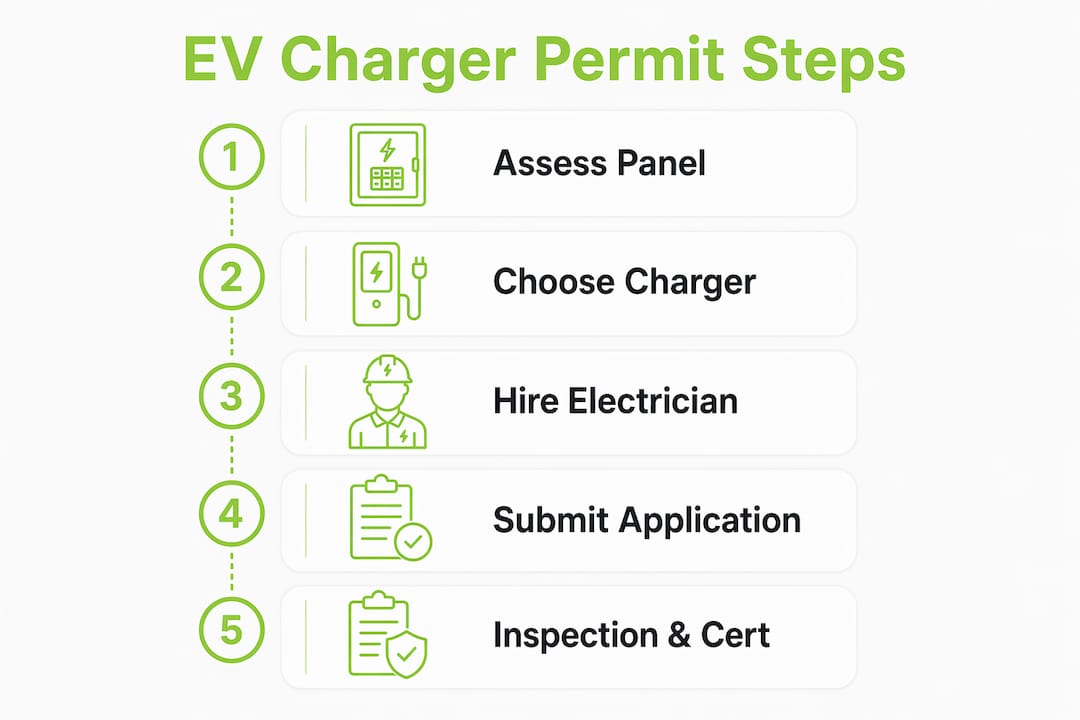
Step 1: Assess your electrical panel
Panel capacity and load calculations are essential prerequisites before permit submission. Insufficient panel capacity discovered late leads to costly rework and resubmission. A qualified electrician will calculate your existing load, confirm the available spare capacity, and advise whether a consumer unit upgrade is needed before the charger can be added.
Step 2: Select your charger and confirm specifications
Charger model selection dictates specific electrical requirements such as breaker size and wire gauge. These details must appear on your permit application. Omitting equipment specifications is one of the most common reasons applications are rejected at the first review stage.
Step 3: Hire a qualified electrician
Licensed contractors manage technical documentation including wiring diagrams and load calculations, which are required for permit submission. Confirm that your chosen electrician holds NICEIC or ELECSA registration. Ask to see their registration card or verify their status on the relevant scheme’s online register.
Step 4: Submit the permit application
Your application pack should include:
- A completed building regulations notification form (or your electrician’s self-certification form)
- A wiring diagram showing the new circuit layout
- Load calculations confirming the panel can support the additional draw
- The charger’s technical specification sheet, including rated output and protection class
- Confirmation of earthing and bonding arrangements
Residential permit approval averages around 16 days, though some councils process complete submissions in as few as five working days. A complete, accurate application is the single biggest factor in achieving a faster turnaround.
Step 5: Pass inspection and receive certification
Once the work is complete, your electrician will either arrange a council inspection or issue a self-certification certificate under their NICEIC or ELECSA registration. Electrical inspectors are critical to confirming that installations meet current safety standards. Keep all certificates and documentation in a safe place. You will need them for insurance purposes and when you sell the property.
Pro Tip: Request a copy of the Electrical Installation Certificate (EIC) from your electrician on the day the work is completed. This document is your primary proof of compliance and is required by most insurers.
What mistakes cause permit delays or denials?
The most avoidable problems in the EV charger permit process share a common cause: insufficient preparation before submission.
Skipping the permit process does not just risk a fine. It can void your home insurance, invalidate your charger warranty, and create a legal liability if the installation causes a fire or injury. The permit exists to protect you, not to slow you down.
The following issues account for the majority of permit delays and failed inspections:
- Incomplete applications. Missing wiring diagrams, absent load calculations, or unsigned forms cause immediate rejection. Check the council’s requirements list before submitting.
- Undiscovered panel capacity issues. Discovering that your consumer unit needs upgrading after the permit is submitted means starting the process again with revised documentation.
- Unlicensed electricians. Hiring an uncertified contractor means the council will require a full inspection rather than accepting self-certification, adding weeks to the process.
- Wiring or grounding errors. Failing a rough-in inspection because cables are undersized or earthing is incorrect is entirely preventable with a pre-inspection check by your electrician.
- Operating the charger before certification. Using a charger before the final certificate is issued invalidates most warranties and insurance policies. Wait for the paperwork before plugging in.
Pro Tip: Ask your electrician to conduct a pre-submission review of all documentation before you send anything to the council. Fifteen minutes of checking saves weeks of waiting.
Key takeaways
An EV charger installation permit is a legal requirement for Level 2 chargers in the UK, and obtaining one correctly protects your insurance, your warranty, and your property’s value.
| Point | Details |
|---|---|
| Level 2 chargers always need a permit | New 240V circuits and breaker additions constitute notifiable electrical work under UK building regulations. |
| Identify your local authority first | Submit to your council’s building control department to avoid delays of one to three weeks. |
| Use a NICEIC or ELECSA electrician | Registered contractors can self-certify work, removing the need for a separate council application in many cases. |
| Prepare documentation before applying | Wiring diagrams, load calculations, and equipment specs must be complete to avoid rejection. |
| Never use the charger before certification | Operating an unpermitted installation voids most home insurance policies and charger warranties. |
Why I think most people get the permit process wrong
After more than two decades working on electrical installations across the South West, I have seen the same mistake repeated more times than I can count. Homeowners focus entirely on choosing the right charger and forget that the electrical infrastructure behind it is what determines whether the installation is safe, legal, and insurable.
The permit process is not bureaucracy for its own sake. It is the mechanism that forces a proper load calculation, a correct wiring design, and an independent check of the finished work. Every one of those steps catches something that would otherwise go unnoticed until it causes a problem.
The other thing I have noticed is that people underestimate how much a NICEIC registration simplifies everything. When your electrician is registered, the self-certification route removes the council from the loop entirely in most cases. You get your certificate faster, you avoid the uncertainty of a council inspection timeline, and you have a named, accountable professional on record. That accountability matters when you come to sell the property or make an insurance claim.
Budget for the permit as part of the installation cost from day one. It is not an optional extra. It is the document that makes the whole installation legitimate.
— Craig
Centralec-electrical: permits handled as part of every installation
Centralec-electrical has over 23 years of experience installing EV chargers across the South West, and every installation includes full compliance with UK building regulations as standard.
As a NICEIC-approved contractor, Centralec-electrical handles the self-certification process directly, so you do not need to submit a separate building regulations application to your council. The team manages load calculations, wiring diagrams, and all technical documentation from the first site visit through to the final Electrical Installation Certificate. For a full breakdown of what the process involves, the EV charger installation requirements page covers every compliance step in detail. If you want to understand the full cost picture including permit fees, the installation cost guide sets out what to expect with no hidden charges.
FAQ
Do I always need a permit for an EV charger?
A permit is required whenever the installation involves new wiring, a new circuit, or changes to your consumer unit. Level 2 chargers always meet this threshold, so a permit or self-certification is required in every case.
How long does the EV charger permit process take in the UK?
Approval averages around 16 days for residential installations, though councils with online portals and complete submissions can process applications in as few as five working days.
Can my electrician handle the permit application for me?
Yes. Electricians registered with NICEIC or ELECSA can self-certify the work and notify the local authority on your behalf, which removes the need for you to submit a separate application.
What happens if I install an EV charger without a permit?
Operating a charger without the correct certification voids most home insurance policies and charger warranties. You may also face a requirement to remove or rectify the installation at your own cost.
What documents do I need for an EV charger permit application?
You need a completed notification form, a wiring diagram, load calculations, the charger’s technical specification sheet, and confirmation of earthing and bonding arrangements. Your electrician should prepare all of these before submission.