 Skip to content

Yes, you can get an EV charger for your flat — but two conditions must be met first. You need a dedicated private parking bay, and you need written permission from your landlord or freeholder. Get those two things confirmed before you do anything else. Once you have them, an OZEV-approved installer can handle the rest, including applying for the government grant that covers 75% of purchase and installation costs, up to £500.
The fastest first step is simple: check your tenancy agreement or lease for your parking entitlement, then write to your building manager or freeholder requesting permission. Book a NICEIC-approved installer for a site survey at the same time. That survey is free with most reputable firms and tells you exactly what is and isn’t feasible before you spend a penny.
Table of Contents
- Who qualifies for the EV chargepoint grant for flats?
- Do you need permission from your landlord or freeholder?
- What are the practical charging options for flat residents?
- What does installation cost, and how long does it take?
- How to apply for the grant: a step-by-step checklist
- What to ask an installer before you book
- What to do if your landlord or freeholder refuses
- Why hire a NICEIC-approved electrician: Centralec-electrical as an example
- Key takeaways
- The route that actually works for flat residents
- Centralec-electrical can handle your flat’s EV charger from survey to sign-off
- Useful sources
Who qualifies for the EV chargepoint grant for flats?
The UK government’s Electric Vehicle Chargepoint Grant covers 75% of the combined purchase and installation cost, up to a maximum of £500 per property. The installer claims it on your behalf and deducts it from your invoice — you never handle the money directly.
To qualify, you must:
- Own or lease an eligible plug-in vehicle (or have one on order)
- Have a dedicated, private off-street parking space associated with your property
- Obtain written permission from your landlord or freeholder before work begins
- Use an OZEV-approved installer to carry out the work and submit the claim
The parking requirement is where most flat residents hit a wall. A numbered bay in a private car park attached to your building counts. A shared visitor space, a public car park nearby, or an on-street space does not. If your bay is allocated to your flat in your lease or tenancy agreement, you are in a strong position. If it is informal or shared, the grant is unlikely to apply.
Pro Tip: Ask your installer to confirm grant eligibility during the site survey, before any work is quoted or scheduled. An experienced installer will check your parking evidence and permission status in the same visit, saving you from paying for work that cannot be claimed.
Do you need permission from your landlord or freeholder?
Written permission is not optional. Without recorded consent from the landlord or freeholder, the installer cannot legally proceed or submit a grant claim. The route you take depends on your tenure.

Renters need written consent from their landlord. Most landlords will want to see the installer’s credentials, a proposed cable route, and confirmation that the equipment is OZEV-approved before agreeing.
Leaseholders face a more involved process. Your lease likely requires a Licence to Alter or deed of variation for any permanent infrastructure change. Leasehold installations frequently require this formal consent, and engaging a leasehold specialist reduces the risk of costly disputes. Your freeholder or managing agent is the right first contact.
Landlords installing for tenants can apply for the grant themselves and benefit from building-level schemes — more on that in Section 8.
Worth knowing: planning permission is often not required. The Electric Charging Points for Vehicles (Permitted Development) Regulations 2022 removed the need for planning consent for most wall-mounted units. That does not, however, override your lease or your freeholder’s contractual rights. You still need their written agreement.
When you make your permission request, include:
- Your installer’s OZEV approval and NICEIC credentials
- A technical feasibility note (cable route, load calculations)
- Confirmation of the equipment model and smart-charging capability
- A reinstatement offer (you will make good any damage on vacating)
- An offer to cover reasonable legal costs for a Licence to Alter
Pro Tip: Present your permission request as a short, professional pack rather than an informal email. Freeholders are far more likely to say yes when they can see the installer is qualified, the equipment is certified, and the cable route has been thought through. A one-page summary with the installer’s credentials attached takes twenty minutes to put together and can save months of back-and-forth.
What are the practical charging options for flat residents?
Your best option depends almost entirely on your parking situation. Here is how the main routes compare.
Individual dedicated socket
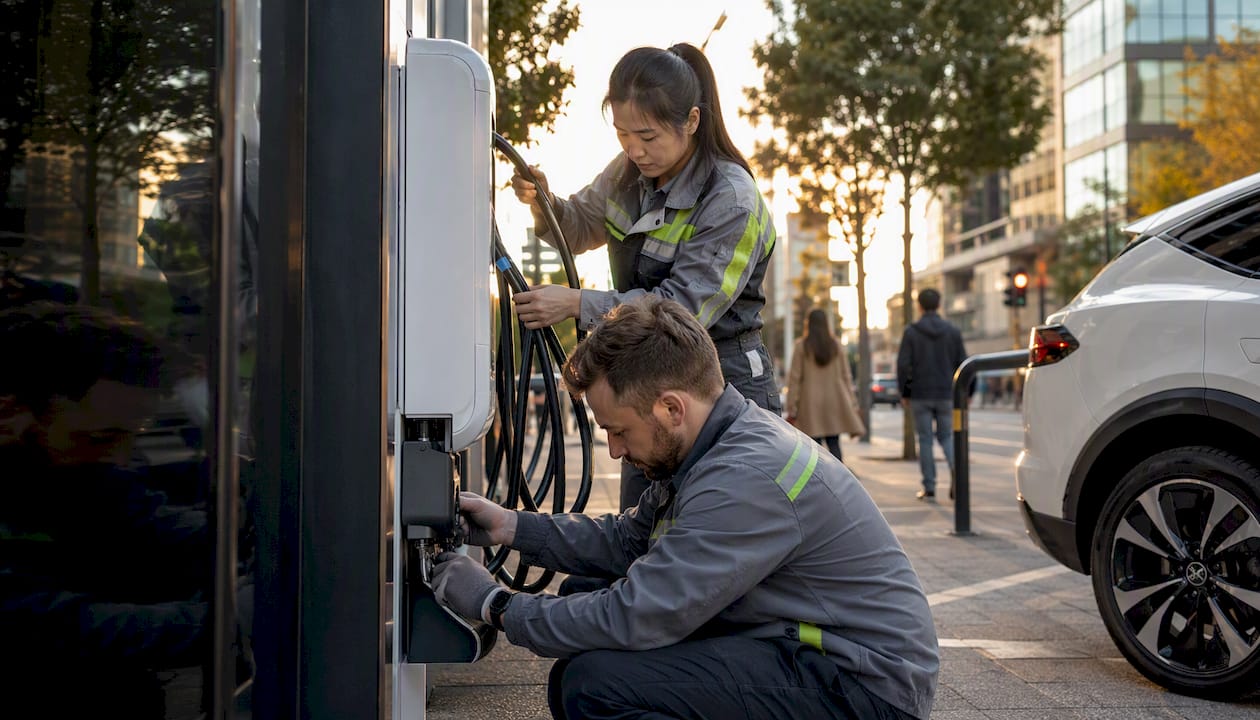
If you have a private, allocated bay, a single-point charger wired directly to your flat’s supply is the most straightforward solution. A 7kW smart charger (such as a Zappi or Wallbox) will charge most EVs overnight. The downside is cable management in communal areas, which requires fire-stopping and freeholder sign-off on the route.
Communal or shared charging
For blocks where individual installs are impractical, communal charging schemes with backbone cabling and metered billing are the most future-proof solution. A central distribution board feeds multiple charge points, each with its own metering so residents pay only for what they use. The upfront cost is higher, but it scales across the whole building and avoids the messy cable-run problem that defeats individual installs in older blocks.
On-street and public charging
Local councils can apply for grants to install on-street chargepoints near residential properties. Check your council’s website for any active schemes. Public rapid chargers are a practical fallback for top-ups but expensive for daily charging and not a substitute for home access.
Workplace charging
If your employer has chargepoints, overnight charging at work is worth considering as a short-term bridge while you pursue a home solution.
| Situation | Best option |
|---|---|
| Private allocated bay, own flat | Individual dedicated socket with OZEV grant |
| Private bay, rented flat | Individual socket — landlord permission required |
| Communal car park, multiple residents | Communal backbone scheme |
| No allocated parking | On-street council scheme or workplace charging |
Pro Tip: If individual installs are blocked, start a Residents’ Association proposal. EVA England’s research shows strong resident demand for charging in residential properties — a signed interest list from five or more residents is often enough to get a freeholder to commission a feasibility study.
What does installation cost, and how long does it take?
Cost varies significantly depending on your building, and no installer should quote a firm price without a site survey. That said, here are the realistic ranges.
Factors that push costs up:
- Long cable runs from the consumer unit to the parking bay
- Consumer unit upgrades or additional circuit protection
- Three-phase supply work (common in older blocks)
- Fire-stopping where cables pass through communal walls or floors
- Load management hardware where multiple chargers share a supply
| Stage | Typical duration |
|---|---|
| Initial enquiry to site survey | 3–7 days |
| Freeholder/landlord permission | 2–8 weeks (varies widely) |
| Grant application and scheduling | 1–2 weeks post-permission |
| Installation day | Half day to full day |
| Certification and completion | Same day as installation |
Indicative starting prices for straightforward installs can begin from a few hundred pounds, but a flat install with a long cable run, consumer unit work, and communal fire-stopping can cost considerably more. The £500 grant reduces your net cost directly. On a £900 install, for example, the grant brings your out-of-pocket cost to £400. On a simpler £600 job, you pay £150.
The permission stage is the biggest variable in the timeline. A cooperative landlord can turn this around in days. A freeholder managing a large block with a management company in the chain can take two months or more.
How to apply for the grant: a step-by-step checklist
The process is more straightforward than it looks. The installer does the heavy lifting on the grant side.
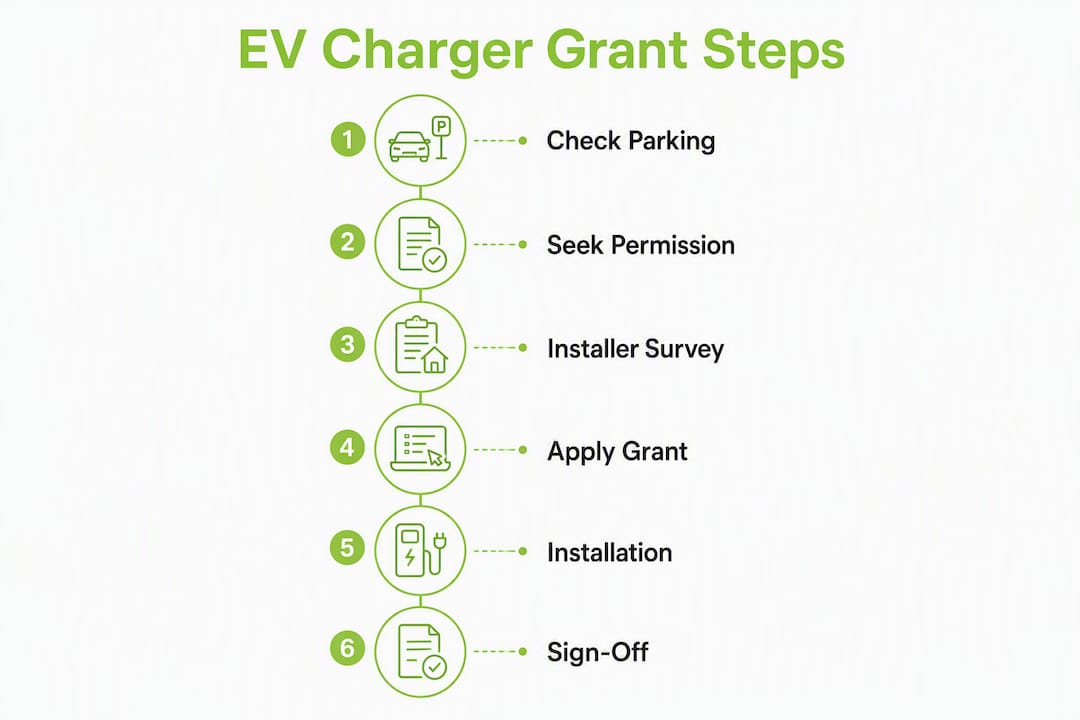
- Confirm your parking entitlement. Check your lease or tenancy agreement for a dedicated, private bay. Get it in writing if it is not already documented.
- Request written permission. Contact your landlord, freeholder, or managing agent with a professional permission pack (see Section 3 for what to include).
- Book an OZEV-approved installer for a site survey. The survey confirms technical feasibility, cable route, and grant eligibility. Centralec-electrical carries out EV charger installation surveys and confirms grant eligibility at this stage.
- Receive a written quote showing the grant deduction. The quote should show the gross cost, the grant amount (75%, up to £500), and your net payment.
- Installer submits the grant claim. Once you approve the quote and permission is confirmed, the installer applies to OZEV and schedules the work.
- Installation and certification. Work is completed in a single visit for most straightforward installs. You receive a completion certificate, installation photos, and grant claim confirmation on the day.
Documents your installer will typically need from you:
- Proof of eligible vehicle (V5C, purchase order, or lease agreement)
- Evidence of your parking bay (lease extract, tenancy agreement, or bay number)
- Written permission from landlord or freeholder
- Meter details and consumer unit location
- Confirmation of your installer’s OZEV approval number (they supply this themselves)
What to ask an installer before you book
Not every electrician who offers EV charger installs is OZEV-approved or experienced with the specific challenges of flat installations. Ask these questions before you commit.
Vetting questions:
- Are you OZEV-approved and can you provide your approval number?
- Are you NICEIC-approved or registered with an equivalent Part P scheme?
- Do you carry public liability insurance, and can you provide a certificate?
- Will you provide a written quote showing the grant deduction?
- What completion certificates do you issue on the day?
Technical checks a competent installer will run during the survey:
- Distribution board and consumer unit capacity (can it support an additional 7kW circuit?)
- Condition of existing wiring and earthing
- Cable route from consumer unit to parking bay, including any communal penetrations
- Whether load management hardware is needed (essential where multiple chargers share a supply)
- Fire-stopping requirements for any cables passing through communal walls or floors
- Meter separation if the charger will be billed separately from the flat’s supply
Red flags to watch for:
- No written quote or vague pricing (“we’ll sort it on the day”)
- Cannot provide an OZEV approval number
- Suggests uncertified or non-smart equipment (smart charging is a legal requirement under the Electric Vehicle (Smart Charge Points) Regulations 2021)
- Requests cash payment without paperwork
- Cannot provide a completion certificate or Building Regulations notification
For multi-unit buildings, electrical safety requirements for apartment blocks add complexity around shared supplies and metering that only an experienced installer will handle correctly.
What to do if your landlord or freeholder refuses
A refusal is not necessarily the end of the road. Property managers often hesitate because of perceived safety and capacity concerns; a professional feasibility study that details electrical capacity and load management usually converts a refusal into consent.
If you are refused, follow this escalation path:
- Commission a feasibility study. A written technical report from a qualified installer, showing load calculations, proposed cable routes, and smart-charging settings, addresses the most common objections in one document.
- Gather resident interest. A signed list from multiple residents strengthens the case and opens the door to communal funding routes.
- Make a formal written request citing your lease terms. Reference the permitted development regulations and the smart-charging legal framework.
- Explore communal grant routes. Landlords and property managers can apply for building-level funding. Some fully funded provider models manage grant applications, install communal backbone infrastructure, and operate billing — removing upfront cost barriers for freeholders entirely.
- Apply to the First-tier Tribunal (Property Chamber) in England if the refusal is unreasonable and your lease does not prohibit the installation. This is a last resort, but leaseholders have used it successfully where freeholders have refused without good reason.
Pro Tip: Frame the communal scheme to your freeholder as a property value argument, not just a resident convenience. Buildings with EV charging are increasingly preferred by buyers and tenants. A fully funded provider model means the freeholder carries no upfront cost and gains a building amenity.
Why hire a NICEIC-approved electrician: Centralec-electrical as an example
Centralec-electrical has over 23 years of experience in electrical installations across the South West, with NICEIC approval on every job. For flat residents, that matters for two specific reasons: grant eligibility and freeholder confidence.
Centralec-electrical installs Wallbox, Zappi, Tesla, and Autel chargers, carries out consumer unit assessments as part of every survey, and issues completion certificates and EICR reports on the day. Transparent, upfront pricing means the written quote you receive shows the grant deduction clearly, with no hidden costs added after the fact.
Key takeaways
Flat residents can access EV charging through the OZEV grant, but the process requires a private parking bay, written freeholder or landlord permission, and an OZEV-approved installer — all three conditions must be in place before work can begin.
| Point | Details |
|---|---|
| OZEV grant headline | Covers 75% of combined purchase and installation cost up to £500 per property; installer claims it and deducts it from your invoice. |
| Private parking is mandatory | A dedicated, allocated bay is required — shared or informal spaces do not qualify. |
| Written permission is non-negotiable | Landlord or freeholder consent must be in writing before the installer can proceed or claim. |
| Communal schemes for complex blocks | Where individual installs are impractical, backbone communal charging is the most scalable route. |
| Centralec-electrical | NICEIC-approved, OZEV-compliant installs across the South West, with full grant handling and certification. |
The route that actually works for flat residents
Most of the difficulty flat residents face comes from treating the grant application and the permission process as separate problems. They are not. The fastest route through both is to book a site survey with a qualified installer first, before you write a single letter to your freeholder.
Here is why that order matters. A freeholder who receives a vague permission request from a resident will almost always say no, or ask for more information, adding weeks to the process. A freeholder who receives a professional technical pack from a NICEIC-approved installer — with load calculations, a cable route diagram, smart-charging compliance confirmation, and a reinstatement clause — has almost nothing left to object to. The installer’s credibility does most of the persuasion work for you.
The communal route is underused and undervalued. For blocks with ten or more flats, a backbone communal scheme funded through a provider model often costs residents nothing upfront and gives the building a permanent, scalable asset. Individual installs make sense where the building and parking layout allow it. For dense urban blocks with shared car parks, communal is almost always the better long-term answer.
Centralec-electrical can handle your flat’s EV charger from survey to sign-off
Getting an EV charger fitted in a flat involves more moving parts than a standard house install: grant paperwork, freeholder permissions, load assessments, and communal cable routes all need coordinating. Centralec-electrical handles every stage, from the initial feasibility survey through to certified completion, with upfront fixed pricing and no hidden costs.
The process starts with a free initial check on your parking and permission situation, followed by a full site survey that produces the technical report your freeholder needs to approve the work. The written quote shows the OZEV grant deduction clearly, so you know your exact out-of-pocket cost before anything is booked. Centralec-electrical is NICEIC-approved and OZEV-authorised, which means the grant claim is handled entirely by the team.
For landlords and property managers looking at building-level solutions, the EV charger installation for landlords page covers communal schemes, backbone infrastructure, and multi-unit grant routes in detail.
Ready to find out what is feasible for your building? Check the EV charger installation requirements page and book your site survey today.
Useful sources
Before proceeding, check the live GOV.UK guidance directly — eligibility details and grant amounts can change, and the pages below reflect the most current official position.
- Electric Vehicle Chargepoint Grant for renters and flat owners — GOV.UK
- Find government grants: EV chargepoint grant for renters and flat owners
- Grants for residential on-street chargepoints — GOV.UK guidance for local authorities
- Electric vehicle charging: permitted development — Planning Portal
- Leaseholder rights for EV charging — B P Collins solicitors
- EV charging for flats and apartment buildings — EVA England
- Installing EV charging points at blocks of flats — Coles Miller solicitors