 Skip to content

EICR remedial works are the repairs, replacements, and retesting required to close out C1, C2, or FI observations on an unsatisfactory Electrical Installation Condition Report. If your property has received an unsatisfactory EICR, you are legally obliged to act. Under the Electrical Safety Standards in the Private Rented Sector (England) Regulations 2020, landlords must arrange and complete remedial works within 28 days of the inspection date, or sooner if the report specifies it. The three things to do right now:
- Make safe immediately — for any C1 observation (danger present), isolate the affected circuit on the day of inspection if the inspector has not already done so.
- Instruct a registered electrician — use a contractor registered with NICEIC or NAPIT to carry out all remedial electrical work; only registered electricians can self-certify compliance with BS 7671 and issue valid certification.
- Collect the paperwork — after works are complete, you need the original unsatisfactory EICR plus the remedial certificates (a Minor Electrical Installation Works Certificate or an Electrical Installation Certificate) attached to it. Centralec Electrical Ltd provides a full close-out pack as standard, including photographs and contractor details, so your compliance file is audit-ready from day one.
Table of Contents
- What do EICR remedial works actually cover?
- What are your legal duties after an unsatisfactory EICR?
- What do C1, C2, C3, and FI mean on an EICR?
- What faults do EICRs commonly flag, and what fixes them?
- How much do EICR remedial works typically cost?
- Who should carry out the work, and what certificates should you receive?
- How long do EICR remedial works take?
- How do you choose a reliable contractor for remedial work?
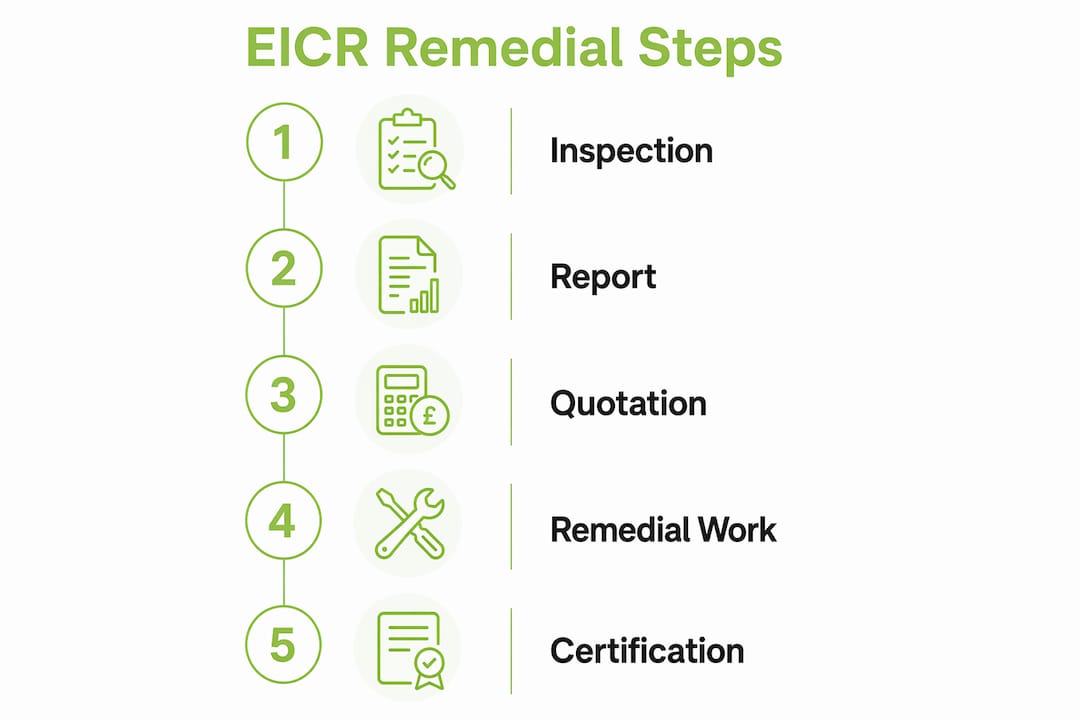
- What does a compliant remedial works workflow look like?
- Key takeaways
- Why registered electricians make the difference landlords overlook
- Centralec Electrical Ltd: EICR remedial works in the South West
- Useful sources
What do EICR remedial works actually cover?
Remedial works are corrective repairs or alterations to an electrical installation that restore compliance with BS 7671 (the IET Wiring Regulations). They are not the same as routine maintenance or voluntary upgrades. Routine maintenance covers planned servicing, lamp replacements, and general upkeep that would happen regardless of an inspection result. Remedial works are specifically triggered by EICR observations and exist to close a defined safety or compliance gap.
The distinction matters practically. A landlord who replaces a light fitting as part of a refurbishment is doing maintenance. A landlord who replaces the same fitting because the EICR recorded a C2 for an exposed live part is doing remedial work, and that work requires certification.
Typical remedial tasks include:
- Replacing an outdated consumer unit with a modern dual-RCD or RCBO board
- Installing or upgrading main protective bonding conductors
- Fitting RCD protection to circuits that currently lack it
- Repairing or replacing damaged, overheated, or deteriorated cables
- Replacing cracked, loose, or overheated accessories (sockets, switches, pendants)
- Rectifying failed insulation resistance on circuits
Some remedial work is notifiable under Part P of the Building Regulations in domestic properties. Consumer unit replacements, for example, are notifiable. A registered NICEIC or NAPIT electrician can self-certify notifiable work, which means they notify the local authority on your behalf and issue the appropriate certificate. Always confirm with your contractor which elements of the scope are notifiable and what documentation you will receive as a result.
Pro Tip: Ask your electrician to cross-reference every item in their quote against the observation numbers on your EICR. If a quote does not reference specific observation codes, it is not tied to your actual report and scope disputes become almost inevitable.
What are your legal duties after an unsatisfactory EICR?
The Electrical Safety Standards in the Private Rented Sector (England) Regulations 2020 place clear statutory duties on landlords. The clock for completing remedial works starts from the inspection date, not the date you receive the report, so delays in reading your email do not extend the deadline.
Devolved differences are worth noting briefly. Scotland and Wales have their own electrical safety regulations for rented properties, with similar but not identical requirements. If your property is in Scotland or Wales, check the specific devolved legislation rather than assuming England’s 2020 Regulations apply directly.
Paperwork landlords must hold after remedial works:
- The original unsatisfactory EICR (keep this permanently)
- Minor Electrical Installation Works Certificate (MEIWC) for minor repairs
- Electrical Installation Certificate (EIC) for larger works such as consumer unit replacement
- Retest results confirming affected circuits now pass
- Contractor details: name, company, NICEIC or NAPIT registration number, and public liability insurance reference
Practical steps for tenant communication and local authority compliance:
- Provide a copy of the unsatisfactory EICR to your tenant within 28 days of receiving it (or before a new tenancy begins).
- Once remedial works are complete, provide the tenant with a copy of the remedial certificates within 28 days of completion.
- If the local authority requests evidence of compliance, you must supply it within seven days.
- If a tenant refuses access, document every attempt to gain entry in writing and consider formal notice under the tenancy agreement. Unresolved C1 or C2 items keep the EICR unsatisfactory and the compliance risk remains yours.
- Keep all correspondence about access attempts in your compliance file alongside the EICR and certificates.
What do C1, C2, C3, and FI mean on an EICR?
These four codes are the shorthand an inspector uses to classify every observation. Understanding them lets you triage your report and prioritise correctly.
- C1 — Danger present: The installation poses an immediate risk of injury. C1 items require immediate action; the inspector may isolate the affected circuit on the day. There is no 28-day window for C1s.
- C2 — Potentially dangerous: The fault is not immediately dangerous but could become so. The statutory expectation under the 2020 Regulations is remediation within 28 days of the inspection date.
- C3 — Improvement recommended: Not a safety failure. C3 items do not make an EICR unsatisfactory and there is no legal obligation to act on them, though addressing them improves long-term safety.
- FI — Further investigation required: The inspector cannot determine the extent or nature of a fault without additional testing or opening up the installation. FI items must be investigated; if the investigation reveals a defect, that defect must be remediated. FI items can expand in scope and cost once the investigation begins.
On timescales: plan contractor mobilisation on the day of inspection when possible. The 28-day window is short in practice, and sourcing quotes, scheduling access, and ordering parts can easily consume two weeks of it. For C1 items, treat the timeline as hours, not days.
Interim measures while you wait for a contractor: isolate the affected circuit if safe to do so, inform the tenant of the hazard in writing, and document the interim action with a date and description. This does not close the observation, but it demonstrates responsible management if the matter is ever reviewed.
What faults do EICRs commonly flag, and what fixes them?
Most EICR observations cluster around a handful of recurring issues. Knowing what the fix typically looks like helps you judge whether a quote is proportionate.
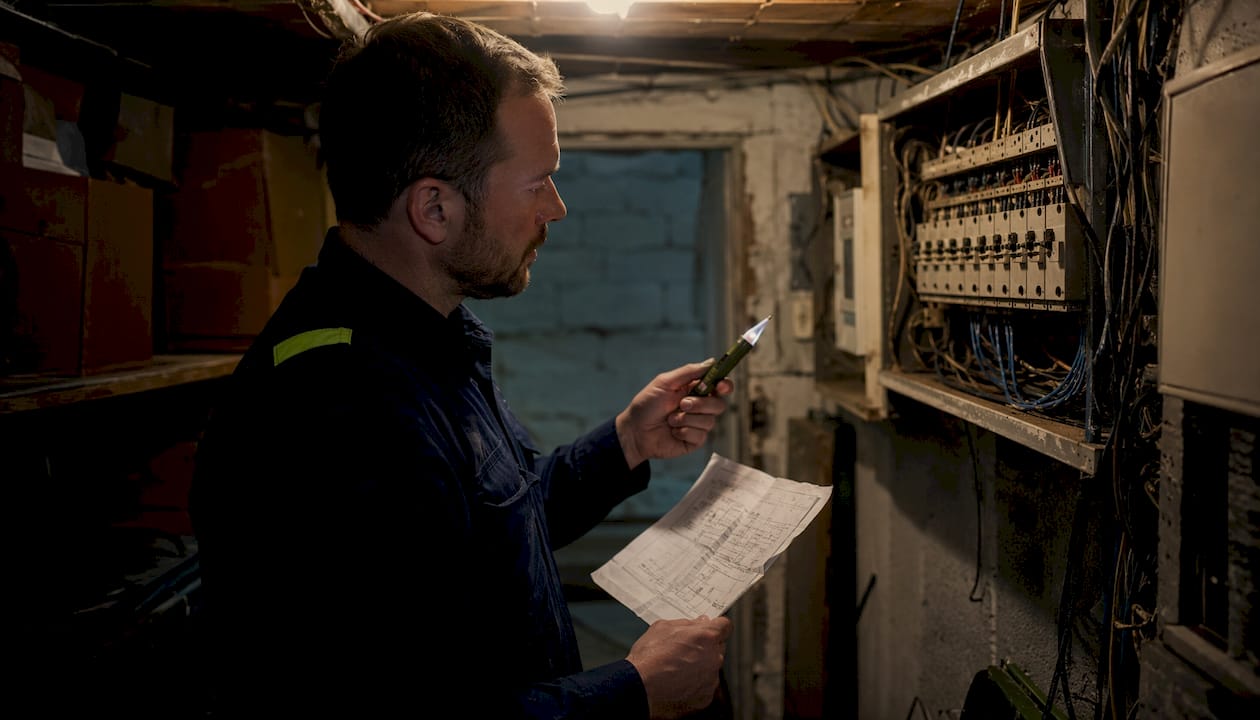
Consumer unit problems are among the most common findings. Older fuse boards with no RCD protection, or boards with a single RCD covering all circuits, are regularly coded C2. The remedial action is usually a full consumer unit replacement with a modern dual-RCD or RCBO board. This is a one-day job in most standard houses and is notifiable under Part P.
Missing or undersized main protective bonding is another frequent C2. Gas and water service pipes entering the property must be bonded to earth. The fix is straightforward: a bonding conductor is run from the main earthing terminal to each service pipe and connected with an approved clamp. It is non-invasive in most cases.
Failed or absent RCD protection on socket circuits or bathroom circuits is coded C2 and sometimes C1 if the exposure is direct. The remedy may be a consumer unit upgrade, the addition of an RCD socket, or the installation of an inline RCD, depending on the circuit configuration.
Damaged or overheated cables range from a single accessible section (a targeted replacement taking a few hours) to concealed runs requiring chase work or partial rewiring. The invasiveness varies considerably. If cables run under plaster, expect some making good after the work.
Loose or overheated terminations at accessories, junction boxes, or the consumer unit are often coded C1 or C2 depending on severity. The fix is re-termination or replacement of the accessory, which is usually quick. However, widespread overheating across multiple points can indicate a deeper wiring problem and may trigger an FI.
FI items deserve particular attention. An FI is not a defined fault; it is an instruction to investigate. Once the investigation is complete, the actual fault may be minor or it may reveal a partial rewire. Budget and timescale for FI items should always be treated as provisional until the investigation is done. For guidance on what an EICR checks in a property, it helps to understand the full scope before the inspection so findings are less surprising.
How much do EICR remedial works typically cost?
Cost varies significantly depending on the fault type, the age and complexity of the installation, and regional labour rates. The table below gives sourced ranges for the most common remedial items.
| Remedial item | Typical UK price range | Notes |
|---|---|---|
| Consumer unit replacement | £600–£1,200 | Standard house; includes unit, installation, testing and EIC |
| Main protective bonding | £150–£300 | Per service (gas/water); non-invasive in most cases |
| RCD socket or inline RCD | £100–£250 | Per circuit; varies by access and board type |
| Accessory replacement (sockets, switches) | £60–£120 | Depends on quantity and finish |
| Targeted cable repair/replacement | £120–£350 | Accessible runs; concealed work adds cost |
| Partial rewire | £1,500–£3,000 | Depends on number of circuits and access |
What drives the cost up:
- Concealed wiring that requires chasing walls and making good
- Consumer unit complexity (larger boards, RCBO-per-circuit configurations)
- Parts availability and lead times for specialist components
- Emergency or out-of-hours callouts, which carry a premium
- FI investigations that reveal larger scopes than initially quoted
- Regional labour rates, which are higher in London and the South East than elsewhere
To get a quote you can actually rely on, share the full EICR with every electrician you approach. Sharing the full report ensures quotes are tied to specific observation numbers and prevents scope disputes later. Ask each contractor to itemise their quote by observation code, state what certification will follow each item, and confirm whether any work is notifiable under Part P.
For a broader view of inspection costs before remedial work begins, the EICR cost guide covers what affects pricing at the inspection stage.
Who should carry out the work, and what certificates should you receive?
Remedial electrical work must be carried out by a qualified, registered electrician. Registration with NICEIC or NAPIT is the practical standard: these schemes assess competence, require adherence to BS 7671, and allow members to self-certify their work. An unregistered electrician cannot self-certify, which means notifiable work would require a separate building control application, adding cost and delay.
Certificates you should receive after remedial works:
- Minor Electrical Installation Works Certificate (MEIWC): issued for small repairs and alterations that do not extend or alter a circuit significantly, such as accessory replacements or bonding additions.
- Electrical Installation Certificate (EIC): required for larger works, including consumer unit replacement or new circuit installation.
- You do not always need a full new EICR after remedial works. Attaching the MEIWC or EIC to the original unsatisfactory EICR creates a compliant audit trail without the cost of a full reinspection, provided the remedial certificates clearly reference the original report’s observation numbers.
Contractor proofs to request before work begins:
- NICEIC or NAPIT registration number (verify it on the scheme’s public register)
- Public liability insurance certificate
- Written scope of works tied to EICR observation numbers
- Confirmation of which items are notifiable under Part P and how notification will be handled
- Written warranty or guarantee on completed work
Questions to include in your quote request:
- Which observation codes does this quote address?
- What certification will you issue for each item?
- Is any element of this work notifiable under Part P, and how will you handle notification?
- What is your retest plan after works are complete?
- What is your process if the scope changes once work has started (for example, if an FI reveals additional faults)?
- What is your lead time from instruction to start date?
How long do EICR remedial works take?
Duration depends almost entirely on what the EICR found. Here is a realistic breakdown:
- Accessory replacements (sockets, switches, pendants): a few hours for a handful of items; a full day if there are many across a large property.
- Bonding installation: typically two to four hours for a standard two-service property.
- Consumer unit replacement: one full working day in most standard houses; longer for larger or more complex boards.
- Targeted circuit repairs (accessible cable runs, re-terminations): half a day to a full day depending on quantity.
- Partial rewire (specific floors or circuits): two to four days typically, depending on access and the number of circuits involved.
- Full rewire: several days to a week or more for a standard house; larger properties take longer. For a detailed breakdown, the rewiring timescale guide gives property-specific estimates.
- FI investigations: the investigation itself may take a few hours, but if it reveals a fault requiring repair, that repair adds to the timeline. Always treat FI timescales as provisional.
Common causes of delay:
- Concealed wiring requiring chase work and subsequent making good
- Parts on order (specialist consumer units, RCBO types, or cable sizes not held in stock)
- Tenant access difficulties requiring rescheduling
- FI investigations that expand into larger repair scopes
- Notifiable work requiring coordination with building control (though registered electricians self-certify, which avoids most of this)
Ask your contractor for a provisional schedule at the quote stage, including a contingency plan for FI items. If the property is tenanted, agree the access plan in writing with the tenant before the contractor arrives.
How do you choose a reliable contractor for remedial work?
Speed matters here: you have a statutory deadline and a tenanted property. The selection framework below is designed to be fast and defensible.
The non-negotiable checks:
- Verify NICEIC or NAPIT registration on the scheme’s public register before instructing anyone
- Confirm public liability insurance is current
- Insist on a written, itemised fixed quote tied to EICR observation numbers
- Confirm what certification will be issued and when
- Ask for a written warranty on completed work
Red flags to walk away from:
- A vague scope that says “fix electrical issues” without referencing specific observations
- Refusal to provide a registration number or certificate of insurance
- No written certificate promised after works
- Cash-only payment with no paperwork
- High-pressure same-day upsell without a written scope or documentation
Trust signals that actually mean something:
- NICEIC or NAPIT registration confirmed on the public register (not just a logo on a van)
- A written BS 7671 compliance statement included in the quote
- Quote itemised by EICR observation number
- Photographed evidence of completed work provided as standard
- A written guarantee covering both workmanship and materials
Pro Tip: Using the same electrician who carried out the original EICR can speed up remediation considerably. They already know the installation, can often provide a same-day quote, and can sometimes begin immediate remedial work where parts are available.
Sharing your full EICR report with any contractor you approach is not optional if you want accurate, comparable quotes. An electrician quoting without the report is guessing at scope. For more on verifying credentials, the NICEIC approved contractor page explains what registration means in practice.

What does a compliant remedial works workflow look like?
A well-run remedial job follows a clear sequence. Here is how Centralec Electrical Ltd approaches it, from unsatisfactory EICR to close-out pack.
- Immediate make-safe: On receiving the EICR, any C1 circuits are isolated or made safe before any other work is planned. This is documented with a date, time, and description.
- Report review and scoped quotation: The full EICR observation schedule is reviewed. Every item in the quote is referenced to a specific observation number, so there is no ambiguity about what is and is not included.
- Access and scheduling: Tenant access is confirmed in writing, with a date and time agreed. For FI items, a provisional scope and contingency timescale are included.
- Works completed to BS 7671: All remedial work is carried out by NICEIC-registered electricians using compliant materials and correct isolation, testing, and verification procedures.
- Retest of affected circuits: After repairs, the relevant circuits are retested. This includes insulation resistance, earth fault loop impedance, and RCD operation where applicable.
- Certification issued: A MEIWC is issued for minor works; an EIC for larger works such as consumer unit replacement. Each certificate references the original EICR observation numbers it closes.
- Close-out pack assembled: The close-out pack contains the original unsatisfactory EICR, all remedial certificates, retest records, photographs of completed work, and full contractor details including NICEIC registration number and insurance reference.
Documents the duty-holder must retain for local authority, insurer, and audit purposes:
- Original unsatisfactory EICR (permanent retention)
- MEIWC or EIC for each remedial item, cross-referenced to observation numbers
- Retest records confirming circuit compliance
- Photographs of completed work
- Contractor details: name, company, registration number, insurance
- Copies of any tenant communications regarding the EICR and remedial works
Centralec Electrical Ltd operates with 24/7 availability and fixed upfront pricing, so there are no surprises on the invoice and no gaps in the paperwork. For landlords managing properties in the South West, this means a C1 emergency does not wait until Monday morning.
Key takeaways
EICR remedial works require a registered electrician, a structured close-out pack, and action within the statutory 28-day window from the inspection date.
| Point | Details |
|---|---|
| Act on C1 immediately | C1 observations indicate immediate danger; isolate affected circuits on the day, before the 28-day clock even starts. |
| 28-day clock from inspection | The deadline runs from the inspection date, not when you receive the report; instruct a contractor the same day where possible. |
| Use a registered electrician | Only NICEIC or NAPIT-registered electricians can self-certify remedial work to BS 7671 and issue valid compliance certificates. |
| Keep the full documentation file | Retain the original EICR, all remedial certificates (MEIWC or EIC), retest records, and contractor details permanently. |
| Centralec Electrical Ltd | NICEIC-approved, with fixed pricing and a full close-out pack as standard; contact them to get a quote tied to your EICR observation numbers. |
Why registered electricians make the difference landlords overlook
Most landlords who come unstuck after an unsatisfactory EICR do not fail because they ignored it. They fail because they instructed the wrong person, or accepted a quote that was not tied to their actual report.
The paperwork problem is underestimated. An MEIWC or EIC issued by a non-registered electrician is not self-certified under a competent person scheme. It may not satisfy a local authority request, and it almost certainly will not satisfy an insurer following a claim. The certificate looks the same on paper, but the legal weight is entirely different.
There is also a tendency to treat C3 observations as optional in a way that creates future liability. They are not legally required, but an installation with multiple C3 items is one inspection cycle away from C2 findings. Addressing them while a contractor is already on site costs a fraction of what a return visit will.
The most defensible position for any landlord is a clean, traceable compliance file: original EICR, remedial certificates cross-referenced to observation numbers, retest records, and contractor credentials. That file protects you with the local authority, with your insurer, and with a tenant who later raises a disrepair claim. It is also the only thing that proves the work was done properly, not just done.
For landlords managing multiple properties, treating remedial works as a structured compliance programme rather than ad-hoc repairs pays dividends. A planned approach with a single registered contractor who knows your portfolio reduces mobilisation time, keeps documentation consistent, and makes the next EICR cycle far less stressful. Landlords with broader property maintenance responsibilities may also find it useful to coordinate remedial access alongside other obligations, such as pest control responsibilities, where tenant access is a shared scheduling challenge.
Centralec Electrical Ltd: EICR remedial works in the South West
If your EICR has come back unsatisfactory, Centralec Electrical Ltd gives you a direct route from report to compliant close-out, without the back-and-forth that eats into your 28-day window.

Every remedial quote is itemised by EICR observation number, so you know exactly what is being fixed and why. Centralec Electrical Ltd is NICEIC-approved, with over 23 years of experience carrying out electrical safety upgrades for landlords and property managers across the South West. Fixed upfront pricing means no hidden costs, and every completed job comes with a full close-out pack: certificates, retest records, photographs, and contractor details ready for your compliance file.
If your EICR flagged a consumer unit issue, the rewire vs consumer unit upgrade guide helps you understand which route is right before you commit. For landlords with larger portfolios, EV charger installation for landlords is worth reviewing if a consumer unit upgrade creates capacity for future charging infrastructure.
Share your EICR with Centralec Electrical Ltd and request an itemised quote. Call or contact via the website to schedule a site visit and get your remedial works underway.
Useful sources
These are the primary references landlords should keep to hand when managing EICR compliance and instructing remedial works.
- Electrical Safety Standards in the Private Rented Sector (England) Regulations 2020 — the statutory framework for landlord obligations, the 28-day deadline, and tenant communication requirements. The official government guidance page is the definitive reference.
- BS 7671 (IET Wiring Regulations) — the technical standard all remedial work must comply with. Your contractor’s certificates should reference BS 7671 compliance explicitly.
- Legislation.gov.uk — The Electrical Safety Standards Regulations 2020 — the primary legislation itself, useful when you need to cite the exact statutory text.
- Centralec Electrical Ltd — EICR explained — covers what an EICR inspection includes and what to expect from the process.
- Landlord EICR compliance guide — a practical walkthrough of landlord obligations, tenant access, and record-keeping requirements.
- Landlord electrical responsibilities explained — additional detail on duties and documentation for landlords managing single or multiple properties.
When seeking quotes for remedial works, have the full EICR to hand, including the observation schedule with all C1, C2, FI, and C3 codes listed. Any electrician quoting without sight of the full report cannot give you an accurate, defensible scope.