 Skip to content

A standard consumer unit upgrade in the UK typically costs within a moderate range for most domestic properties, with premium models costing notably more. The work is notifiable under Part P of the Building Regulations, meaning it must be carried out by a registered, competent electrician who issues an Electrical Installation Certificate on completion. DIY is not a legal option.
Before you call anyone, three things are worth checking:
- Your budget band: a basic dual-RCD board runs in a lower price range; a full RCBO board with SPD is somewhat higher; a high-integrity 14–16 way board with surge protection is at the highest end.
- Your circuit count: the number of circuits in your home is the single biggest driver of board size and price. Count your breakers now.
- What the quote covers: insist on a fixed, itemised price that explicitly includes the unit, labour, circuit testing, the Electrical Installation Certificate, and Part P notification. Anything less is an incomplete quote.
Table of Contents
- What does a consumer unit upgrade cost in 2026?
- What are you actually paying for?
- What pushes the final bill higher?
- Which type of consumer unit should you choose?
- How long does a consumer unit upgrade take?
- What are the legal requirements for a consumer unit replacement?
- How do you choose the right electrician?
- Is it worth upgrading your consumer unit now?
- Real-world pricing: three sample job breakdowns
- Key takeaways
- The part most homeowners get wrong
- Centralec-electrical: fixed-price upgrades with full certification
- Useful sources and further reading
What does a consumer unit upgrade cost in 2026?
The table below shows typical UK totals by job type, covering materials, labour, testing, and Part P notification.
| Job type | Low | Typical | High | Best for |
|---|---|---|---|---|
| Basic split-load (dual RCD) | £450 | £550 | £650 | Small flats, garages |
| Standard 10-way RCBO + SPD | £750 | £1,100 | £1,200 | 2–3 bed semis, most homes |
| 14–16 way high-integrity + SPD | £1,200 | £1,800 | £1,800 | 4-bed detached, EV-ready homes |
| Three-phase domestic | £1,800 | — | — | Workshop, large detached |
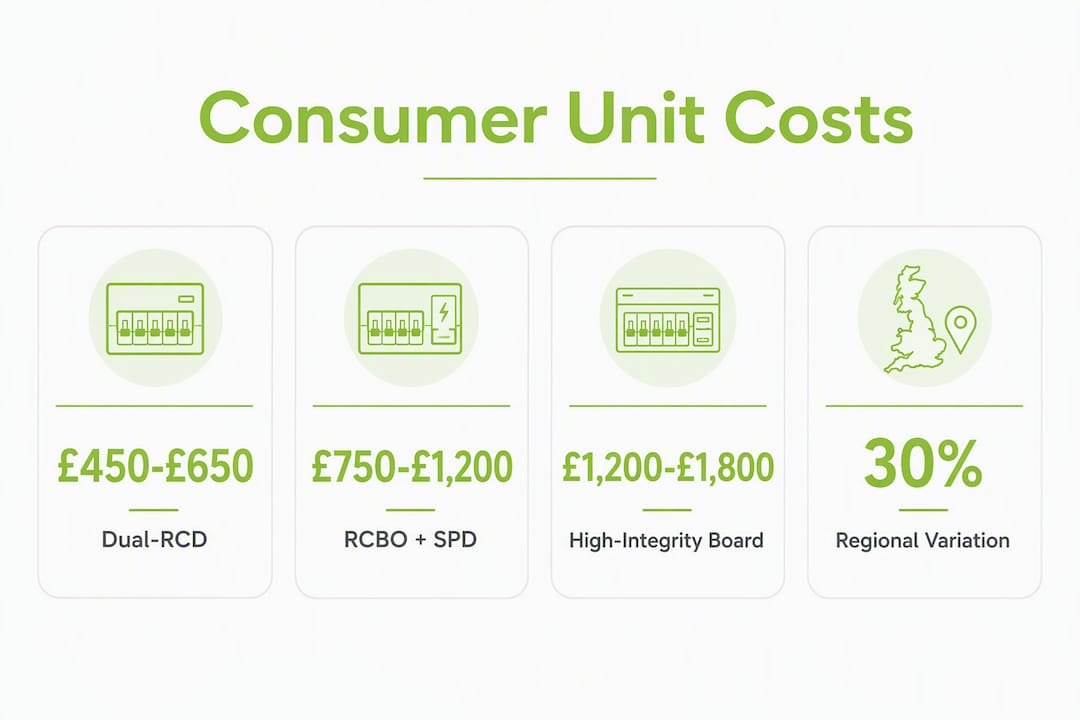
By property size, the picture looks roughly like this. A small flat or terraced house with six circuits typically lands at £450–£650. A 2–3 bed semi needing a 10-way RCBO board sits in the £750–£1,200 range. A four-bedroom detached with 12 or more circuits, an EV charger feed, and a surge protection device can easily reach £1,200–£1,800 before any remedial work.
Regional pricing varies, with London and the South East generally more expensive and other regions such as Midlands, Wales, Scotland, and the North East somewhat less expensive.
What are you actually paying for?
The headline price bundles several distinct costs. Breaking them apart makes it easier to spot a quote that is missing something.
| Cost element | Notes |
|---|---|
| Consumer unit (materials) | Range varies widely depending on unit type from basic metal units to high-integrity boards with SPD |
| Individual RCBOs (Type A) | Needed in quantities matching circuit count |
| SPD (surge protection device) | Typically included with fitting |
| Labour | Depends on job complexity and hours required |
| Circuit testing and EIC | Included in labour costs and mandatory |
| Part P notification | Included via competent person scheme membership |
A 10–12 way metal unit costs £93–£130 at trade prices. A pre-populated 14-way high-integrity board with SPD can reach £630–£940 at trade. That gap explains why two quotes for “a new consumer unit” can differ by several hundred pounds before a single hour of labour is added.
Pre-populated boards reduce onsite labour because the devices arrive factory-fitted. That said, the electrician still needs to terminate every circuit cable individually, label the board, and run a full test sequence, so labour savings are real but not dramatic.
On VAT: most domestic electrical work is subject to standard-rate VAT. Always confirm whether a quote is inclusive or exclusive of VAT before comparing figures. A quote that looks competitive at £800 ex-VAT is actually £960 once VAT is added.
Most electricians prefer to quote a fixed price for a consumer unit replacement rather than a day rate. The 2026 day rate for a qualified electrician sits at roughly £250–£400, but a fixed-price quote protects you if the job runs long.
What pushes the final bill higher?
The quote you receive before the electrician arrives is based on assumptions. Once the board comes off the wall, those assumptions get tested. Here are the most common extras and the typical cost of each.
- Earthing conductor upgrade: older properties often have undersized or deteriorated main earthing conductors. Upgrading to current standards typically costs £150–£400.
- Main bonding to metallic services: gas and water pipes must be bonded to earth. If bonding conductors are missing or undersized, expect to add £100–£300.
- Remedial wiring fixes: circuits that fail insulation resistance or earth loop impedance testing cannot be certified until the fault is corrected. Remedial wiring costs £100–£600+ depending on what is found.
- Moving the board: relocating the consumer unit a metre or two adds roughly £400; larger moves involving the incoming mains can reach £1,000–£2,000+.
- Meter tails: if the cables between the meter and the new board are too short or undersized, replacing them adds around £100–£200.
- Additional circuits: a new circuit for an EV charger, kitchen appliance, or outbuilding typically costs £150–£300 per circuit.
- Asbestos: if the board is mounted on an asbestos-containing board (common in properties built before 1985), specialist removal is required before work can begin. Get this scoped separately.
- DNO work: if the incoming supply needs upgrading, that is the Distribution Network Operator’s territory and is quoted and managed separately.
The single biggest on-site surprise is poor earthing or missing main bonding. These are safety-critical defects that cannot be left uncorrected, so they get fixed on the day whether they were in the original quote or not. The cost is usually modest in isolation, but it is the item most likely to catch a homeowner off guard.
Pro Tip: Ask any electrician quoting the job to state explicitly what happens if earthing or bonding is found to be deficient. A good quote lists these as conditional line items with a price range, not as a vague “additional work may be required” disclaimer.
Quotes that exclude remedial work are not necessarily dishonest, but they are incomplete. The risk is that a low headline price becomes a much higher final invoice. A fixed-price quote that names specific exclusions and gives a per-item rate for likely remedials is far more useful than a cheap number with no caveats.
Which type of consumer unit should you choose?
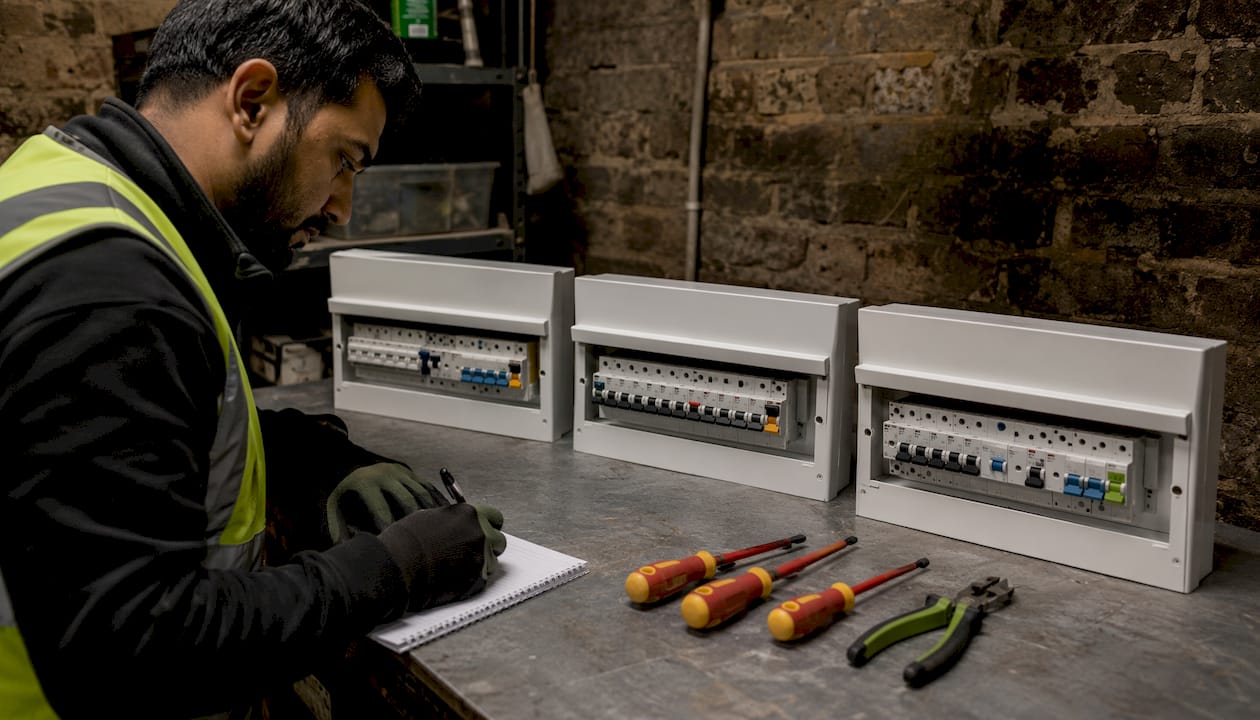
The protection technology inside the board matters as much as the enclosure itself. There are three meaningful choices for most domestic upgrades.
Split-load dual-RCD boards
The traditional split-load arrangement divides circuits into two groups, each protected by a single RCD. It is cheaper to buy and faster to fit. The downside is fault discrimination: a fault on one circuit trips the entire bank, cutting power to everything on that side of the board. For a small flat or a property with straightforward wiring, it remains a cost-effective option.
Full RCBO boards
An all-RCBO arrangement gives every circuit its own combined overcurrent and residual-current protection. A fault on the kitchen ring main trips only that circuit; everything else stays live. The price premium over a dual-RCD board is typically £200–£400, and for most homeowners it is money well spent. Homes with EV chargers, home offices, or extensive smart devices benefit most, because nuisance tripping on one circuit does not cascade into a wider outage.
SPDs and AFDDs
A surge protection device (SPD) guards sensitive electronics against voltage spikes from the grid or nearby lightning. The cost is £80–£150 including the dedicated MCB and fitting. With EV chargers and smart appliances now common in domestic properties, SPDs are increasingly specified as standard rather than optional.
Arc Fault Detection Devices (AFDDs) go further, detecting the electrical signature of arcing faults in wiring before they cause a fire. They are not yet mandatory for most domestic retrofits under BS 7671, but the IET Wiring Regulations do recommend them for higher-risk situations, including older properties with degraded wiring. AFDDs add meaningful cost per circuit and are most often specified in care homes, HMOs, and properties with known wiring concerns.
Pro Tip: Ask for Type A RCBOs and a metal enclosure as standard. Type A devices handle DC fault currents from EV chargers and certain smart appliances; older AC-only RCBOs cannot. Metal enclosures are required under current regulations and offer better fire containment than plastic.
How long does a consumer unit upgrade take?
The process runs in distinct stages, and knowing what happens at each one helps you plan the day.
- Pre-quote site visit (30–60 minutes): a competent electrician should visit before quoting to assess the existing board, earthing arrangement, and circuit condition. Any quote given without a site visit is based on assumptions.
- Booking and lead time: most domestic electricians book 1–3 weeks out for planned upgrades. Emergency slots exist but cost more.
- Day of work, isolation (15–30 minutes): the supply is isolated at the meter. Your power will be off for the majority of the working day.
- Removal and installation (2–4 hours): the old board comes off, the new unit goes in, and every circuit cable is terminated, labelled, and secured.
- Testing (1–2 hours): all circuits must be tested under BS 7671 before the board is energised. This includes insulation resistance, earth loop impedance, and RCD trip-time tests. Testing is not optional and must be included in the quoted price.
- Certification and paperwork (30–60 minutes): the Electrical Installation Certificate is completed and the Part P notification is submitted through the electrician’s competent person scheme.
A straightforward swap on a well-maintained property typically takes 4–8 hours in total. If remedial work is needed, the job may extend to a full day or require a return visit. Expect the power to be off for most of the working day regardless.
On the day, make sure the electrician has clear access to the meter cupboard, the consumer unit, and any ducting or trunking. Clearing the area beforehand saves time. Some making-good of plaster or paintwork around the board may be needed after the job, and this is typically not included in the electrical quote.
What are the legal requirements for a consumer unit replacement?
Consumer unit replacement is notifiable work under Part P of the Building Regulations in England and Wales. This is not a technicality. It means the work must either be carried out by a registered member of a competent person scheme (such as NICEIC or NAPIT), who self-certifies the work, or the homeowner must notify their local building control authority and pay for an inspection, which typically adds £200–£400 to the cost.
The governing technical standard is BS 7671, the IET Wiring Regulations. Every consumer unit replacement must comply with the current edition. This covers the type of protection devices used, the earthing arrangement, the enclosure material (metal is required), and the testing regime.
On completion, the electrician must issue an Electrical Installation Certificate (EIC). This is a mandatory document, not an optional extra. An EIC is different from a Minor Works Certificate, which is used for smaller additions to an existing circuit. If an electrician offers you a Minor Works Certificate for a full board replacement, that is wrong.
An EICR (Electrical Installation Condition Report) is a separate document used to assess the condition of an existing installation. It is not the same as an EIC. An EICR is recommended before a consumer unit upgrade if the wiring condition is unknown, and is a legal requirement for private rental properties in England every five years. If an EICR flags defects, those must be addressed before or during the upgrade.
Uncertified work carries real consequences. Home insurance policies typically exclude claims arising from uncertified electrical work. When selling a property, solicitors routinely request the EIC for any notifiable work carried out since 2005. Missing paperwork can delay or derail a sale. For NICEIC-approved contractors, self-certification is straightforward and included in the job cost.
How do you choose the right electrician?
The cheapest quote is rarely the right one. Here is what to check before committing.
Accreditation and insurance:
- Confirm NICEIC, NAPIT, or ELECSA membership. These are the recognised competent person schemes for Part P work. Membership can be verified on each scheme’s online register.
- Ask for evidence of employer’s liability and public liability insurance.
What a proper quote must include:
- The make and model of the consumer unit being fitted
- Number of ways and protection type (dual RCD, RCBO, AFDD)
- Whether an SPD is included
- Labour hours or a fixed price
- Circuit testing and EIC
- Part P notification
- A clear statement of what is excluded and how remedial items will be priced
Questions worth asking:
- Are the RCBOs Type A or AC-only?
- Is the enclosure metal?
- What happens if earthing or bonding is found to be deficient?
- Is the quote fixed, or will it change if the job takes longer?
- What is the workmanship warranty period?
A fixed-price quote that itemises every element is the standard you should expect. Day-rate quotes for a consumer unit replacement put all the risk on you if the job runs over.
Is it worth upgrading your consumer unit now?
Several trigger events make the case for upgrading immediately rather than deferring.
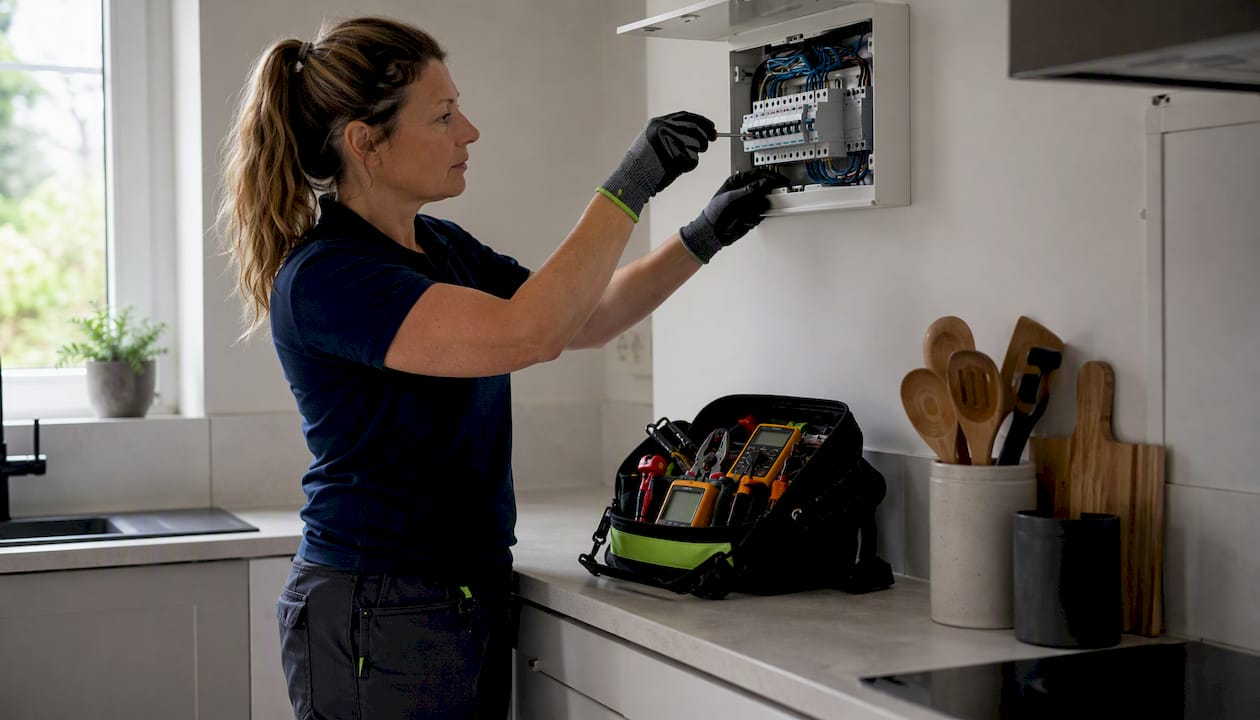
An older fuse board with rewirable fuses offers no RCD protection and no automatic disconnection in the event of a fault. That alone is a compelling safety argument. Modern consumer units with RCDs or RCBOs disconnect within milliseconds of detecting a fault current, which is the difference between a nuisance trip and a serious injury.
Beyond safety, the practical triggers are:
- Failed EICR: if an inspection has returned a C1 or C2 code relating to the board or its protection, upgrading is not optional.
- Selling or letting the property: buyers’ solicitors and letting agents increasingly flag outdated boards. Landlords in England are legally required to hold a satisfactory EICR for rental properties.
- EV charger installation: a dedicated circuit for an EV charger almost always requires a spare way on the board, adequate earthing, and often an SPD. If the existing board cannot accommodate this, an upgrade is the prerequisite. See EV charger installation requirements for the full picture.
- Frequent nuisance tripping: a dual-RCD board that trips an entire bank on a minor fault is a sign that the protection arrangement is not well matched to the circuits it serves.
A modern consumer unit fitted to current standards has a functional lifespan of 25–40 years. An older rewirable fuse board has no defined lifespan, but any board that predates the 17th Edition of the Wiring Regulations (2008) is likely to be non-compliant with current standards in at least some respects. If you are unsure whether your wiring would support a new board without remedial work, an EICR is the right starting point.
Real-world pricing: three sample job breakdowns
These are representative job breakdowns based on typical 2026 market pricing. They illustrate how the final invoice is built up in practice.
Job 1: Simple 10-way RCBO + SPD swap, 2-bed terraced house
Wiring in good condition, no remedial work required. Metal consumer unit with 8 Type A RCBOs, 2 MCBs, and a Type 2 SPD. Labour 5 hours.
| Line item | Cost |
|---|---|
| Labour (5 hours) | £350 |
| Testing and EIC | Included |
| Part P notification | Included |
| Total | £750 |
Job 2: Mid-complexity, 3-bed semi, bonding and earthing upgrade required
Board in poor condition, main bonding to gas and water missing, earthing conductor undersized. 12-way RCBO board with SPD.
| Line item | Cost |
|---|---|
| Testing and EIC | Included |
| Total | £1,200–£1,800 |
Job 3: High-spec 14-way board, 4-bed detached, EV charger circuit added
New 14-way high-integrity board with SPD, one additional circuit for EV charger, earthing upgrade. Wiring otherwise in good condition.
| Line item | Cost |
|---|---|
| SPD + MCB | £130 |
| Additional EV charger circuit | £250 |
| Earthing upgrade | £300 |
| Testing and EIC | Included |
| Total | £1,200–£1,800 |
Centralec-electrical carries NICEIC approval and has over 23 years of experience across domestic and commercial electrical work in the South West. All consumer unit upgrades are quoted on a fixed-price basis with full itemisation, Part P self-certification, and a workmanship guarantee included as standard.
Key takeaways
A consumer unit upgrade in the UK costs £450–£1,800 for most domestic properties in 2026, depending on board type, circuit count, and the condition of existing wiring.
| Point | Details |
|---|---|
| Budget by board type | Dual-RCD: £450–£650; RCBO + SPD: £750–£1,200; 14-way high-integrity: £1,200–£1,800. |
| Insist on a fixed, itemised quote | The quote must include the unit, labour, testing, EIC, and Part P notification as named line items. |
| Allow contingency for remedials | Earthing upgrades (£150–£400) and bonding (£100–£300) are the most common on-site additions. |
| Specify Type A RCBOs and SPD | Type A devices handle DC fault currents from EV chargers; SPDs protect sensitive electronics for £80–£150. |
| Centralec-electrical | Provides fixed-price consumer unit upgrades with NICEIC approval, EIC, and Part P self-certification in the South West. |
Regional pricing varies by up to 30%; London and the South East sit at the top of every range. Power is typically off for a large part of the working day on the day of the upgrade.
The part most homeowners get wrong
The most common mistake is treating the headline quote as the total cost. It rarely is, and the gap between the two is almost always earthing and bonding.
Most homeowners have never seen their earthing arrangement. Neither have most of the people quoting the job, because checking it properly takes time and requires the board to come off the wall. The result is that a significant proportion of consumer unit upgrades uncover deficiencies on the day that were not in the original price. That is not fraud. It is the predictable consequence of quoting a job without fully assessing the existing installation.
The fix is straightforward: ask every electrician quoting the job to inspect the earthing and bonding before they give you a number. A good electrician will do this as a matter of course. One who quotes from a photo of the board and a circuit count is giving you a best-case figure, not a realistic one.
There is also a tendency to focus on the board specification and overlook the testing. Testing is not a formality. It is the process that determines whether the existing wiring is safe to connect to the new board. If circuits fail, they must be corrected before the EIC can be issued. That is the law under BS 7671, and it is the reason a “straight swap” sometimes becomes a two-day job. Understanding this going in makes the conversation with your electrician much easier.
Centralec-electrical: fixed-price upgrades with full certification
If your consumer unit is overdue for replacement, or you are planning an EV charger installation and need to know whether your board can handle it, Centralec-electrical offers fixed-price consumer unit upgrades across the South West with no hidden costs.
Every job includes a pre-quote site visit to assess earthing and bonding, a fully itemised fixed-price quote, a metal consumer unit with Type A RCBOs and SPD where appropriate, full circuit testing, an Electrical Installation Certificate, and Part P self-certification through NICEIC. Workmanship is guaranteed. If you are planning an EV charger alongside the upgrade, the EV charger installation cost page covers what to budget for both together.
To request a fixed quote, contact Centralec-electrical directly. A site visit is the first step, and it costs nothing.
Useful sources and further reading
The following sources were used for price benchmarking, legal background, and technical standards in this guide.
- Elec-Mate: Consumer Unit Replacement Cost 2026 — primary source for 2026 market price ranges, material trade costs, labour benchmarks, and regional uplifts. Used throughout the cost sections.
- BookaBuilderUK: Consumer Unit Replacement Cost UK 2026 — used for remedial work cost ranges (earthing, bonding, wiring fixes).
- BookaBuilderUK: Fuse Box Replacement Cost 2026 — used for testing and certification requirements under BS 7671.
- Trade Skills 4U: Consumer Unit Considerations — used for Part P notifiability and the competent person requirement.
- Book Sparky: How Much Does a New Consumer Unit Cost? — corroboration for the common homeowner price band and regional notes.
- APMI: MCBs, RCDs, RCBOs and Consumer Units — technical background on Type A vs AC-only RCBOs and their relevance to EV chargers and modern appliances.
- EcoFlow Energy: Consumer Unit Replacement Cost (Practitioner Note) — practitioner guidance on earthing surprises and the EICR-style testing triggered by a board replacement.
- IET Wiring Regulations (BS 7671) — the governing technical standard for all electrical installation work in the UK, including consumer unit specifications, testing requirements, and SPD/AFDD recommendations.
- Part P of the Building Regulations — the statutory framework requiring consumer unit replacement to be notifiable work carried out by a competent person or notified to building control.