 Skip to content
Most UK electricians charge a daytime call-out fee within a typical range, with emergency or out-of-hours visits generally costing significantly more. That figure covers the electrician’s travel, the first 30–60 minutes of diagnostic time, and the cost of keeping a fully stocked vehicle on the road.
- What the fee usually covers: travel to your property, initial fault diagnosis, and the first portion of labour (often up to one hour). Parts and VAT are normally charged on top.
- Trust signal: look for NICEIC registration before booking. NICEIC-approved electricians are assessed against the BS 7671 wiring regulations and carry the scheme’s insurance-backed guarantee.
TL;DR: Budget £40–£120 for a standard daytime call-out, £100–£150+ for evenings, weekends, or genuine emergencies, and always ask for an itemised quote before the electrician arrives.
Table of Contents
- What does an electrician call-out fee actually cost in the UK?
- How do electricians actually charge for a visit?
- What pushes the price up or down?
- Is it legal to charge a call-out fee, and what are your rights?
- Questions to ask before you confirm a booking
- Typical costs for common small jobs
- When should you call an emergency electrician?
- How Centralec-electrical handles call-out fees and pricing
- Key takeaways
- Why call-out fees exist, and how to get fair value from a visit
- Centralec-electrical: transparent pricing for every call-out
- Useful sources
What does an electrician call-out fee actually cost in the UK?
The term “call-out fee” (sometimes called a call-out charge) refers to the fixed amount an electrician bills simply for attending your property, before any additional labour or parts are invoiced. It is distinct from the hourly rate that follows once the diagnostic phase is complete.
According to industry pricing data, typical daytime call-out fees generally fall within a common range for most of England and Wales, with London and the South East attracting a premium that increases the cost., partly because ONS earnings data shows consistently higher labour costs in those regions.
| Visit type | Typical call-out fee | Notes |
|---|---|---|
| Standard daytime (Mon–Fri, 8am–6pm) | typical range | Most common scenario |
| Evening / weekend | higher than standard daytime | Reflects availability premium |
| Emergency / out-of-hours | starting from a lower flat charge, rising sharply | Includes urgent visits |
| London / South East daytime | higher than average daytime | Regional labour premium applies |
Emergency call-out fees generally start from around £24 as a flat charge, though the total bill rises quickly once hourly rates and parts are added. The flat charge is simply the attendance fee; the hourly rate on top is where the real cost accumulates.
Regional variation is real but not dramatic outside London. A rural location in Devon or Somerset may add a small travel supplement if the electrician has to cover significant distance, but the base fee structure is broadly consistent across most of England.
How do electricians actually charge for a visit?
Three billing models dominate the domestic market, and knowing which one applies before you confirm a booking prevents most billing surprises.
Call-out fee plus hourly rate is the most common structure. You pay a fixed attendance charge, then an hourly rate for all labour beyond the initial diagnostic period. Average hourly rates for domestic work typically sit at £40–£60, with London and the South East at the higher end of that band.
First-hour minimum charge bundles the call-out and the first hour of labour into a single figure, usually £65–£120. Checkatrade’s cost guide notes that typical hourly ranges run £45–£60 for general domestic work, and many sole traders build this into a minimum charge rather than separating call-out and labour on the invoice.
Fixed price for small jobs is increasingly common for straightforward tasks such as fitting a single socket or replacing a light fitting. The electrician quotes a total price upfront, which absorbs the call-out cost. This works well when the scope is clear and the job is unlikely to reveal hidden faults.
A worked example of how costs stack up under the hourly model:
- Call-out fee: £65
- First hour of labour: included in call-out
- Second hour: £50
- Parts (e.g. replacement socket): £8
- Subtotal: £123
- VAT at 20%: £24.60
- Total: £147.60
VAT applies when the electrician is VAT-registered, which most established firms are once their turnover exceeds the registration threshold. Always ask upfront whether the quoted price is inclusive or exclusive of VAT.
Pro Tip: Fixed quotes make most sense for jobs with a clear scope. If the electrician cannot see the full extent of the problem before starting (a tripping circuit, for example), an hourly rate with a capped estimate is fairer to both parties.
For smaller jobs, the call-out fee can represent the largest single line on the invoice. Batching multiple small tasks into one visit is the most reliable way to reduce per-job cost, because the attendance charge is spread across several items rather than billed once per visit.
What pushes the price up or down?
Several factors influence the final bill beyond the base call-out charge.
- Time of day and urgency. Evening, weekend, and night visits commonly attract a 1.5x–2x uplift on the standard rate. A job that costs £120 on a Tuesday afternoon could cost £180–£240 on a Saturday night.
- Regulatory and certification work. Certain domestic electrical jobs fall under Part P of the Building Regulations, requiring the electrician to self-certify or notify the local authority. NICEIC-registered electricians can self-certify, but the administrative cost is sometimes reflected in the quote.
- Regional labour market. The ONS Annual Survey of Hours and Earnings consistently shows higher wages in London and the South East, which feeds directly into electrician salary benchmarks and, by extension, the rates tradespeople charge in those areas.
Is it legal to charge a call-out fee, and what are your rights?
Yes, call-out fees are entirely legal in the UK. There is no legislation that prohibits them, and they are an established industry standard. They cover the real costs of attending your property: fuel, vehicle wear, the electrician’s time in transit, and the opportunity cost of holding availability.
Your consumer rights under the Consumer Rights Act 2015 and the Consumer Contracts Regulations 2013 give you clear protections:
- Call-out fee deduction — Many electricians will offset the call-out fee against the final invoice if you proceed with the repair on the same visit. Ask about this before booking.
If you believe you have been charged unfairly or misled about pricing, the Citizens Advice consumer helpline and your local Trading Standards office are the appropriate first contacts. For disputes about certification or workmanship on notifiable work, the relevant third-party certification scheme (such as NICEIC) has a complaints process.
Questions to ask before you confirm a booking
A two-minute phone call with the right questions prevents most billing disputes. Use this checklist when you ring.
Essential pricing questions:
- What is your call-out fee, and does it include the first hour of labour?
- What is your hourly rate after the first hour?
- Are your prices inclusive or exclusive of VAT?
- How do you charge for parts: trade cost, trade plus a percentage, or a fixed markup?
- Will the call-out fee be deducted from the final invoice if I proceed with the repair?
- Do you charge a travel supplement for my postcode?
Credentials and insurance:
- Are you NICEIC-registered or approved by another recognised scheme (NAPIT, ELECSA)?
- Can you provide your registration number so I can verify it online?
- Do you carry public liability insurance, and what is the cover level?
- Will you issue a completion certificate for notifiable work under Part P?
Red flags to watch for:
- Refusal to give any price estimate before attending
- No registration with a recognised scheme
- Vague invoices with no labour/parts breakdown
- Unusually low flat rates with no explanation (often a sign of unlicensed work or hidden upselling)
- High-pressure insistence on starting work immediately without a written quote
Pro Tip: Ask for the call-out fee in writing before the visit, even a text message or email confirmation. It takes 30 seconds and removes any ambiguity about what you agreed to pay.
Typical costs for common small jobs
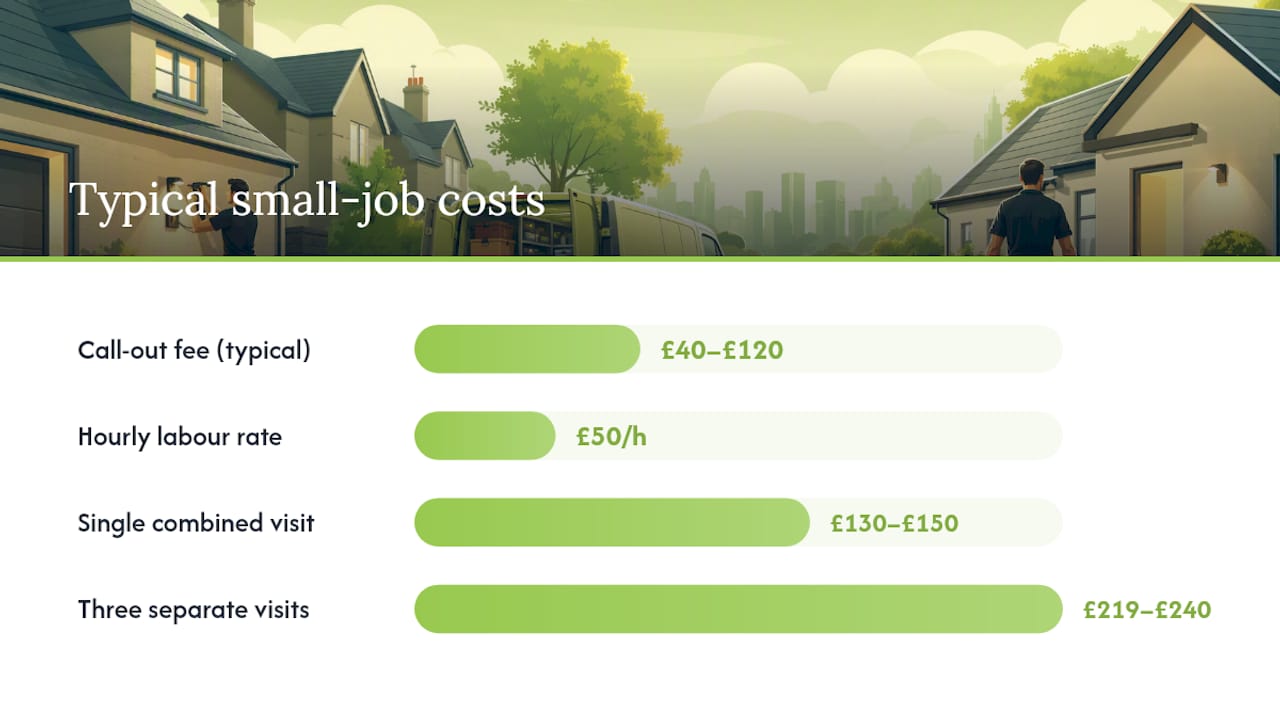
The table below shows realistic total costs for three common scenarios, using a call-out fee typically between £40 and £120 (inclusive of the first hour), a £50 hourly rate thereafter, and standard parts costs. All figures exclude VAT.
| Job | Call-out / first hour | Additional labour | Parts estimate | Total (ex. VAT) |
|---|---|---|---|---|
| Replace a single socket | typical call-out fee | — | small parts cost | overall cost estimate |
| Replace a light fitting | typical call-out fee | — | small parts cost | overall cost estimate |
| Diagnose and reset a tripped RCD | typical call-out fee | charge for extra time | — | overall cost estimate |
| Replace a fused spur | typical call-out fee | — | small parts cost | overall cost estimate |
A few points on these figures. The call-out fee absorbs the first hour, so short jobs that complete within that window cost the same as the attendance charge plus parts. Jobs that run over an hour attract the additional hourly rate pro-rated to 30-minute increments with most electricians.
The batching principle matters here. If you have a broken socket, a faulty light fitting, and a spur to replace, booking all three in one visit means paying the call-out fee once rather than three times. That single visit might total £130–£150 instead of £219–£240 for three separate bookings.
When should you call an emergency electrician?
Some faults genuinely cannot wait until Monday morning. Others can, and calling an emergency service unnecessarily is an expensive mistake.
Call an emergency electrician immediately if you have:
- A burning smell from a socket, consumer unit, or wiring
- Visible scorching, melting, or discolouration around outlets or switches
- Exposed live conductors or damaged cables
- Complete loss of power with no obvious cause (not just a tripped breaker)
- Sparking from a socket or appliance connection point
- Water ingress near electrical fittings or a flooded consumer unit
For guidance on who to call for electrical emergency help and a fuller list of reasons to call emergency maintenance, Centralec-electrical has practical consumer pages covering both.
What to expect on cost: out-of-hours rates commonly run at 1.5x–2x the standard rate, so a £65 daytime call-out becomes £97–£130 at 10pm on a Sunday. The hourly rate follows the same multiplier. Budget £150–£250 as a realistic minimum for a genuine out-of-hours emergency visit once labour and parts are included.
Pro Tip: While waiting for the electrician, switch off the affected circuit at the consumer unit if it is safe to do so. Do not attempt to investigate exposed wiring yourself. If there is any risk of fire, evacuate and call 999 before calling an electrician.
How Centralec-electrical handles call-out fees and pricing
Centralec-electrical operates on a transparent, itemised pricing model. The call-out fee is stated upfront before any visit is confirmed, and where the call-out is followed by repair work on the same visit, the fee is offset against the final invoice rather than charged as a separate addition.
Key trust signals:
- NICEIC-approved — electricians, assessed against BS 7671 and able to self-certify notifiable domestic work under Part P
For a local electrical installation service or to check coverage in your area, Centralec-electrical’s service pages set out the full scope of domestic and commercial work available.
Key takeaways
Standard daytime electrician call-out fees in the UK typically fall within a common range, with emergency and out-of-hours visits commonly costing significantly more; the call-out fee should always be confirmed in writing before the electrician attends.
| Point | Details |
|---|---|
| Typical daytime range | Standard call-out fees run £40–£120; London and the South East sit at the higher end. |
| Emergency premium | Out-of-hours visits commonly cost 1.5x–2x the standard rate, pushing totals to £100–£150+. |
| Batch your jobs | Combining multiple small tasks in one visit spreads the call-out fee and cuts per-job cost. |
| Always ask upfront | Confirm the call-out fee, hourly rate, VAT status, and parts policy before the electrician attends. |
| Centralec-electrical | NICEIC-approved, 24/7 availability, transparent itemised pricing, and call-out fee offset on same-visit repairs. |
Why call-out fees exist, and how to get fair value from a visit
The economics behind a call-out fee are straightforward once you see them from the trade’s side. An electrician’s van is effectively a mobile workshop: stocked with cable, connectors, testers, and safety equipment. Keeping that vehicle on the road, insured, and ready to respond costs money every day, whether or not a job comes in. Add fuel, the time spent driving, and the fact that accepting a booking means turning down another, and a minimum attendance charge is not a profit grab. It is a cost-recovery mechanism.
Where homeowners lose money is in booking single small jobs on separate days. The call-out fee is fixed regardless of whether the job takes 20 minutes or two hours, so a £65 charge on a £8 socket repair is painful. The fix is simple: keep a short list of minor electrical tasks and book them together. Flexible scheduling helps too. If your fault is not urgent, booking a mid-week morning slot often attracts the standard rate rather than an evening or weekend premium.
One practical note: if an electrician quotes a very low flat rate with no call-out fee mentioned, ask explicitly how parts and additional labour are charged. The call-out fee sometimes reappears as a “diagnostic charge” or “minimum labour” line once the job is underway.
Centralec-electrical: transparent pricing for every call-out
If you are weighing up whether to book an emergency visit or plan a batch of smaller jobs, Centralec-electrical gives you a straight answer on cost before anyone leaves the depot. No vague estimates, no surprise lines on the invoice. NICEIC-approved electricians, 23 years of domestic and commercial experience, and a 24/7 emergency service that covers the South West with clear out-of-hours rates.

For planned work, from domestic electrical services to full rewires and EV charger installations, the same transparent approach applies: itemised quotes, no hidden costs, and a satisfaction guarantee on every completed job. Get in touch with Centralec-electrical to confirm your call-out fee and book a visit.
Useful sources
- How Much Does an Electrician Cost in the UK? (2026) | What’s The Damage
- Electrician Day Rates in the UK 2026
- Electrician rates per hour UK 2026 | Elec‑Mate
- Electrician call‑out fee | MyBuilder
- Electrician hourly rate | Checkatrade cost guide
- What UK tradespeople charge for emergency callouts in 2026 | Optqo
- Annual Survey of Hours and Earnings (ONS) 2025
- Third‑party certification schemes for domestic electrical work | GOV.UK