 Skip to content
Nobody checks their wiring until it stops working. That’s the problem.
A breaker won’t reset. A switch crackles when you flick it on. There’s a faint burning-plastic smell near the kitchen socket you never think about. These are the faults you notice. The ones that actually hurt people usually give no warning at all — a copper connection works loose behind the plaster over a decade of the house heating up and cooling down each winter, the insulation on a cable dries out and starts flaking apart in the loft, an old fuse in the consumer unit seizes and just doesn’t trip when it’s supposed to.
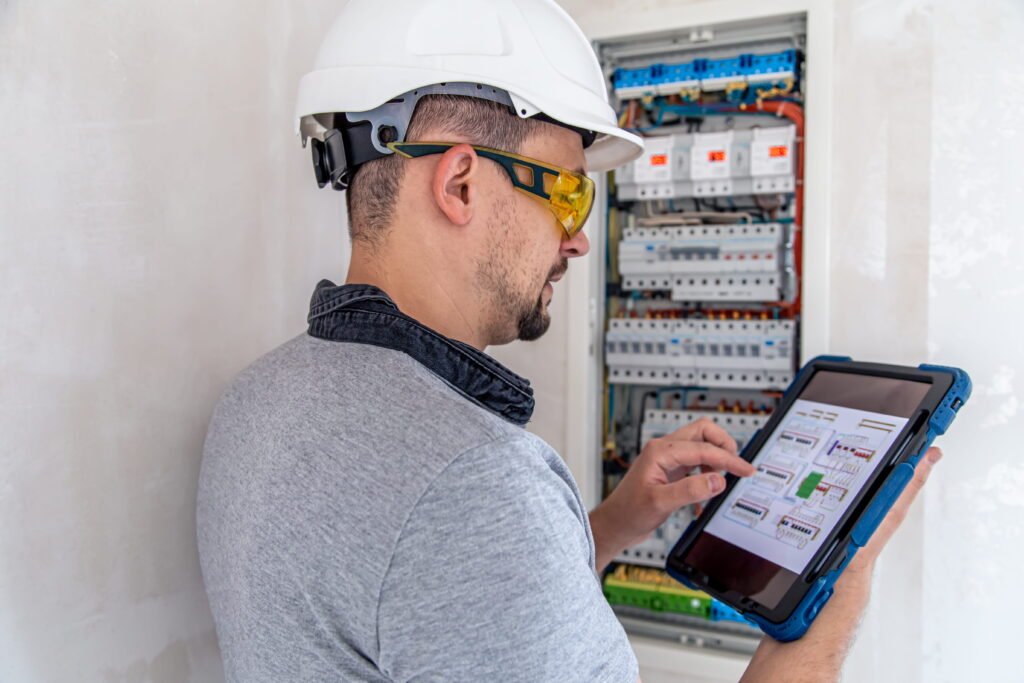
That’s what an EICR is for. An engineer opens up the consumer unit, tests every circuit, and tells you what’s actually going on inside the walls — before it becomes a shock, or worse, a fire. Centralec Electrical’s NICEIC-approved engineers do exactly this for homeowners, landlords, and commercial premises right across the South West.
Here’s what an EICR actually covers, what the law requires, what it costs, and why it matters even if nobody’s forcing you to get one.
What Is an EICR Certificate?
An Electrical Installation Condition Report is a formal inspection and testing procedure carried out on a property’s fixed wiring. It checks every cable, switch, socket, and piece of distribution equipment against BS 7671 — the 18th Edition of the IET Wiring Regulations, the national standard for electrical safety.
During the inspection, the engineer tests:
- The main earthing conductor and bonding connections, to confirm they’re adequate.
- The service head, meter tails, and distribution equipment.
- Insulation resistance, to catch cable breakdown before it becomes visible.
- Earth fault loop impedance, which confirms protective devices will disconnect fast enough in a short circuit.
- RCDs and RCBOs, timed to check they trip at the right speed and sensitivity.
- Signs of overloaded circuits, unauthorised DIY work, or visible damage.
Once testing’s done, the engineer issues a digital certificate. The system is rated either Satisfactory or Unsatisfactory — there’s no middle ground.
Landlord Electrical Safety Requirements: The Legal Mandate
Under the Electrical Safety Standards in the Private Rented Sector (England) Regulations 2020, private landlords have to get their electrical installations inspected and tested by a qualified person at least every 5 years. That’s not a recommendation. It’s law.
Landlords must:
- Get an EICR from an approved, certified contractor before a new tenancy starts.
- Give incoming tenants a copy before they move in, and give existing tenants a copy within 28 days of the inspection.
- Hand a copy to the local housing authority within 7 days if asked.
- Fix any C1 or C2 defects within 28 days, or sooner if the report says so.
Councils do enforce this. A landlord who doesn’t comply can be fined up to £30,000 per breach, face a rent repayment order, and find their landlord insurance void the moment a claim comes in. In busy rental markets like Bristol, and in smaller towns like Yeovil, council housing teams are watching for exactly this kind of non-compliance.
Why Homeowners Need EICR Testing (Even Without Legal Compulsion)
The 2020 Regulations only bind landlords. If you own and live in your own home, no one is legally required to make you get an EICR. That doesn’t mean the risk disappears — it just means nobody’s checking on your behalf.
Here’s why owner-occupiers should still book one every 5 to 10 years.
1. Electrical Fire Prevention
Electrical distribution faults cause thousands of accidental house fires in the UK every year. Overloaded circuits, degraded rubber-insulated wiring from the 1960s, and loose high-resistance connections all generate heat inside timber-framed walls and lofts — heat that builds for months before anyone smells smoke. An EICR catches that heat buildup while it’s still just a number on a test meter.
2. Guarding Against Lethal Electric Shocks
If an earthing conductor got disconnected during a past renovation, metal appliance casings, radiators, and light fittings can become live during a fault and stay that way. Without a working path to ground and functioning RCD protection, the next person to touch that appliance becomes the path to earth instead.
3. Handling Modern Power Loads
Homes built decades ago in places like Wells were wired for a different kind of household — a kettle, a few lamps, maybe an electric fire. Today’s homes run induction hobs, electric showers, heat pumps, and EV chargers, often all at once. If your consumer unit still runs on rewirable fuses, an inspection paired with a consumer unit upgrade or full rewire brings the property up to 18th Edition standards.
4. Smooth Property Sales & Buyer Confidence
Solicitors and mortgage lenders often ask for a recent EICR before they’ll sign off on a sale. Having a current, Satisfactory certificate in hand removes a common source of last-minute renegotiation and shows the buyer the property’s actually been looked after.
What Happens During a Domestic Electrical Inspection?
An EICR needs calibrated test equipment and takes real time — for a typical 3-to-4-bedroom home, budget 2 to 4 hours.
Visual survey: the engineer traces accessible cabling, checks socket faces for scorch marks, and inspects the consumer unit enclosure.
Dead testing (power off):
- Continuity testing, to confirm protective bonding conductors aren’t broken.
- Insulation resistance testing, using an injected test voltage to check cable insulation is intact.
- Polarity testing, to check switches and fuses are wired the right way round.
Live testing (power back on):
- Earth fault loop impedance (Zs) — measuring total resistance in the fault loop.
- RCD/RCBO trip testing — timing the safety switches in milliseconds.
Report compilation: every test result gets logged with a classification code.
If the engineer finds something dangerous mid-inspection, Centralec can send someone out for 24/7 emergency repairs and fault-finding to make the installation safe there and then.
Decoding EICR Condition Codes: C1, C2, C3, and FI
| Code | Classification | Action Required | Result on Report |
|---|---|---|---|
| C1 | Danger Present | Immediate corrective action required | Unsatisfactory |
| C2 | Potentially Dangerous | Urgent remedial action required | Unsatisfactory |
| C3 | Improvement Recommended | Safe for continued use, but below current standards | Satisfactory |
| FI | Further Investigation | Safety can’t be confirmed without deeper investigation | Unsatisfactory |
How Much Does an EICR Cost in the UK?
Price mainly comes down to two things: the size of the property and how many circuits it has.
| Property Type | Typical Circuits | Estimated Inspection Cost |
|---|---|---|
| 1–2 Bedroom Flat | 4–6 | £120 – £180 + VAT |
| 2–3 Bedroom Semi-Detached | 6–10 | £160 – £260 + VAT |
| 4–5 Bedroom Detached Home | 10–16 | £240 – £380 + VAT |
| Large Rural Properties | 16+ | Bespoke Quote |
When Should You Book an EICR?
- Every 5 years — rental properties, HMOs, and commercial buildings.
- Every 10 years — private, owner-occupied homes.
- Before buying a home — to avoid inheriting hidden faults.
- After a flood or a fire nearby — even a small one.
- The moment you notice something’s off — fuses tripping repeatedly, lights flickering for no obvious reason.
Choosing an Accredited Local Electrician in the South West
At Centralec Electrical, our certified, insured electricians cover Somerset and Bristol, including:
- Bridgwater — rapid response across Sedgemoor and North Petherton.
- Taunton — domestic rewires and landlord testing across Taunton Deane.
- Bristol — HMO licensing checks in Clifton, Redland, and Central Bristol.
- Weston-super-Mare — coastal residential testing and guest house maintenance.
- Yeovil — industrial power and residential EICRs across South Somerset.
- Wells — heritage property rewiring in the Mendip area.
- Burnham-on-Sea — holiday park hookup compliance and weatherproof installations.
Frequently Asked Questions
Will my electricity be turned off during the EICR inspection? Yes. Power goes off in stages, usually for 1 to 2 hours, so the engineer can run the dead tests safely.
What happens if my property fails its EICR? You’ll get an itemised list of what needs fixing. Once the work’s done, we issue a confirmation certificate.
Is an EICR required by home insurance providers? Most policies require the building to be kept in a safe condition. A Satisfactory EICR is your proof of that if you ever need to make a claim.
How quickly do I get my certificate? Within 24 to 48 hours of the inspection, as an official digital PDF.
Book Your Certified EICR Inspection Today
Whether you need a 5-year landlord certificate or just peace of mind for your own home, Centralec Electrical handles the testing properly, start to finish — and if the inspection turns up work that needs doing, our full range of electrical services covers the fix too.
📞 Freephone: 0800 772 0666 🌐 Website: https://centralec-electrical.co.uk/ ⚡ Direct Booking: Request an EICR Inspection Online