 Skip to content

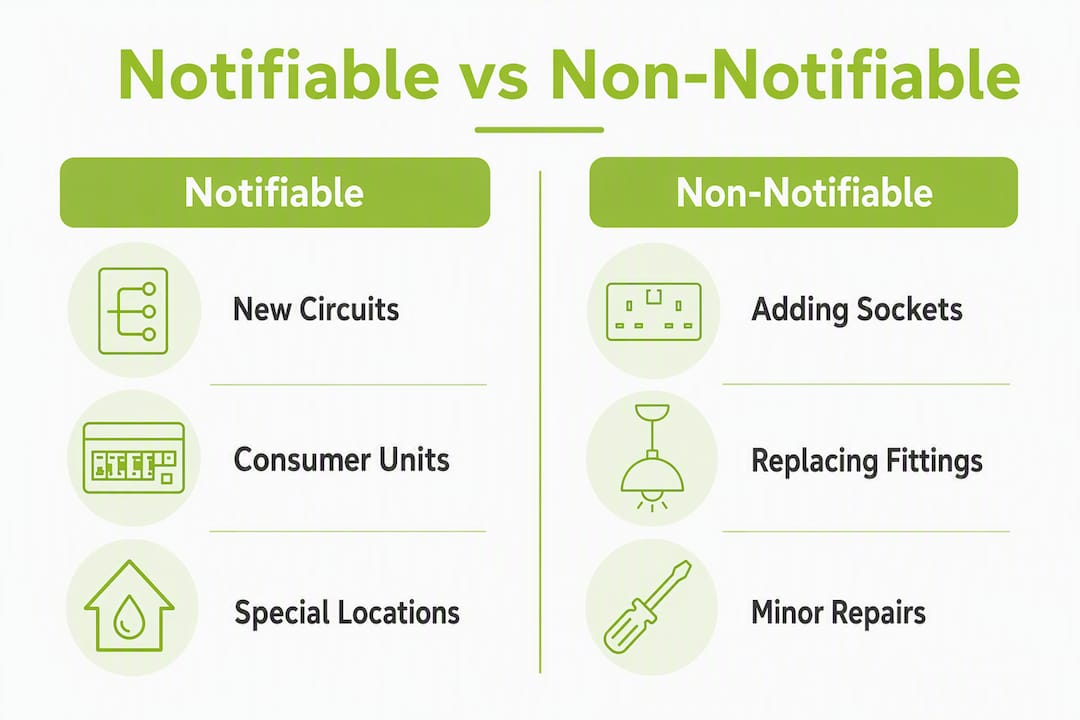
Three types of domestic electrical work trigger a Part P notification in England and Wales: installing a new circuit, replacing a consumer unit, and making additions or alterations to existing circuits in a special location (bathrooms, shower rooms, swimming pools, and saunas). If your job falls into any of these categories, you have two options: hire an electrician registered with a Competent Person Scheme such as NICEIC or NAPIT, who can self-certify the work, or notify your Local Authority Building Control before work starts.
- New circuit installation (including a new circuit for an EV charger, outbuilding, or kitchen) — notifiable
- Consumer unit replacement — notifiable
- Additions or alterations in a special location (bathroom, shower room, swimming pool, sauna) — notifiable
- Like-for-like socket or light fitting replacements outside special locations — not notifiable, but must still meet BS 7671
Pro Tip: Adding a socket to an existing ring circuit in a lounge is usually not notifiable. The moment that same job is in a bathroom or shower room, it is. Location changes everything.
Table of Contents
- What Part P actually is and why it carries legal weight
- Which jobs are formally notifiable under Part P?
- Common jobs: notifiable or not?
- How to comply: self-certify or notify building control?
- England versus Wales: the 2013 changes still matter
- Who is responsible and what happens if work is not notified?
- How to find and verify a registered electrician
- The certificates you should receive and keep
- Typical costs and timelines for notifiable work
- How Centralec-electrical handles Part P compliance for you
- Key takeaways
- A working electrician’s honest view on Part P
- Authoritative sources and further reading
- Get your Part P compliance sorted without the guesswork
What Part P actually is and why it carries legal weight
Part P is the section of the Building Regulations for England and Wales that covers electrical safety in and around dwellings. Its purpose is straightforward: protect people from fire and electric shock caused by faulty electrical installations. Approved Document P is the statutory guidance document that explains when notification is required and how compliance is demonstrated.
Compliance is almost always shown by following BS 7671, the IET Wiring Regulations, which sets the technical standard for electrical installations in the UK. Meeting BS 7671 does not automatically mean you have complied with Part P, but it is the recognised route to showing you have.
“All electrical installation work should be inspected and tested in accordance with BS 7671 and installers should give the appropriate electrical certificate to the person ordering the work and notify the building control body or provide the compliance certificate within 30 days.”
— Approved Document P, GOV.UK
Three routes exist to demonstrate compliance:
- Self-certification by a registered Competent Person (the most common route)
- Third-party certification by an approved inspector
- Notification to a Building Control body before work starts, followed by inspection
The duty to comply rests with the person carrying out the work. Competent Person Schemes reduce the administrative burden but do not remove the legal obligation for the work itself to meet the technical standard.
Which jobs are formally notifiable under Part P?
Regulation 12(6A) defines notifiable work precisely. There are three categories:
What counts as a special location?
A special location is defined by proximity to water or heat sources that increase the risk of electric shock:
- Bathroom or shower room — zones are measured from the bath or shower head. Zone 0 is inside the bath or shower tray; Zone 1 is directly above; Zone 2 extends 600mm beyond the bath or shower. Any electrical work within these zones, or that alters a circuit serving them, is notifiable.
Pro Tip: Fixed equipment connected via a 13A plug can still fall within the scope of Part P if it involves fixed wiring or alters a circuit. The fact that something plugs in does not automatically exempt it from the regulations.
Common jobs: notifiable or not?
Here is a plain-language guide to typical domestic jobs. These are general indicators; always confirm with a registered electrician if you are unsure.
- Replacing a consumer unit — Yes, notifiable. One of the three statutory triggers.
- Installing a new circuit for an EV charger — Yes, notifiable. A new circuit is always notifiable. See EV charger installation certification for how this interacts with Part P specifically.
- Full house rewire — Yes, notifiable. Involves multiple new circuits throughout the property.
- Adding a socket to an existing circuit in a lounge or bedroom — Usually no in England (post-2013 rules). Still must comply with BS 7671.
- Installing a new light fitting in a living room — No, provided it is a like-for-like replacement or addition to an existing circuit outside a special location.
- Installing a shaver socket or extractor fan in a bathroom — Yes, notifiable. Any addition or alteration to a circuit in a bathroom is notifiable.
- Adding a socket in a kitchen — No in England (post-2013). Possibly yes in Wales, where kitchen alterations may still be notifiable.
- Installing outdoor sockets or lighting on an existing circuit — No in England. Possibly yes in Wales.
- Installing a new shower unit requiring a new dedicated circuit — Yes, notifiable. New circuit plus special location.
- Replacing a like-for-like light switch — No, not notifiable anywhere.
Regardless of whether work is notifiable, every installation must be safe and meet BS 7671. Non-notifiable does not mean unregulated.

How to comply: self-certify or notify building control?
You have two clear routes. The first is almost always faster and cheaper.
Route 1: Hire a Competent Person (self-certification)
- Find an electrician registered with a recognised Competent Person Scheme such as NICEIC, NAPIT, or TrustMark.
- The electrician carries out and tests the work to BS 7671.
- They self-certify the work and notify the relevant authority on your behalf, usually within 30 days of completion.
- You receive an Electrical Installation Certificate and a Building Regulations compliance certificate.
This route typically means no separate building control fee and no inspector visit to arrange.
Route 2: Notify Local Authority Building Control yourself
- Contact your local council’s building control department before work starts.
- Submit a Building Notice or Full Plans application.
- An inspector visits to check the work meets the regulations.
- If satisfied, they issue a completion certificate.
This route costs more and takes longer. Where a homeowner or unregistered installer performs notifiable work, they must notify Building Control before work starts; the inspector will visit and issue a completion certificate if the work meets the regulations.
Before you hire, ask these questions:
- Are you registered with NICEIC, NAPIT, or another Competent Person Scheme? Can I see your registration number?
- Will you self-certify this work and provide an Electrical Installation Certificate?
- Are you fully insured for this type of work?
- Do you offer an insurance-backed guarantee?
- What is the expected timeline from start to certificate?
England versus Wales: the 2013 changes still matter
The rules diverged in 2013 and the gap is still significant.
- England narrowed the scope of notifiable work in 2013. Kitchen circuit alterations and outdoor circuit changes that were previously notifiable are generally no longer notifiable in England, provided they do not involve a new circuit or a special location.
- Wales retains the broader pre-2013 list. Kitchen and outdoor circuit alterations may still be notifiable in Wales. If you are in Wales and adding sockets in a kitchen or extending an outdoor circuit, treat the work as potentially notifiable until you have confirmed otherwise.
The IET guidance on Part P explains the jurisdictional differences clearly. The 2013 changes were designed to focus enforcement on the highest-risk work: new circuits, consumer unit changes, and special locations. The intent was proportionate regulation, not a relaxation of safety standards.
“England narrowed the scope of notifiable work in 2013; Wales retains a broader list that can include kitchen and outdoor circuit alterations which are not notifiable in England.”
— IET guidance on BS 7671 and Building Regulations
Pro Tip: When in doubt, treat the job as notifiable. The cost of hiring a registered competent person is almost always less than the cost of enforcement action or remedial work ordered by Building Control.
Who is responsible and what happens if work is not notified?
Legal responsibility sits with the person carrying out the work. If that is a homeowner doing their own electrical work, the responsibility is theirs. If it is a contractor, the contractor carries primary responsibility, but the building owner can also face consequences.
What Building Control can do:
- Require remedial work at the homeowner’s expense
- Issue enforcement notices
- In serious cases, pursue criminal liability under the Building Regulations
If notifiable work is carried out without notification, the homeowner or installer can face enforcement action and may have to pay inspection and remedial costs. Building Control can also inspect non-notifiable work if it appears unsafe.
“Building Control departments remind homeowners that non-notifiable work is still covered by Building Regulations and can be subject to enforcement if found unsafe — so correct certification and testing remain essential regardless of notification status.”
— Building Control Partnership
The property sale and insurance risk is real. Homeowners and landlords are legally responsible for proving compliance when selling or letting a property. Missing certificates can delay transactions and affect insurance cover. Solicitors routinely ask for electrical certificates during conveyancing, and an absence of paperwork for notifiable work is a red flag that can stall or kill a sale.
Landlords have additional obligations. An Electrical Installation Condition Report is required every five years for rental properties in England, and any notifiable work carried out during a tenancy must be properly certified.
How to find and verify a registered electrician
The fastest check is the public register. NICEIC, NAPIT, and TrustMark all maintain searchable online databases of registered contractors. A few minutes on those sites before you book can save significant trouble later.
Verification checklist:
- Ask for the electrician’s scheme membership and registration number before agreeing to any work.
- Cross-check the registration number on the scheme’s public register (NICEIC, NAPIT, or TrustMark websites).
- Confirm they carry public liability insurance and that it covers the type of work you need.
- Ask whether they will self-certify and provide an Electrical Installation Certificate on completion.
- Request examples of previous similar work and ask for a sample certificate if you have not used them before.
Centralec-electrical is NICEIC approved, which means every job is carried out to the standard required for self-certification under Part P.
Questions to ask at quote stage:
- Will this work be notifiable, and which route will you use to certify it?
- What certificates will I receive, and when?
- Is an insurance-backed guarantee available?
- What is the expected timeline from start to paperwork?
The certificates you should receive and keep
Every piece of notifiable work should generate paperwork. Keep all of it indefinitely and pass it to new owners or tenants.
- Electrical Installation Certificate (EIC) — issued for all new installations, new circuits, and consumer unit replacements. Confirms the work has been inspected and tested to BS 7671.
- EICR (Electrical Installation Condition Report) — required every five years for rental properties in England. Landlords should also obtain one after significant electrical work. See the landlord electrical compliance guide for the full picture.
If certificates are missing after work has been completed, contact the installer first. If they are registered with a scheme, the scheme body may hold a copy. As a last resort, you can commission a new EICR to assess the current condition of the installation, though this does not retrospectively certify the original work.
Typical costs and timelines for notifiable work
Costs vary by job type, location, and whether you use a Competent Person or notify Building Control directly.
- Building Control inspection fee (where self-certification is not used): commonly £200–£300, though amounts vary between local authorities. Using a registered competent person typically avoids this fee entirely.
- Consumer unit replacement: prices vary by property size and the number of circuits; get at least two written quotes. See rewire vs consumer unit upgrade for a cost comparison.
- New circuit installation: cost depends on cable run length, access, and the type of circuit. An EV charger circuit is a common example.
- EICR: costs vary by property size and the number of circuits tested.
Timeline expectations:
- A Competent Person must notify the relevant authority within 30 days of completing the work.
- Building Control inspections, when required, typically need to be scheduled in advance; allow at least a few days’ notice before work starts.
- Certificate turnaround from a scheme-registered electrician is usually within a few weeks of job completion.
Always confirm in writing who is responsible for paying any building control fees before work begins.
How Centralec-electrical handles Part P compliance for you
Centralec-electrical is an NICEIC-approved electrical contractor based in the South West, with many years of experience carrying out notifiable domestic electrical work. Every job is carried out by a fully insured, scheme-registered electrician who can self-certify under Part P, so you avoid separate building control fees and inspections.
Services directly relevant to Part P compliance include:
- Consumer unit replacements and upgrades
- New circuit installations (including EV charger installation requirements)
- Full house rewires
- Bathroom and special location electrical work
- EICR inspections for landlords and property sales
- Building Regulations compliance certificates issued on completion

Pricing is fixed and upfront with no hidden costs, and a satisfaction guarantee applies to all completed work. To get a quote or confirm whether your job is notifiable, contact Centralec-electrical directly through the website.
Key takeaways
Part P notification is legally required for new circuits, consumer unit replacements, and any electrical work in special locations such as bathrooms; the simplest route to compliance is hiring an NICEIC or NAPIT-registered electrician who self-certifies on your behalf.
| Point | Details |
|---|---|
| Three notifiable job types | New circuits, consumer unit replacements, and additions in special locations (bathrooms, pools, saunas) always require notification. |
| Self-certification is the faster route | A Competent Person Scheme member (NICEIC, NAPIT, TrustMark) notifies on your behalf and typically avoids a separate building control fee. |
| England and Wales differ | Wales retains broader notifiability for kitchen and outdoor circuits; England narrowed the scope in 2013. |
| Keep all certificates indefinitely | EIC, MEIWC, Building Regulations compliance certificate, and EICR are required for property sales, lettings, and insurance claims. |
| Centralec-electrical | NICEIC-approved, South West-based, experienced self-certifying notifiable domestic work and issuing all required certificates. |
A working electrician’s honest view on Part P
The paperwork side of Part P gets a bad reputation, usually from people who have had to chase certificates after the fact. The process itself is not complicated when a registered electrician handles it from the start. The problems almost always trace back to one of two situations: a homeowner who hired someone cheap and unregistered, or a DIYer who did not realise the job was notifiable until they tried to sell the house.
What I see on site more than anything else is the consumer unit replacement that was done without notification. It looks fine. It might even be wired correctly. But there is no certificate, no record of inspection, and no way to prove to a buyer’s solicitor that the work was ever checked. At that point, the options are expensive: commission a full EICR, potentially open up walls, and hope the work passes. Sometimes it does not.
The England versus Wales distinction catches people out too. A landlord with properties on both sides of the border sometimes assumes the same rules apply everywhere. They do not. If you are in Wales and you have had kitchen or outdoor circuit work done since 2013 without checking whether it was notifiable under Welsh rules, it is worth reviewing.
One practical check worth doing before any electrical work: ask the electrician to confirm in writing whether the job is notifiable and which route they will use to certify it. That single question, asked before work starts, prevents almost every certificate problem I have seen.
Authoritative sources and further reading
- Approved Document P: Electrical Safety, Dwellings — GOV.UK: The statutory guidance document. Defines notifiable work, special locations, and the routes to compliance. The primary reference for any Part P question.
- Electrical Safety First — Part P of the Building Regulations — Plain-language consumer guidance on finding a registered electrician and understanding self-certification.
Get your Part P compliance sorted without the guesswork
Notifiable electrical work handled by a non-registered installer creates a paper trail problem that follows a property for years. Centralec-electrical offers a straightforward alternative: NICEIC-approved electricians who carry out the work, self-certify under Part P, and hand you every required certificate on completion, with fixed upfront pricing and no hidden costs.
Whether you need a consumer unit upgrade, a new circuit for an EV charger, bathroom electrical work, or a landlord EICR, the process is the same: one call, one quote, one set of certificates. For landlords specifically, the EV charger installation for landlords service covers both the new circuit notification and the compliance paperwork in a single visit.
Contact Centralec-electrical through the website to confirm whether your job is notifiable and to get a fixed quote from a registered competent person.