 Skip to content
Five government grant schemes are currently open for EV charger installations in the UK, and from 1 April 2026, the maximum award rose to £500 per socket for most eligible applicants. State-funded schools can claim up to £2,000 per socket. Funding is confirmed until 31 March 2027.
Here is a quick map of what is live right now:
- Renters and flat owners: up to £500 per socket (75% of cost)
- Households with on-street parking: up to £500 per socket, permanent cross-pavement solution required
- Workplace Charging Scheme (WCS): up to £500 per socket, up to 40 sockets across sites
- Residential landlords: up to £500 per socket
- State-funded education institutions: up to £2,000 per socket, up to 40 sockets
Three schemes that previously existed — staff and fleets, commercial landlord chargepoint, and residential landlord infrastructure — closed to new customer applications on 31 March 2026. If you were on one of those, check whether your installer’s claim window is still open.
Immediate next steps:
- Confirm which of the five live schemes matches your situation
- Check your vehicle is on the OZEV-approved vehicle list
- Create your own account on the government’s Find a grant platform and start your application before booking an installer
- Contact an OZEV-authorised installer for a site survey and fixed quote
Table of Contents
- Which EV charger grant schemes are available right now?
- Are you eligible? The OZEV grant eligibility checklist
- How do you actually apply for an EV charger grant?
- What does the grant actually cover, and what will you pay?
- What do businesses, landlords and schools need to know?
- Common mistakes that get EV charger grant claims rejected
- Key takeaways
- Why the installer you choose matters more than most people realise
- Get a fixed-price OZEV-compliant quote from Centralec-electrical
- Useful sources
Which EV charger grant schemes are available right now?
The government simplified the grant landscape from eight schemes to five from 1 April 2026. Each scheme targets a distinct group, so identifying yours takes about thirty seconds.
| Scheme | Who it’s for | Max grant per socket | Socket limit |
|---|---|---|---|
| EV Chargepoint Grant — renters & flat owners | Renters and flat owners in private or rented residences | £500 | 1 per household |
| EV Chargepoint Grant — on-street parking | Homeowners/renters without off-street parking | £500 | 1 per household |
| Workplace Charging Scheme (WCS) | Businesses, charities, public sector | £500 | 40 across all sites |
| Residential landlord grant | Private residential landlords | £500 | Up to 40 sockets |
| Education institution grant | State-funded schools and colleges | £2,000 | 40 across sites |
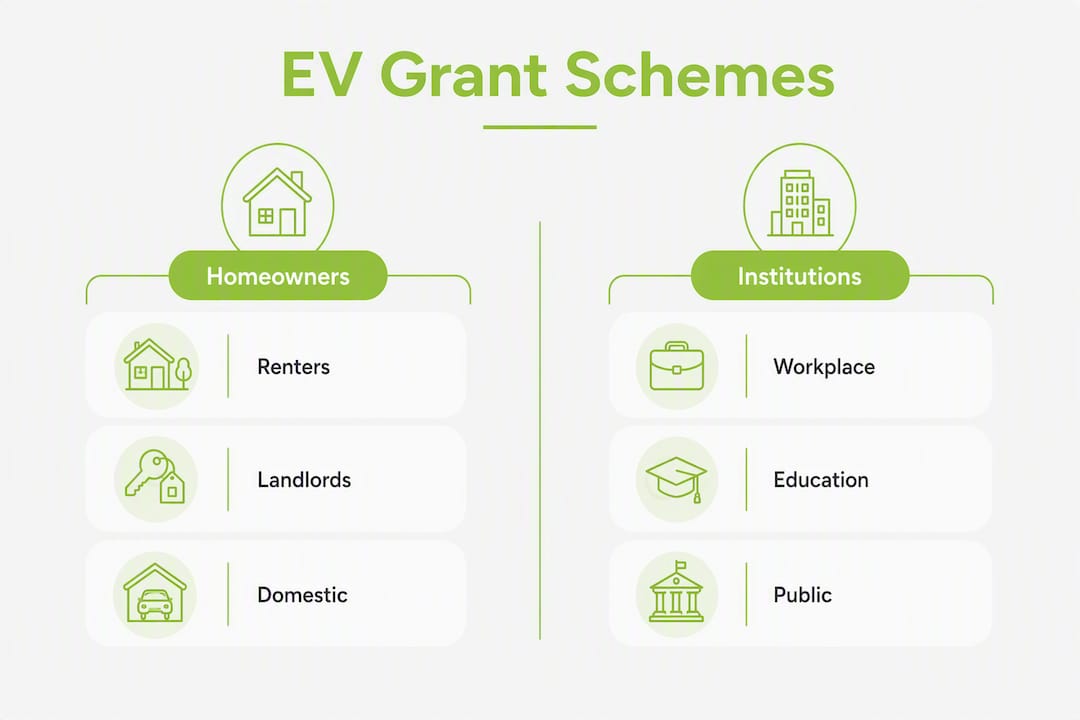
A few things worth noting. The renters and flat owners grant covers the purchase and installation cost of the chargepoint unit itself; it does not fund optional home rewiring beyond what is strictly necessary for the install. The on-street parking grant is the most administratively demanding of the five, requiring highways authority consent before any work begins. The Workplace Charging Scheme is the one employers most often overlook: it applies to businesses of any size, including sole traders with a dedicated parking space at their premises.
The education grant stands apart. At up to £2,000 per socket, it reflects the higher infrastructure costs that come with institutional sites, and it is only available to state-funded institutions — independent schools are not eligible.
Are you eligible? The OZEV grant eligibility checklist

Eligibility rules vary slightly by scheme, but most share a core set of requirements. Work through this checklist before you contact an installer.
Property and residency
- You must live in the property (own or rent) for the home grants
- Flat owners and renters qualify; you do not need to own the building
- Shared-ownership properties are generally eligible, but check your lease for any restrictions on external works
Parking
- Standard home grants require private off-street parking (a driveway, garage, or allocated bay)
- If you only have on-street parking, you must apply under the specific on-street scheme and obtain highways authority consent for a permanent cross-pavement solution
- Temporary cable covers or rubber mats do not qualify; the solution must be permanent
Vehicle eligibility
- Your vehicle must appear on the OZEV-approved vehicle list, or you must have a confirmed order for an eligible vehicle
- The list is updated regularly; check it at the point of application, not just when you bought the car
Installer requirements
- You must use an OZEV-authorised installer. There is no workaround here: the grant cannot be applied retrospectively if you use a non-authorised installer or if work begins before your application is approved
- The grant is deducted from your invoice by the installer; you pay the reduced amount directly
One detail that catches people out: the grant covers up to 75% of the total purchase and installation cost, capped at £500. If your chargepoint and installation together cost £600, the grant covers £450. If the total is £400, the grant covers £300. The cap is a ceiling, not a flat payment.
How do you actually apply for an EV charger grant?
The application process involves both you and your installer, and the order of steps matters. Starting work before your application is approved automatically invalidates your claim.
Step-by-step process
- Check eligibility. Confirm your property type, parking situation, and vehicle against the scheme requirements above.
- Create your own account on Find a grant. You must do this yourself; installers are not permitted to submit applications on your behalf.
- Start your application. You will need to provide details of your property, your vehicle (or order confirmation), and any permissions required (for example, landlord consent if you are a renter, or highways authority approval for on-street installs).
- Receive notification of eligibility. Do not contact an installer to begin work until you have this confirmation.
- Get quotes from OZEV-authorised installers. At this stage, ask for a written quote showing the full pre-grant cost and the grant-deducted amount separately.
- Installer completes the work. Your installer submits the claim, provides photographic evidence, and deducts the grant from your invoice.
- You pay the reduced amount. The installer recovers the grant directly from OZEV.
What evidence is required
- Proof of residency or tenancy
- Vehicle registration or confirmed order document
- Landlord permission (for renters)
- Highways authority consent (for on-street installs)
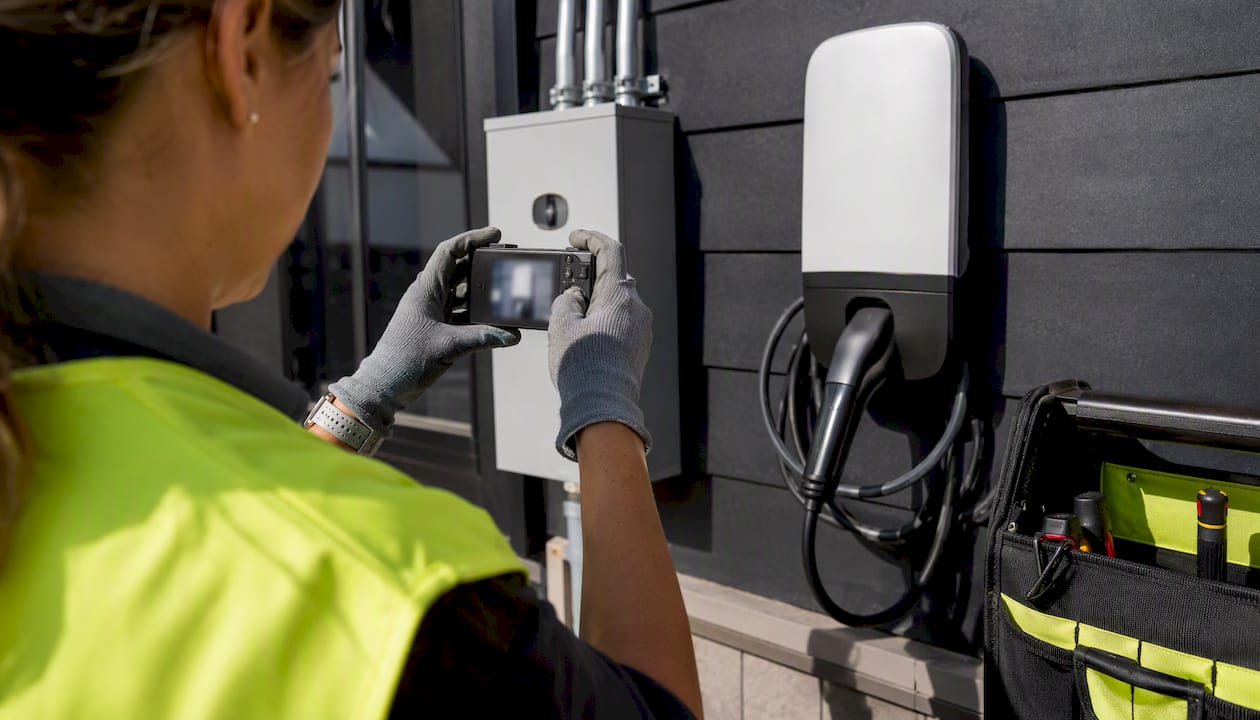
- Photos of the installation: close-up of the unit showing model and serial number, wide-angle showing location, and parking bay context
From 1 April 2026, installer claims must include multiple mandatory photos covering the model and serial number, the installation location, and the parking bay. Claims submitted without these are rejected outright.
What does the grant actually cover, and what will you pay?
The grant covers the cost of the chargepoint unit and the installation labour, including any ancillary electrical work that is strictly necessary to complete a safe, compliant install. It does not cover optional upgrades such as a full consumer unit replacement that goes beyond what the charger requires, or decorative cable management.
Typical cost ranges for a domestic install
A standard single-socket home install (unit plus labour) typically falls in the £800–£1,200 range, though costs vary by property type, cable run length, and whether the consumer unit needs any work. The full cost breakdown is worth reviewing before you request quotes, so you know what to expect on the invoice.
Worked examples
- Homeowner with driveway, straightforward install. Total cost: £900. Grant covers 75% = £675, but the cap is £500. You pay £400.
- Renter needing a cross-pavement channel (on-street install). Total cost including permanent channel: £1,400. Grant covers up to £500. You pay £900. Note that highways consent adds lead time and potentially a separate local authority fee, which the grant does not cover.
| Scenario | Total install cost | Grant applied | You pay |
|---|---|---|---|
| Homeowner, driveway | £900 | £500 | £400 |
| Renter, on-street | £1,400 | £500 | £900 |
| Workplace (single socket) | — | £500 | £500 |
| School (single socket) | £2,000 | £2,000 | £500 |
OZEV requires that the grant is deducted from the customer’s invoice before the installer claims it; the invoice must show both the full pre-grant cost and the reduced amount you actually pay. If an installer presents you with an invoice that only shows the post-grant figure, ask them to reissue it correctly before you sign off.
What do businesses, landlords and schools need to know?
Workplace Charging Scheme
The WCS allows businesses, charities and public sector organisations to claim up to £500 per socket across up to 40 sockets. That means a business installing 10 sockets could claim up to £5,000 in total. The scheme is open to organisations of any size, including sole traders, provided the chargepoints are installed at a workplace with dedicated parking.
Businesses apply through the WCS portal, and the same rule applies: work must not begin before the application is approved. For multi-site installs, each site is treated separately in terms of evidence, but the 40-socket cap applies across all sites combined.
Residential landlords
Landlords letting private residential properties can claim up to £500 per socket. The socket limit for residential landlords is notably higher than for other schemes, making this one of the more valuable routes for portfolio landlords. For practical guidance on managing a multi-property install, the landlord-specific installation guide covers the bulk-install process in detail.
State-funded education institutions
Schools and colleges funded by the state are eligible for up to £2,000 per socket, up to 40 sockets across sites. The higher rate reflects the more complex infrastructure typical of institutional sites. Independent schools are not eligible under this scheme.
| Scheme | Eligible applicant | Max per socket | Max sockets |
|---|---|---|---|
| Workplace Charging Scheme | Businesses, charities, public sector | £500 | 40 (all sites) |
| Residential landlord grant | Private residential landlords | £500 | Up to 40 |
| Education institution grant | State-funded schools/colleges | £2,000 | 40 (all sites) |
One practical difference for institutional and multi-site applicants: the evidence requirements are more extensive. Expect to provide site plans, parking bay designations, and in some cases planning consent, in addition to the standard photographic evidence.
Common mistakes that get EV charger grant claims rejected
Most rejected claims come down to a small number of avoidable errors. Here is what to watch for.
Top reasons for rejection
- Work started before approval. This is the single most common cause of invalidated claims. Installations carried out before the applicant receives eligibility notification automatically disqualify the claim.
- Wrong installer. Using a non-OZEV-authorised installer means the grant cannot be claimed, regardless of how compliant the installation itself is.
- Missing or inadequate photos. Claims without the mandatory close-up, wide-angle, and parking bay photos are rejected at the evidence stage.
- Duplicate funding. Claiming the same socket under two schemes, or claiming for a socket already funded through another public grant, triggers an audit.
- Incorrect invoice format. Invoices must show the pre-grant cost; inflated pre-grant figures or invoices that only show the post-grant amount can trigger fraud investigations.
On-street installs: the highways pitfall
On-street installs carry extra administrative steps that many applicants underestimate. Highways authority consent is mandatory, and the solution must be permanent — a rubber cable mat will not satisfy the requirement. Budget several weeks for the consent process, and factor in any local authority fees, which are not covered by the grant.
Spotting a problem installer
Be wary of any installer who offers to submit your Find a grant application on your behalf (they are not permitted to do so), quotes a suspiciously high pre-grant price, or cannot produce their OZEV authorisation number on request. These are the patterns OZEV audits look for, and if a fraudulent claim is submitted in your name, you may face a clawback even if you were unaware of the issue.
Key takeaways
The most important thing to act on now: the grant uplift to £500 per socket is live from 1 April 2026, funding runs until 31 March 2027, and starting work before your application is approved will cost you the entire grant.
| Point | Details |
|---|---|
| Grant rates from April 2026 | Up to £500 per socket for homes and workplaces; up to £2,000 per socket for state-funded schools. |
| Funding deadline | All five live schemes are funded until 31 March 2027 — apply well before that date. |
| Application order matters | You must receive eligibility approval before any installation work begins; early starts invalidate claims. |
| On-street installs need extra steps | Permanent cross-pavement solutions and highways authority consent are mandatory; allow extra lead time. |
| Centralec-electrical | OZEV-authorised, NICEIC-approved installer in the South West offering fixed-price quotes and full claim support. |
Why the installer you choose matters more than most people realise
Most of the conversation around EV charger grants focuses on eligibility and amounts, which makes sense. But the part that actually determines whether your claim succeeds or fails is the installer you choose and how they handle the paperwork.
OZEV’s grant-at-point-of-sale model means the installer deducts the grant from your invoice and then recovers it from the government. That puts a significant amount of responsibility in the installer’s hands. An installer who inflates the pre-grant cost, submits incomplete photos, or mishandles the claim documentation does not just risk their own authorisation; they can pull your claim down with them.
The NICEIC approval that Centralec-electrical holds is not just a quality badge. It means every installation is independently assessed against the current wiring regulations, which is exactly what OZEV expects to see when it audits a claim. With over 23 years of experience handling EV charger installs across domestic and commercial properties in the South West, the team understands what the evidence pack needs to look like and how to present the invoice correctly.
There is also a practical point about timing. Centralec-electrical’s site surveys identify potential issues — consumer unit capacity, cable run distances, on-street permissions — before the quote is issued, not after the work has started. That matters because unexpected costs discovered mid-install are not covered by the grant, and they tend to arrive at the worst possible moment.
Get a fixed-price OZEV-compliant quote from Centralec-electrical
Centralec-electrical handles the full install process for homeowners, renters, landlords and businesses across the South West: site survey, OZEV-authorised installation, photographic evidence pack, and invoice formatted exactly as OZEV requires. No hidden costs, no surprises on the day.
With NICEIC approval and more than two decades of EV charger installations behind them, the team knows what a clean, compliant claim looks like from start to finish. Whether you are a homeowner claiming under the renters and flat owners scheme, a landlord planning a multi-socket install, or a business applying through the Workplace Charging Scheme, Centralec-electrical will give you a fixed upfront price and manage the documentation so your grant goes through without complications.
Find out exactly what your install involves and request a compliant EV charger quote to get started.
Useful sources
The official GOV.UK pages below are the primary references for all grant amounts, eligibility rules, and application links. Deadlines and evidence requirements do change, so check these pages directly before you apply rather than relying on any third-party summary, including this one.
- Electric vehicle chargepoint grants — GOV.UK: the main hub page covering all five live schemes, eligibility criteria, and links to individual scheme pages.
- Changes to EV chargepoint grant schemes from 1 April 2026 — GOV.UK: the definitive source for the new grant rates, which schemes closed, and transitional arrangements.
- Electric Vehicle Chargepoint Grant for Renters and Flat Owners — Find a grant: scheme-specific page with opening and closing dates, eligibility detail, and the application link.
- Electric Vehicle Chargepoint Grant for Households with On-Street Parking — Find a grant: covers the permanent cross-pavement requirement, highways consent, and evidence needed.
- OZEV home and workplace grants terms and conditions — GOV.UK: the full terms covering invoice requirements, evidence standards, and fraud provisions.
- Grant boost announcement — GOV.UK: the government’s announcement explaining the policy intent behind the April 2026 uplift.
How to use these sources: the Find a grant pages contain the live application links and the most up-to-date evidence checklists. The GOV.UK guidance pages carry the legal terms. If you are unsure whether a specific cost or property type qualifies, the terms and conditions page is the definitive reference — or contact OZEV directly via the contact details listed on GOV.UK.
This article provides general information about UK government grant schemes. Grant rules, amounts, and eligibility criteria can change; confirm current requirements on GOV.UK or with an OZEV-authorised installer before making any financial decisions.