 Skip to content

For solar-first UK homes, the myenergi Zappi is the clearer choice. For households that want reliable mixed charging — solar in summer, cheap overnight rates in winter — the Hypervolt Home 3 Pro pulls ahead.
The decision usually comes down to three things:
- Solar surplus behaviour: Zappi’s Eco+ mode tracks real-time PV generation and charges only on genuine surplus, pausing when clouds reduce output. Hypervolt blends grid and solar, keeping the charge steady but drawing some grid power in the process.
- Tariff and app integration: Hypervolt has native Octopus Intelligent Go support and a polished app. Zappi integrates deeply with the myenergi ecosystem (eddi hot-water diverter, libbi battery storage).
- Cable reach and installation complexity: Hypervolt offers 7 m and 10 m tether options, which matter on longer Scottish driveways. Both require a correctly placed CT clamp to function properly.
Pro Tip: Before requesting a quote, confirm whether your installer will supply and cable the CT clamp as part of the job. A misplaced or wireless CT on a long run is the single most common reason smart solar features underperform after installation.
Table of Contents
- Hypervolt vs Zappi: quick side-by-side specs and UK installed prices
- How each charger actually behaves on a solar home
- What you will actually pay: costs, drivers, and quote checklist
- CT clamp placement, DNO limits, and installation compliance
- How to choose the right charger for your solar home
- Final recommendation and configuration for each buyer profile
- Key takeaways
- An installer’s honest perspective on the Zappi vs Hypervolt decision
- Get your EV charger installed correctly the first time
- Useful sources and further reading
Hypervolt vs Zappi: quick side-by-side specs and UK installed prices
Both chargers are OZEV-approved, meaning eligible homeowners can apply for the EV chargepoint grant to reduce the effective cost.
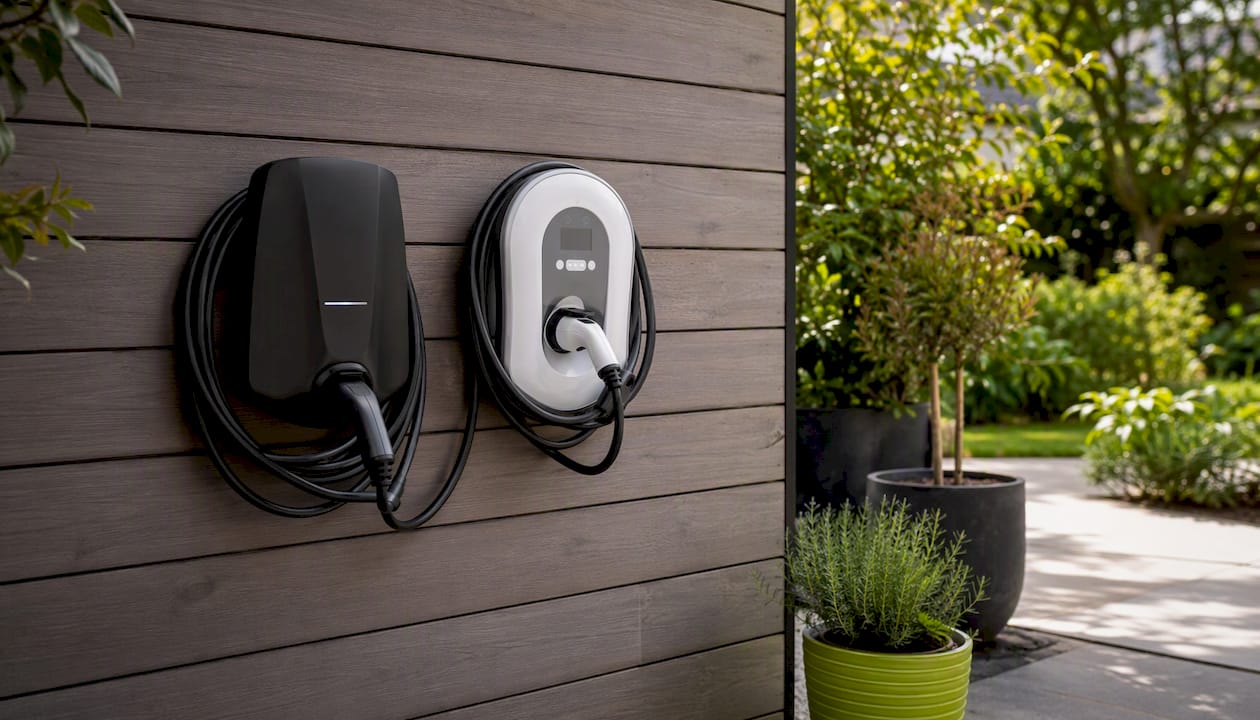
| Feature | myenergi Zappi v2.1 / GLO | Hypervolt Home 3 Pro | Ohme Home Pro | Pod Point Home | Andersen A2 | Wallbox Pulsar Plus | Easee One | BG Sync EV | Simpson & Partners Home 7 |
|---|---|---|---|---|---|---|---|---|---|
| Best for | Solar-first | All-rounder | Tariff/off-peak | Mainstream reliability | Aesthetics | Space-conscious | Multi-EV | Simple UK backup | Budget reliability |
| Unit price | — | — | — | ~£350 | — | ~£350 | — | — | — |
| Typical installed (UK) | £999–£1,199 | £1,025–£1,225 | — | — | — | — | — | — | — |
| Max power / phase | 7 kW (1ph) / 22 kW (3ph) | — | — | — | — | — | — | — | — |
| Solar modes | Eco / Eco+ / Fast | Super Eco / Eco / Boost | Limited | Basic | Basic | Basic | Basic | None | None |
| App & tariff | myenergi app, ToU tariff | Hypervolt app, Intelligent Go, OVO | Strong tariff APIs | Basic scheduling | Basic app | Basic app | Load balancing app | Simple UI | Basic |
| Tether options | 6.— or untethered | 7.— / 10 m | 7.— | — | — | — | 7.— | — | — |
| IP rating | IP65 | IP66 / IK10 | — | IP65 | IP65 | — | — | IP65 | — |
| Warranty | 3 years | 3 years | 3 years | 3 years | 3 years | 2 years | 3 years | 3 years | 2 years |
| CT complexity | Medium-high | Medium | Low | Low | Low | Low | Medium | Low | Low |
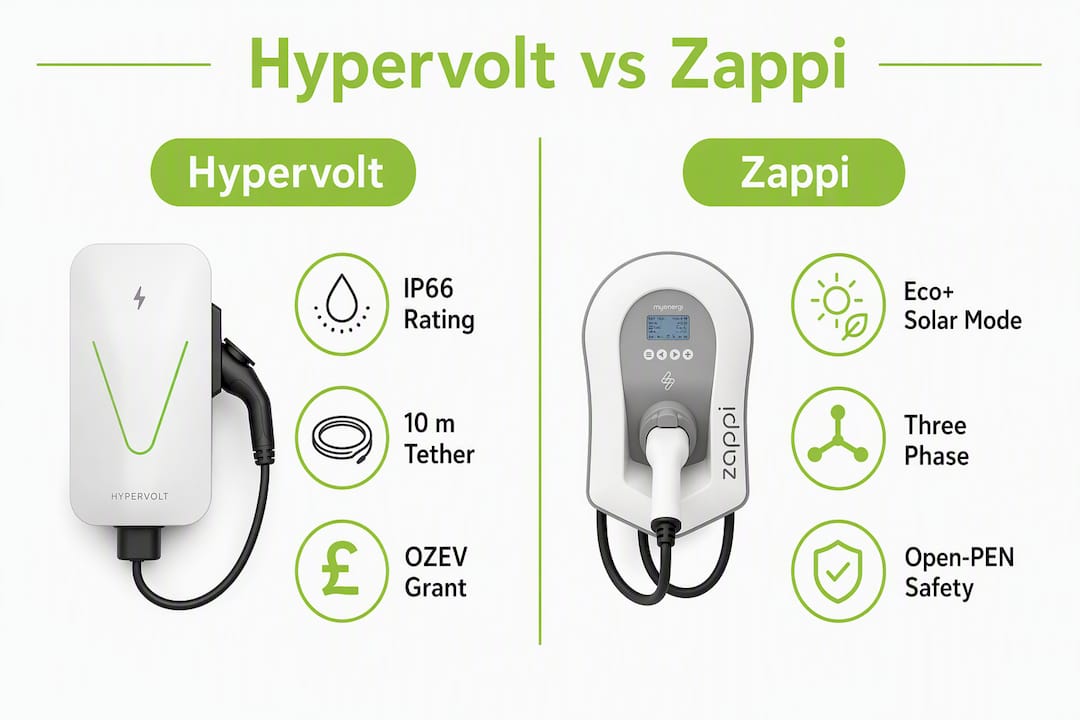
The unit price gap between Zappi GLO and Hypervolt Home 3 Pro is roughly £26. Once installation is included, that difference is negligible. What actually separates them is how they behave on a patchy February afternoon when your 4 kW array is producing 1.8 kW.
One-line strengths:
- Zappi v2.1 / GLO: The only charger here with true surplus-only charging and full myenergi ecosystem integration.
- Hypervolt Home 3 Pro: Best app, toughest enclosure (IP66/IK10), longest tether options, and native Intelligent Go support.
- Ohme Home Pro: Wins on tariff automation and unit price; solar is secondary.
- Pod Point Home: Wide installer network, straightforward setup, no solar specialism.
- Andersen A2: Premium design and compact footprint; solar features are basic.
- Wallbox Pulsar Plus: Small and flexible; good for tight installs, not solar-first homes.
- Easee One: Modular load-sharing for multi-EV properties; not a solar specialist.
- BG Sync EV: Dependable UK backup option; no meaningful solar mode.
- Simpson & Partners Home 7: Competitive pricing and straightforward installation; no solar specialism.
OZEV grant note: The EV chargepoint grant currently covers up to £350 for eligible homeowners. Applied to either the Zappi or Hypervolt, it shifts the effective installed cost into the £650–£875 range for a standard install, which makes the solar-specialist premium much easier to justify.
How each charger actually behaves on a solar home
Solar modes: what Eco+ really means in practice
Zappi’s three modes work like this. Fast mode charges at full rate regardless of solar output, drawing from the grid freely. Eco mode blends surplus PV with grid power to keep charging continuous, with a minimum floor of 1.4 kW — below that threshold, the shortfall comes from the grid. Eco+ is the purest solar mode: it pauses charging entirely when surplus drops below 1.4 kW rather than importing grid power to compensate.
That pause behaviour is where opinions split. Installers in Scotland report that Eco+ pauses frequently on overcast days, which frustrates homeowners who need a predictable charge. Hypervolt’s equivalent — Super Eco, Eco, and Boost — takes a blended approach, keeping the charge moving by drawing a small amount of grid power when solar dips. You get steadier charging; you lose the guarantee of 100% solar miles.
Installer consensus is that the buyer’s tolerance for intermittent charging usually decides the winner, not the raw specs.
App experience and tariff integration
Hypervolt’s app is widely regarded as the most polished in this category. Native support for Octopus Intelligent Go and OVO Charge Anytime means the charger can automatically schedule overnight charging at the cheapest rate without manual intervention. For households on a flat tariff or without solar, that alone justifies the choice.
Zappi’s myenergi app covers scheduling and energy monitoring, and integrates with the eddi hot-water diverter and libbi battery. If you already have or plan to add myenergi products, single-brand control through one app is a genuine convenience. Hypervolt focuses on the charger and cloud services; it does not extend into home energy management the way myenergi does.
Hardware: tethers, IP ratings, and Scottish driveways
The Hypervolt Home 3 Pro’s IP66/IK10 rating makes it the most physically robust unit in this comparison. The IK10 rating means it can withstand a 20-joule impact — relevant for exposed wall positions in coastal or rural Scottish properties. Zappi’s IP65 is solid but a step below.
Tether length matters more than buyers expect. Hypervolt’s 10 m option resolves most awkward parking layouts without additional cable management. Zappi ships with a 6 m tethered cable or as an untethered unit with a Type 2 socket — the untethered option suits households where different drivers use different vehicles, but it requires carrying a cable.
Pro Tip: On a long driveway or outbuilding install, request hard-wired CT data cabling rather than relying on wireless. EV Ultra combined power-and-data cable reduces signal loss on longer runs and prevents the intermittent CT readings that can destabilise solar diversion.
Zappi v2.1 also offers a 22 kW three-phase variant — the only charger in this list with a genuine three-phase domestic option. If your property has a three-phase supply, that is a significant advantage for future-proofing.
What you will actually pay: costs, drivers, and quote checklist
The small unit price difference between Zappi GLO and Hypervolt Home 3 Pro disappears entirely once installation is factored in. Recorded installed price ranges cluster at £999–£1,199 for the Zappi and £1,025–£1,225 for the Hypervolt on a standard domestic install.
| Cost component | Typically included | Watch for extras |
|---|---|---|
| Unit supply | Yes | Confirm model variant (tethered/untethered) |
| Standard cable run (up to 10 m) | Usually | Longer runs, trunking, or armoured cable cost more |
| CT clamp supply and cabling | Often excluded | Confirm CT is hard-wired, not wireless |
| Consumer unit work | Rarely | Older boards may need a new breaker or full upgrade |
| OZEV grant paperwork | Varies | Ask explicitly — some installers charge admin |
| Commissioning and testing | Should be included | Verify smart features are tested before sign-off |
| EV Ultra or data cable (long runs) | Rarely | Essential on runs over 15 m |
For a detailed cost breakdown, the factors that push a quote above the standard range are: consumer unit upgrades (older boards without a spare 40 A breaker), cable runs over 15 m, armoured cable for underground or outbuilding installs, and additional CTs for home battery systems.
Questions to ask every installer before accepting a quote:
- Is the CT clamp included, and will it be hard-wired or wireless?
- What cable length is included, and what is the per-metre rate beyond that?
- Does the quote include consumer unit work if required?
- Will you complete and submit the OZEV grant application?
- Will you commission and test the smart features before leaving site?
- Is EV Ultra or equivalent data cabling specified for runs over 15 m?
CT clamp placement, DNO limits, and installation compliance
CT clamp placement is the single most common reason smart solar features fail after installation. Both Zappi and Hypervolt rely on CT-based load management to meet BS 7671 and the Smart Charge Points Regulations. A CT clipped to the wrong cable gives the charger a false picture of available surplus — the app shows nonsense figures, or worse, the charger draws from the grid thinking it has surplus.
For homes with an AC-coupled battery, the configuration is more involved. Zappi requires a dedicated battery CT set to ‘Avoid Drain’ to prevent it from treating battery discharge as PV surplus. Without that setting, the charger can deplete stored energy into the car rather than waiting for genuine solar generation. This is not a fault — it is a commissioning step that many installers skip.
Commissioning steps your installer should complete before leaving:
- Confirm CT clamp is on the correct incoming supply cable (not the tails or a sub-circuit).
- For battery homes: configure battery CT and verify ‘Avoid Drain’ is active.
- Set firm current limits appropriate to the supply head (typically 32 A on a 60 A service).
- Run a dynamic load management test under expected peak household load.
- Verify the app is reading live generation and consumption correctly.
- Test all three charging modes and confirm the charger responds to surplus changes.
Flats, tenements, and constrained supplies
On tight or older supplies — 60 A service heads, tenement shared tails — installers should enable dynamic load management and set conservative firm limits, then test under peak load before leaving site. Both Zappi and Hypervolt support dynamic load management, but it must be actively configured. Ohme and Hypervolt tend to handle constrained supplies more gracefully out of the box, which is why they are often recommended for tenement flats.
Open-PEN protection is built into Zappi as standard (required under BS 7671:2018 Amendment 1). Confirm your installer is aware of the earthing arrangement at your property — a PME/TN-C-S supply requires PEN fault protection, which Zappi provides natively.
Pro Tip: For solar-compatible EV charger installs on properties with a home battery, always request a written commissioning record showing CT configuration, ‘Avoid Drain’ status, and load management settings. It takes ten minutes to produce and saves hours of fault-finding later.
How to choose the right charger for your solar home
Solar-first, small array (3–4 kW)
Go with the Zappi in Eco+ mode. A 3–4 kW array generates enough surplus on a clear day to keep the charger active, but on overcast days you will see pauses. Widen the Min Green Level threshold slightly (e.g. 75% rather than 100%) to reduce pauses without abandoning solar priority. Request a PV CT and, if you plan to add a battery later, a second CT port.
Solar plus home battery
Zappi remains the stronger choice, but the configuration matters enormously. You need a battery CT set to ‘Avoid Drain’ in addition to the PV CT. Without it, the charger will drain your battery into the car. Ask your installer to confirm this setting during commissioning and to test it with the battery at partial charge.
Mixed use: solar in summer, off-peak tariff in winter
This is where Hypervolt earns its place. Its native Intelligent Go integration handles overnight scheduling automatically, and its solar modes cover summer surplus adequately. You do not get Zappi’s precision surplus tracking, but you get a charger that works well year-round without manual mode switching.
Flats and limited supply
Neither charger is ideal for a flat with a shared supply and no dedicated parking. Where installation is possible, Ohme Home Pro or Hypervolt are better suited — both handle load management more gracefully on constrained supplies. Check with your DNO about any export cap or supply upgrade requirements before committing to a charger.
Long driveways (Scotland and rural properties)
Hypervolt’s 10 m tether option is the practical answer. Specify EV Ultra cabling for the CT data run if the consumer unit is more than 15 m from the charger position. For a smart EV charger installation on a rural property, also confirm whether the installer has experience with armoured cable and outbuilding supplies.
Vehicle compatibility note: Some EVs are sensitive to frequent charge-pause-restart cycles (Zappi Eco+ behaviour). Check your vehicle handbook for any minimum session duration requirements, and consider using Eco mode rather than Eco+ if your car reports charging errors after pauses.
Final recommendation and configuration for each buyer profile
Solar-first configuration (Zappi v2.1 / GLO):
- Mode: Eco+ for clear days; switch to Eco on overcast days to reduce pauses.
- CT setup: PV CT on generation circuit; battery CT on battery output (if applicable) set to ‘Avoid Drain’.
- Min Green Level: start at 100%, adjust to 75% if pauses are disruptive.
- Tether: 6 m tethered or untethered (Type 2 socket) depending on parking layout.
- Request: itemised quote including CT cabling, commissioning record, and OZEV paperwork.
All-rounder configuration (Hypervolt Home 3 Pro):
- Tether: 7.— or 10 m depending on driveway length.
- Tariff: enable Octopus Intelligent Go or OVO Charge Anytime in the Hypervolt app.
- CT setup: two CTs if home battery is present; confirm with installer.
- Solar: use Eco mode for blended solar/grid charging; Super Eco for higher solar contribution.
- Request: itemised quote confirming IP66 enclosure, CT cabling, and commissioning test.
Practical next steps:
- Book a site survey before committing to a charger model — the installer needs to assess your consumer unit, supply head, and cable run length.
- Ask for CT placement confirmation in writing.
- Request an itemised quote that lists CTs, cable runs, consumer unit work, and commissioning as separate line items.
- Check OZEV grant eligibility before accepting a quote — the £350 grant materially changes the effective cost for eligible homeowners.
Key takeaways
The Zappi is the right charger for genuine solar-first UK homes; the Hypervolt Home 3 Pro is the stronger all-rounder for mixed solar and tariff use.
| Point | Details |
|---|---|
| Solar-first choice | Zappi v2.1 / GLO in Eco+ mode delivers true surplus-only charging for PV households. |
| All-rounder choice | Hypervolt Home 3 Pro suits mixed solar and tariff use, with native Intelligent Go support and 10 m tether options. |
| CT placement is critical | Incorrect CT placement is the most common reason smart features fail; always request a commissioning record. |
| Installed cost reality | Unit price gap (~£26) is negligible once installation is included; typical installed ranges are £999–£1,199 for the Zappi and £1,025–£1,225 for the Hypervolt. |
| OZEV grant impact | The OZEV grant can materially reduce the effective installed cost for eligible homeowners. |
| Centralec-electrical | Centralec-electrical installs Zappi and Hypervolt across the South West, with NICEIC approval, CT configuration, and OZEV paperwork included. |
Pro Tip: Get a site survey and CT verification before choosing your charger model — the right choice sometimes depends on where your consumer unit sits relative to your parking position.
An installer’s honest perspective on the Zappi vs Hypervolt decision
The debate between Zappi and Hypervolt gets framed as a technical spec comparison, but after years of installing both, the real question is simpler: how much does the homeowner care about 100% solar miles versus a charger that just works every morning?
Zappi is genuinely brilliant at what it does. When the sun is out and the array is producing well, watching it track surplus in real time is satisfying in a way that a blended charger never quite matches. But Eco+ on a Scottish November morning — intermittent cloud, 1.2 kW of generation, a car that needs 20 miles by 8 AM — is a source of frustration for homeowners who were not warned about it. The fix is usually just switching to Eco mode on grey days, but nobody tells them that at the point of sale.
Hypervolt’s advantage is that it rarely surprises you. The app is genuinely good, the enclosure is the toughest in this class, and the Intelligent Go integration means the charger earns its keep even in January when solar is minimal. The trade-off is that you are always drawing some grid power in solar mode, which bothers some owners more than others.
The CT clamp issue is the one I would push hardest on. Both chargers are only as smart as the sensor reading your supply. A wireless CT on a long run, or one clipped to the wrong cable, turns a £1,200 smart charger into an expensive dumb one. Ask your installer to show you where the CT is going before they start the job.
Get your EV charger installed correctly the first time
Choosing between Hypervolt and Zappi is the easy part. Getting the CT clamp in the right place, the consumer unit work done properly, and the OZEV grant paperwork submitted without chasing — that is where the installation matters as much as the hardware.

Centralec-electrical is a NICEIC-approved electrical contractor with over 23 years of experience installing EV chargers, including Zappi, Hypervolt, Wallbox, and Autel units. Every install includes a site survey, CT placement and configuration, commissioning test, and OZEV grant paperwork as standard. No hidden costs, no surprises on the invoice.
To see exactly what is included in a Centralec-electrical EV charger installation, visit the EV charger installation requirements page, or request an itemised quote directly. If you want a detailed cost breakdown before committing, the installation cost guide covers what drives prices up and what to push back on.
Useful sources and further reading
A short list of the primary sources used for this comparison, plus recommended reading for buyers and installers:
- myenergi Zappi product page — Official spec sheet covering all Zappi v2.1 variants, charging modes, CT clamp supply, and connectivity options.
- myenergi Zappi v2.1 user manual — Full technical reference for charging modes, CT configuration, and commissioning steps.
- Zappi GLO vs Hypervolt Home 3 Pro comparison — TeslaCharger — Side-by-side spec and installed price comparison with OZEV grant context.
- Zappi vs Hypervolt vs Ohme for Scotland — Mackie Electrical — Installer-informed comparison covering real-world behaviour, tether options, and Scottish property considerations.
- Zappi vs Hypervolt for UK solar homes — ChargerFit — Ecosystem and app comparison with practical buyer guidance.
- Hypervolt vs Zappi smart charger guide — EV Charging Blog — CT placement, BS 7671 compliance, and load management commissioning notes.
- Configuring Zappi with a home battery — Tanjent Energy — Step-by-step CT and ‘Avoid Drain’ configuration guide for AC-coupled battery systems.
- OZEV EV chargepoint grant — GOV.UK — Official eligibility criteria and application process for the £350 homeowner grant.
- Centralec-electrical Zappi installation review — Centralec-electrical’s own installation notes and practical guidance on Zappi commissioning.
Manufacturer spec pages and firmware release notes change periodically. Always confirm current specifications with your installer and check the manufacturer’s site for the latest firmware support and warranty terms before purchasing.