 Skip to content

Hire a NICEIC-registered electrician holding the Level 3 Award in Installation and Commissioning of EV Charging Equipment and you will get a safe, certified install with DNO notification handled and an Electrical Installation Certificate on completion. For homeowners in the South West, Centralec-electrical is the recommended provider. Before you call anyone, do these three things:
- Take photos of your consumer unit, the wall where the charger will go, and the cable route from the fuse board to your parking spot.
- Note your car’s charging port type and whether you have solar panels or a tight household electrical supply.
- Check Tesla’s official certified installer search to see which trained installers operate in your area.
A standard 7 kW home charger draws 32 A, adds significant range per hour, and fully charges most EVs overnight. That is the benchmark for a competent UK residential install.
Table of Contents
- How do you find and vet a certified Tesla home charger installer?
- What actually happens on site, from survey to handover?
- How much does a Tesla home charger install cost in the UK?
- Which Tesla Wall Connector features should you prioritise?
- How long does a home charger installation take?
- Why DNO notification and the right qualifications matter more than you think
- Key takeaways
- What installers wish you knew before they arrive
- Centralec-electrical: NICEIC-approved EV charger installation in the South West
- Useful sources and further reading
How do you find and vet a certified Tesla home charger installer?
Start with two directories: Tesla’s ‘Find a Certified Installer’ tool and the NICEIC or NAPIT online registers. Cross-referencing both takes ten minutes and immediately filters out unqualified tradespeople. For a broader view of local installer options, a comparison of vetted providers can help you shortlist faster.

Qualifications that actually matter
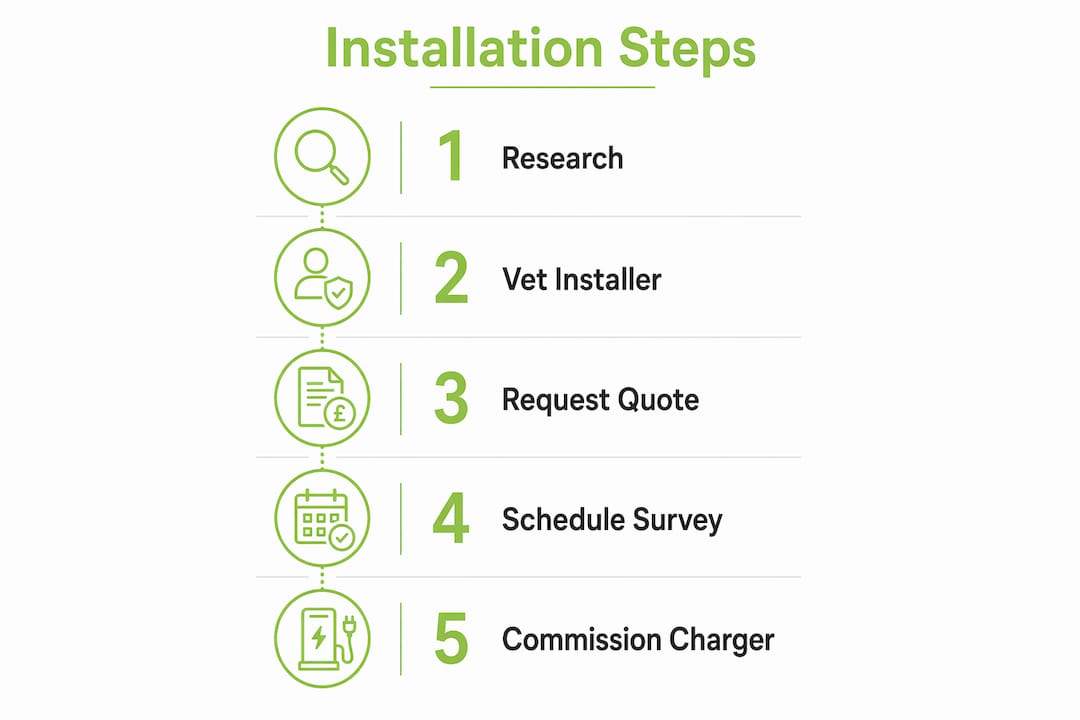
The Level 3 EVCE award is the clearest dividing line between a professional EV charger installer and a general electrician who has watched a few YouTube videos. It covers BS 7671 Section 722, the IET Code of Practice, inspection, testing, and DNO notification requirements. NICEIC or NAPIT registration on top of that means the installer is assessed regularly and can self-certify the work under a competent person scheme, which handles your Part P obligation automatically.
Ask every installer these four questions before they visit:
- Are you NICEIC or NAPIT registered?
- Do you hold the Level 3 EVCE qualification?
- Will you notify my DNO and provide a full Electrical Installation Certificate referencing Section 722?
- What exactly is included in this quote — cable length, consumer unit work, earth rod, testing?
What a proper quote looks like
An itemised quote should list the charger unit, labour, cable length and type, any consumer unit or RCBO work, earth rod if required, DNO notification, and the Electrical Installation Certificate. If a quote arrives as a single round number with no breakdown, treat it as a red flag. Equally, any installer who quotes without a site survey is guessing at the cable run and earthing requirements.
Pro Tip: Ask to see photos of a recent install and the EIC from that job. A confident, qualified installer will share both without hesitation.

What actually happens on site, from survey to handover?
The process follows a clear sequence, and knowing it helps you spot when something has been skipped.
- Remote pre-quote. You send photos of the consumer unit, proposed charger location, and cable route. The installer gives a ballpark figure and flags any obvious complications.
- Site survey. Mandatory for an accurate, fixed price. The electrician checks earthing type (PME or TT), fuse board capacity, cable routing options, and wall construction. This takes around 30 minutes.
- DNO notification. Under the Electricity Safety, Quality and Continuity Regulations, a 7 kW charger is usually notify-only. Your installer submits this; you should not have to chase it yourself.
- Installation day. The electrician fits a dedicated 32 A circuit from the consumer unit, routes cable (steel wire armoured cable where it runs underground or through exposed areas), installs an RCBO or appropriate RCD protection, and mounts and wires the charger.
- Earthing work. On PME (TN-C-S) supplies, the EV circuit protective conductor cannot share the PME earth. A separate TT earth electrode is installed and tested. This is a compliance requirement under BS 7671 Section 722, not an optional extra.
- Commissioning and testing. The charger is powered up, the RCD is tested to BS 7671 Regulation 643.8, and the installer pairs the unit with the app and confirms load management settings.
- Handover. You receive the Electrical Installation Certificate referencing Section 722, proof of DNO notification, warranty paperwork, and photos of the completed install.
DIY is not an option here. A qualified electrician must commission the charger; attempting it yourself voids the warranty, invalidates your insurance, and breaches Part P of the Building Regulations.
How much does a Tesla home charger install cost in the UK?
Prices vary more than most online guides suggest. A straightforward 7 kW supplied-and-fitted install usually costs £900–£1,600 for a typical domestic job, with more complex installations (long cable run, consumer unit upgrade, groundworks) often reaching £1,800–£2,500+. A site survey is the only way to get a fixed price.
| Scenario | Typical cost range | What drives the price |
|---|---|---|
| Standard 7 kW, short cable run | £900–£1,600 (covering charger, labour, cable, and certification) | |
| 7 kW, longer or concealed cable route | £1,800–£2,500+ (higher cost due to extended cable run and additional materials) | |
| 7 kW + consumer unit upgrade | £1,800–£2,500+ (increased price from fuse board upgrades) | |
| Complex install (trenching, earth rod, supply upgrade) | £1,800–£2,500+ (further increased costs from groundworks, earthing, and supply enhancements) |
Figures sourced from BestBuilders.co.uk 2026 fitted pricing for Part P/OZEV-approved installers; South West regional labour rates run approximately 5% below the Midlands baseline.
Many advertised prices are ‘starting from’ figures. Real costs commonly increase by £500–£1,000 when a consumer unit upgrade, long cable runs, or groundworks are needed. A site survey is the only way to get a fixed price.
Grants and savings
Renters and flat owner-occupiers with off-street parking can be eligible for a £350 OZEV EV Chargepoint Grant, applied by the installer as a discount off your bill. Homeowners do not currently qualify. Confirm eligibility when you request your quote.
For ongoing savings, pairing a smart charger with a dedicated EV tariff cuts the per-kWh cost to roughly 7p compared with around 28–30p on a standard rate. Over a year, that difference is substantial for most Tesla drivers. See the EV charger installation cost breakdown for a fuller picture of what affects your final bill.
Which Tesla Wall Connector features should you prioritise?
The Tesla Wall Connector is a tethered unit designed specifically for Tesla vehicles. It delivers up to 11 kW on a three-phase supply or 7.4 kW on single-phase, which covers the maximum a standard UK domestic supply can provide. The tethered cable means no adapter fumbling in the rain, and the unit integrates directly with the Tesla app for scheduling and monitoring.
Key features worth asking about when comparing chargers:
- Smart scheduling. Set the charger to run during off-peak tariff windows automatically. Without this, you are paying peak rates unless you remember to plug in at the right time.
- Load balancing / dynamic load management. Reduces the charger’s output when other high-draw appliances are running, preventing nuisance tripping and avoiding a consumer unit upgrade in some cases.
- Solar divert. If you have solar panels, this diverts surplus generation to the car rather than exporting it at a lower rate. Ask your installer about this specifically if you have PV.
- App monitoring. Tracks charging sessions, costs, and energy use. Useful for expense claims if you use the car for work.
- OCPP support. An open protocol that lets the charger work with third-party energy management systems. The Tesla Wall Connector does not support OCPP, so if long-term flexibility matters, a universal OCPP-capable charger may be a better fit.
For households with solar or tight electrical capacity, smart EV charger options with load balancing and solar divert are worth the modest price premium over a basic unit.
How long does a home charger installation take?
A straightforward install runs to 3–6 hours on site. The broader timeline from first enquiry to handover looks like this:
- Enquiry to survey: a few days to a week, depending on the installer’s diary.
- Survey to booking: typically 1–3 weeks.
- Installation day: 3–6 hours for a standard job; longer if consumer unit work or trenching is involved.
- Certification and paperwork: issued the same day or within 48 hours.
Day-of checklist for homeowners: clear a parking space directly outside the consumer unit access point, unlock the fuse board cupboard, identify and clear the proposed cable route, and keep your phone on so the installer can reach you if a decision is needed mid-job.
Delays happen when DNO approval is needed before connection (required when the maximum demand of the whole connection exceeds 13.8 kVA), when a supply upgrade is necessary, or when the property is a flat requiring landlord permission or a management company sign-off. These can add weeks, so flag any of these situations when you first contact an installer.
Why DNO notification and the right qualifications matter more than you think
The earthing issue catches homeowners off guard because it is invisible. Most UK homes have a PME (TN-C-S) supply, where the neutral and earth are combined at the street. BS 7671 Section 722 prohibits connecting the EV circuit’s protective conductor to this combined earth. A separate TT earth rod must be driven into the ground and tested for resistance. Inexperienced electricians sometimes miss this entirely, which creates a genuine shock risk.
The IET Code of Practice for EV Charging Equipment installation and BS 7671 Section 722 are the governing documents. A full Electrical Installation Certificate referencing both is the proof that the work was done correctly. A Minor Works Certificate is not sufficient for an EV charger install.
Installers flag DNO notification as the most common pitfall. Always ask for written confirmation that the notification has been submitted, not just a verbal assurance.
Pro Tip: File the DNO notification reference and the EIC with your house deeds or property paperwork. When you sell, a buyer’s solicitor will ask for evidence that notifiable electrical work was certified. Having it ready avoids delays.
Key takeaways
A certified Tesla home charger installer must hold the Level 3 EVCE qualification, be NICEIC or NAPIT registered, and handle DNO notification and the Electrical Installation Certificate as part of the job.
| Point | Details |
|---|---|
| Hire the right credentials | Insist on a Level 3 EVCE-qualified, NICEIC or NAPIT-registered electrician for every EV install. |
| Always get a site survey | Remote quotes miss earthing type, cable length, and consumer unit capacity — all of which affect the final price. |
| Confirm DNO notification | Ask for written proof that the DNO has been notified; verbal assurance is not enough. |
| Retain the EIC | The full Electrical Installation Certificate referencing Section 722 is required for property sales and insurance claims. |
| Centralec-electrical | NICEIC-approved, 23+ years’ experience, covering the South West with itemised quotes and a satisfaction guarantee. |
What installers wish you knew before they arrive
The jobs that run smoothly share one thing: the homeowner has thought about the cable route before the electrician shows up. The fuse board is often at the back of the house; the car parks at the front. That gap determines whether the job is a half-day or a full day, and whether SWA cable needs to go underground across a driveway. Knowing that in advance means the quote is accurate and the installation day has no surprises.
The other thing that slows jobs down is an old consumer unit. If your fuse board still has rewirable fuses or is already full, budget for an upgrade. It is not a problem — Centralec-electrical handles consumer unit work as part of a complete EV install — but it needs to be on the quote from the start, not discovered on the day.
Centralec-electrical’s NICEIC approval means every install is independently assessed against the same standards. Over 23 years, the team has seen most of what UK domestic wiring can throw at an EV install, and the process is set up to handle it without drama.
Centralec-electrical: NICEIC-approved EV charger installation in the South West
Fixed pricing with no hidden costs is the single biggest difference between Centralec-electrical and a generic quote from an online platform. Every supplied-and-fitted EV charger install includes a site survey, itemised quote, dedicated 32 A circuit, DNO notification, and a full Electrical Installation Certificate on completion. No surprises on the day, no chasing paperwork afterwards.

With over 23 years of electrical experience and NICEIC approval, Centralec-electrical specialises in residential EV charger installations across the South West, covering Tesla Wall Connector, Zappi, Wallbox, and Autel units. The satisfaction guarantee means the job is not finished until the certificate is in your hands and the charger is working as it should.
To book a site survey, have your consumer unit photos, parking location, and car model ready. Then request your EV charger installation quote and a member of the team will confirm availability and next steps. Landlords and flat owner-occupiers can find specific guidance on EV charger installation for rental properties.
Useful sources and further reading
| Source | What you will find there |
|---|---|
| Tesla Support UK — Home Charging | Tesla’s official ‘Find a Certified Installer’ search tool for UK homeowners. |
| IET BS 7671 EV Charging FAQs | Primary technical guidance on Section 722, RCD testing, DNO notification thresholds, and socket-outlet height requirements. |
| NAPIT — Level 3 EVCE Qualification | Details of the Level 3 Award in Installation and Commissioning of EV Charging Equipment, including what the qualification covers. |
| Elec-Mate — EV Charger Installation Guide | Practical guidance on earthing types, PME supplies, DNO notification, and typical cost drivers for UK installs. |
| EnergyPlus — EV Charger Installation Costs | Cost ranges, OZEV grant eligibility, and EV tariff comparisons for UK homeowners. |
| NICEIC — Level 3 Low-Carbon Qualifications | Explanation of why Level 3 EVCE training distinguishes professional EV installers from general electricians. |
| Priory Electrical — choosing a local electrician | Independent guidance on verifying electrician credentials and what to look for when comparing quotes. |
This article provides general information for UK homeowners and is not a substitute for professional electrical advice. Confirm current regulations, grant eligibility, and DNO requirements with a qualified electrician or the relevant primary source for your specific property.