 Skip to content

How do you find a certified EV charger installer near you?
The fastest route to a certified local installer is the government’s own find an EV chargepoint installer tool on GOV.UK, which lists every OZEV-approved electrician by postcode. OZEV approval matters because it is the gateway to grant funding, and only OZEV-registered installers can certify work that qualifies for the EV Chargepoint Grant. NICEIC approval sits alongside that as the UK’s primary electrical competency mark, confirming that an electrician’s work meets BS 7671 wiring regulations.
A typical 7 kW single-phase home charger costs £900–£1,400 fully fitted, excluding grants. Hardware alone costs several hundred pounds, with installation labour varying widely depending on panel capacity and cable length. Those figures assume your consumer unit has spare capacity; if it does not, costs rise considerably.
Before you call anyone, run through this checklist:
- OZEV registration: confirm the installer appears on the GOV.UK approved list
- NICEIC approval: check the NICEIC website directly using the installer’s registration number
- Fixed upfront quote: get the full scope in writing, including permit, labour, and hardware
- Charger compatibility: confirm they install the brand you want (Wallbox, Zappi, Tesla, Autel, Hive, or others)
- Warranty and aftercare: ask what is covered post-installation and for how long
- Insurance: verify they carry public liability cover for domestic electrical work
Pro Tip: Ask every installer whether their quote includes the building notification to your local authority. Some omit this step entirely, which can void your home insurance and complicate a future property sale.
The end-to-end installation process typically takes one to three weeks from first contact to a fully inspected, energised charger. The physical work is usually done in a single day; permitting and inspection scheduling account for most of that window.
Comparing popular UK home EV charger options
The charger you choose shapes the installation as much as the installer does. Smart-charge compliance has been mandatory in the UK since 2022, so every new unit sold here already includes default off-peak scheduling. The table below covers the main charger options and the key dimensions that affect your installation decision.
| Charger | Best for | Certifications / approvals | Smart features | Cable type | Notable detail |
|---|---|---|---|---|---|
| Wallbox | Homeowners wanting versatile, app-controlled charging | OZEV-eligible, CE marked | App scheduling, load management | Tethered or untethered | Wide UK installer network |
| Zappi | Solar panel owners and eco-conscious homeowners | OZEV-eligible, MCS compatible | Solar/wind divert, eco modes | Tethered | Integrates with myenergi hub |
| Tesla charger | Tesla vehicle owners | OZEV-eligible | Auto-updates, Tesla app control | Tethered | Optimised for Tesla onboard charger |
| Autel charger | Drivers needing flexible charge speeds | OZEV-eligible, safety certified | App control, scheduling | Tethered or untethered | Solid build quality; fast charge options |
| Hive EV Charger | Homeowners wanting simple smart control | OZEV-eligible | Hive app, smart scheduling | Tethered | Easy setup; integrates with Hive ecosystem |
| Sync Energy Wall Charger 2 | Tech-savvy homeowners | OZEV-eligible | Advanced energy scheduling, connectivity | Tethered | Supports energy management platforms |
| Cord Lite 5m | Owners wanting a portable cable option | — | None | Portable cable | Compact; useful as a backup solution |
| Cord Zero Untethered | Untethered wall unit users | — | Depends on paired unit | Untethered | Removes cable tangle at the wall |
| Cord Zero 5m / 8m | Varied garage or driveway layouts | — | None | Portable cable | Length options suit different parking setups |
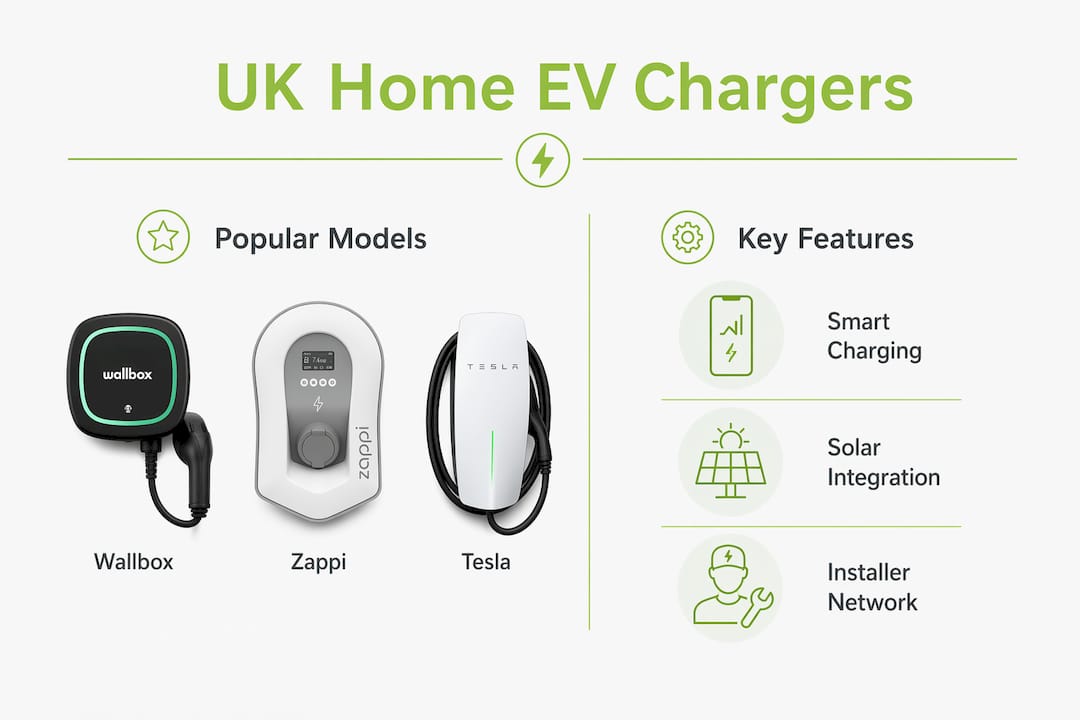
The Zappi stands apart from every other unit on this list because it actively diverts surplus solar or wind energy to your car rather than exporting it to the grid. If you have panels already, or plan to add them, the Zappi pays for the price premium over a standard charger relatively quickly. The Tesla charger, by contrast, is the obvious choice only if you drive a Tesla; its automatic firmware updates and tight integration with the Tesla app are genuinely useful, but it offers nothing extra for any other vehicle.
Wallbox has the broadest UK installer network of the branded options, which matters if you live outside a major city. Autel’s build quality is a step above most mid-range units, and its dual-speed options suit homeowners who want the flexibility to charge faster when the grid is cheap and slower during peak hours.
The Cord Lite 5m, Cord Zero Untethered, and Cord Zero 5m / 8m are cable accessories rather than wall units. They suit homeowners who already have an untethered charger installed, or who want a portable backup for occasional use away from home.
How do you choose the right installer for your home?
Choosing an installer comes down to three things: credentials, transparency, and what happens after the job is done. The credentials part is binary. Either the installer is OZEV-approved and NICEIC-certified, or they are not. There is no middle ground worth considering, because unpermitted installations risk voiding your home insurance and can block a future property sale when an inspector flags the work.
Pricing transparency is where installers genuinely differ. A good quote itemises hardware, labour, permit notification, and any cable management separately. A vague single-line figure almost always hides extras that surface on the day. Get at least two written quotes and make sure both cover identical scope, including the building notification to your local authority.

Pro Tip: If an installer suggests you pull the homeowner permit yourself so they can avoid the licensing process, walk away. That arrangement shifts all liability onto you and is a reliable sign the installer is cutting corners elsewhere.
Post-installation support is underrated. Ask specifically about the warranty on parts and labour, whether they offer an annual inspection, and how faults are reported. Some installers offer a satisfaction guarantee on completed work; others disappear once the invoice is paid.
On costs: most homeowners overestimate the need for a consumer unit upgrade. Many existing units have enough capacity for a 7 kW charger, and a competent electrician will assess this before quoting. Where capacity is tight, load-shedding devices or smart circuit splitters can share existing circuits and avoid a costly upgrade entirely.
A 40A charger delivers roughly 30 miles of range per hour, which covers overnight charging for almost every driver. Paying for a higher-amperage unit only makes sense if your vehicle’s onboard charger and your consumer unit can both support it. Matching amperage to your actual setup avoids overspending without sacrificing anything practical.
Watch for these red flags when evaluating quotes:
- No mention of a building notification or permit
- Reluctance to provide a written, itemised quote
- No evidence of NICEIC or OZEV registration when asked
- Pressure to book immediately without a site assessment
- No clarity on who is responsible if the work fails inspection
For a deeper look at what qualifies a good installer, the best installer selection tips guide covers the questions worth asking before you commit.
What happens during a home EV charger installation?
The installation process follows a predictable sequence, and knowing it helps you avoid delays and ask the right questions at each stage.
- Site assessment: The electrician visits to check your consumer unit capacity, identify the best cable route, confirm the mounting location, and provide a written quote. This typically takes 30–60 minutes.
- Consumer unit check: The electrician calculates whether your existing unit can handle the additional load. Most modern 200A units can; older 100A units sometimes need upgrading or a load management device added.
- Building notification: Your installer submits the required notification to your local authority before work begins. This is a legal requirement under Part P of the Building Regulations.
- Installation day: A new dedicated circuit is run from the consumer unit to the charger location. The electrician installs the double-pole breaker, runs the cable (in conduit where exposed), mounts the charger, and makes all connections. A straightforward garage installation takes 2–6 hours of labour.
- Inspection and sign-off: An electrical inspector verifies that the breaker rating matches the conductor size, the circuit is correctly bonded, and the charger’s current limit is set to match the breaker. Passing inspection closes the notification.
- Certification: Your installer issues an Electrical Installation Certificate, which you keep for insurance and resale purposes.
The full project, from first call to an inspected, energised charger, takes one to three weeks. The physical work is usually done in a single day; the rest of the time is permit turnaround and inspection scheduling.
Hardwired installations support higher amperage circuits (up to 48A on a 60A breaker) and are the preferred choice for permanent home setups. Plug-in socket installations are limited to 40A continuous and introduce a connection point that can wear under repeated high-current use. For homeowners who plan to stay put, hardwired is the cleaner, more reliable option. For renters or those likely to move, a plug-in socket installation offers the flexibility to take the charger with them.
Inspectors specifically check that breaker amperage matches conductor size and that the circuit is properly bonded. A failed inspection is the installer’s responsibility to fix if they pulled the permit, which is another reason to confirm that detail before work begins.
For a full technical walkthrough, the hardwired installation guide covers every step in detail.
What UK grants are available for home EV charger installation?
The OZEV EV Chargepoint Grant is the main financial support available in 2026, but its scope has narrowed significantly. Homeowners with off-street parking no longer qualify. The grant currently covers up to £350 toward the cost of a charger and installation for:
- Renters in rented domestic properties
- Flat owners in blocks of flats
- People in shared parking arrangements
- Landlords installing chargers for tenants
To qualify, you must use an OZEV-approved installer and an eligible charger model. The GOV.UK approved installer list confirms both. Attempting to claim the grant with an uncertified installer or a non-eligible unit results in rejection.
For homeowners who no longer qualify for the domestic grant, the Workplace Charging Scheme remains available for businesses and some residential landlords installing chargers at commercial premises. Details are on the GOV.UK guidance page.
A few practical points worth knowing before you apply:
- The grant is paid directly to the installer, not to you; your invoice reflects the reduced amount
- You cannot claim the grant retrospectively after installation is complete
- Grant availability and eligibility criteria can change; check the current GOV.UK guidance before booking
- Some energy suppliers, including Octopus Energy, offer free or subsidised smart chargers to customers on specific tariffs, which can reduce costs further even where the OZEV grant does not apply
For a full breakdown of what the grant covers and how to apply, the EV charger installation rebate guide has the current eligibility criteria and application steps.
Why Centralec-electrical is the right choice for South West homeowners
Centralec-electrical brings over 23 years of electrical contracting experience to every EV charger installation, with NICEIC approval and OZEV installer status covering the full range of domestic and commercial work. That combination means every installation is carried out to BS 7671 standards, fully certified, and eligible for OZEV grant funding where applicable.
The charger range covers the main brands homeowners actually ask for: Wallbox, Zappi, Tesla, and Autel, fitted by electricians who install these units regularly rather than occasionally. Pricing is fixed and itemised upfront, with no hidden costs added on the day.
Beyond EV chargers, the team handles rewiring, smart home electrical systems, Electrical Installation Condition Reports (EICRs), and 24/7 emergency callouts. That breadth matters when an installation uncovers an older consumer unit that needs attention before a charger can be safely added.
Key reasons South West homeowners choose Centralec-electrical:
- NICEIC-approved electricians on every job, not subcontracted labour
- OZEV-registered installer status for grant-eligible installations
- Transparent pricing with no hidden fees and a written quote before work starts
- Wallbox, Zappi, Tesla, and Autel charger installations all supported
- Satisfaction guarantee on all completed work
- 24/7 availability for emergency electrical issues
Centralec-electrical: a direct alternative to national EV charger providers
The providers compared earlier in this guide are mostly national networks or manufacturer-linked schemes. They work well for straightforward installs in areas with good coverage. Where they often fall short is in the South West, where local knowledge, flexible scheduling, and a single point of contact from quote to sign-off make a real difference.
Centralec-electrical offers professional EV charger installation across the South West with fixed upfront pricing, NICEIC certification, and OZEV approval. There are no call centres, no subcontracted crews, and no surprises on the invoice. If your consumer unit needs attention before the charger goes in, the same team handles it. For a clear picture of what your installation will cost, the EV charger installation cost guide breaks down every line item.
Key takeaways
A certified, OZEV-approved, NICEIC-registered installer is the only safe choice for UK home EV charger installation, and using one is a condition of grant eligibility.
| Point | Details |
|---|---|
| Typical UK installation cost | A 7 kW single-phase charger costs £900–£1,400 fully fitted, excluding grants. |
| Grant eligibility | The OZEV EV Chargepoint Grant (up to £350) applies to renters, flat owners, and shared parking users, not homeowners with off-street parking. |
| Installation timeline | The full process takes one to three weeks; the physical work is usually completed in a single day. |
| Permit and inspection | Building notification under Part P is a legal requirement; skipping it risks voiding home insurance and complicating property sales. |
| Centralec-electrical | NICEIC-approved, OZEV-registered South West installer supporting Wallbox, Zappi, Tesla, and Autel chargers with fixed upfront pricing. |