 Skip to content
A commercial electrician specialises in electrical systems for businesses and large-scale buildings, while a residential electrician focuses on home electrical systems. Choosing the wrong type is not just inconvenient. It can mean failed inspections, voided insurance, and real safety risks. The distinction between a commercial electrician vs residential comes down to power systems, wiring methods, regulatory standards, and the environments each professional works in. Understanding these differences helps you hire the right person from the start.
What are the main electrical system differences between commercial and residential properties?
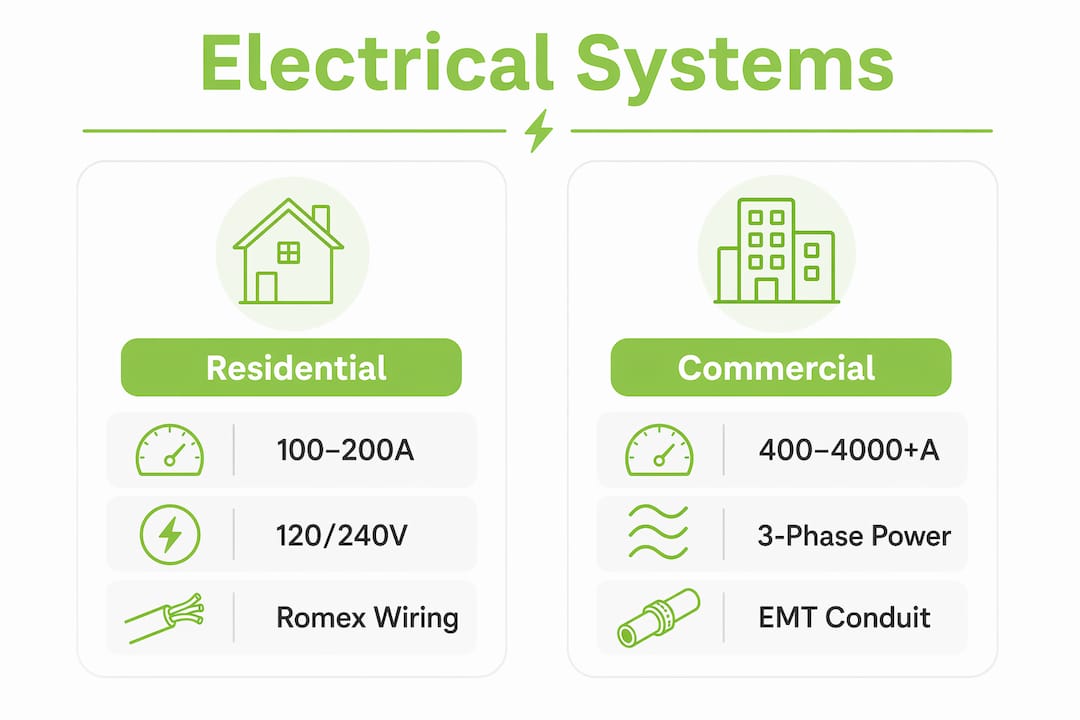
The gap between commercial and residential electrical systems is far wider than most property owners expect. Residential systems typically handle 100–200 amps with loads of 15,000–20,000 watts. Commercial systems start at 400 amps and can exceed 4,000 amps with loads over 100,000 watts. That difference in scale shapes every decision an electrician makes on site.
Voltage is the other major dividing line. Residential electricians work with 120V/240V split-phase power, which is sufficient for household appliances and lighting. Commercial electricians handle 208V, 277V, and 480V three-phase systems. Three-phase power prevents voltage drops when running large motors or industrial equipment, which is why factories and hospitals depend on it.
Wiring materials also differ significantly. Residential wiring uses Romex cable run through timber stud walls, which is cost-effective and quick to install. Commercial installations use EMT conduit or THHN wire, which allows individual conductors to be replaced without tearing out walls. That replaceability is not a luxury. It is a maintenance and safety requirement in buildings that must stay operational for decades.
| Feature | Residential | Commercial |
|---|---|---|
| Typical amperage | 100–200A | 400–4,000+A |
| Voltage supply | 120V/240V split-phase | 208V/277V/480V three-phase |
| Wiring method | Romex cable | EMT conduit or THHN wire |
| Load capacity | 15,000–20,000 watts | 100,000+ watts |
| Wiring access | Fixed within walls | Replaceable via conduit |
Pro Tip: If you are planning a large extension or converting a commercial unit into residential flats, check whether the existing supply is three-phase before budgeting. Upgrading the supply later costs significantly more than planning for it upfront.
How do work environments and tasks differ for commercial vs residential electricians?
The physical environment shapes everything about how each type of electrician operates. Residential electricians work in private homes, often with the owner present. That means respecting furniture, carpets, and personal space, while explaining work clearly to a non-technical client. The job is as much about communication as it is about cables.

Commercial environments are a different world entirely. Commercial sites include hospitals, factories, and offices with strict safety protocols, tight deadlines, and multiple trades working simultaneously. A commercial electrician must coordinate with plumbers, HVAC engineers, and site managers, not just complete their own tasks. That coordination demands project management skills that go well beyond technical knowledge.
Commercial electricians frequently work off-hours to avoid disrupting business operations. A supermarket rewire happens overnight. A hospital generator upgrade happens at the weekend. Residential work, by contrast, follows standard daytime hours. This scheduling difference affects cost, staffing, and planning in ways that clients often underestimate.
Technical reading is another key distinction. Commercial electricians must interpret complex one-line diagrams and large-scale blueprints. Residential work typically involves straightforward floor plans. A commercial electrician who cannot read a one-line diagram is a liability on site. A residential electrician who has never seen one is simply working in a different trade.
- Commercial electricians manage active job sites with multiple trades present
- Residential electricians prioritise client communication and property care
- Off-hours scheduling is standard in commercial work, not the exception
- Blueprint complexity in commercial projects requires specialist reading skills
- Commercial work in large crews demands advanced coordination and project management
What licensing, training, and safety standards apply to each type?
Licensing requirements in the UK do not formally split into “residential” and “commercial” categories in the same way as some other countries. Both types of electrician must complete an apprenticeship and achieve qualifications such as City & Guilds 2365 or NVQ Level 3. However, the practical experience and specialist knowledge required for commercial work goes well beyond the baseline.
Safety standards diverge sharply once you move into commercial territory. Commercial electricians must comply with OSHA 30, Lockout/Tagout (LOTO), and NFPA 70E due to industrial hazards such as arc flash. Arc flash is an explosive release of energy from an electrical fault. It can cause severe burns at distances of several metres, which is why commercial electricians wear specialist arc flash suits and follow strict isolation procedures that residential work simply does not require.
Lockout/Tagout is a procedure that physically prevents machinery from being energised while work is in progress. Residential electricians isolate circuits by switching off a consumer unit. Commercial electricians may need to isolate complex switchgear serving entire floors or buildings, then verify isolation with calibrated test equipment before touching anything.
NICEIC approval is one of the most reliable indicators of competence for both residential and commercial work in the UK. Centralec-electrical holds NICEIC approved contractor status, which means every installation is independently assessed against current wiring regulations. For clients, that approval removes guesswork about whether the work meets the required standard.
- City & Guilds 2365 or NVQ Level 3 forms the baseline for both types
- NFPA 70E and LOTO compliance is mandatory in commercial environments
- Arc flash protection requires specialist PPE not used in residential work
- NICEIC approval provides independent verification of competency
- Landlord electrical compliance sits between the two trades and requires awareness of both
What should you consider when choosing between a commercial or residential electrician?
The decision comes down to the nature and scale of your project. A residential electrician is the right choice for home rewires, consumer unit upgrades, socket additions, and domestic electrical services such as smart home integrations. These projects operate within standard domestic wiring regulations and do not require three-phase knowledge or industrial safety protocols.
Hiring a residential electrician for commercial work risks failed inspections and potential liability. Insurance policies for commercial properties often specify that electrical work must be carried out by a suitably qualified and insured contractor. If a residential electrician completes work on a commercial premises and a fault occurs, the insurance claim may be rejected. That is a risk no business owner should accept.
- Define your project scope. Identify whether the property is domestic, commercial, or mixed-use before contacting any electrician.
- Check the supply type. Ask whether the property has single-phase or three-phase supply. This tells you immediately which type of electrician you need.
- Verify qualifications and insurance. Request proof of NICEIC registration or equivalent accreditation, and confirm the electrician’s public liability insurance covers your property type.
- Clarify scheduling requirements. If your business cannot afford downtime, confirm the electrician can work outside standard hours.
- Get a written quote with no hidden costs. A transparent quote protects you from unexpected charges and confirms the electrician understands the full scope of work.
Pro Tip: For mixed-use buildings, such as a shop with a flat above, you may need an electrician experienced in both domestic and commercial wiring regulations. Ask specifically about their experience with Part P and commercial building regulations before booking.
Key takeaways
Choosing the right electrician type from the outset prevents failed inspections, insurance voids, and costly rework on both residential and commercial projects.
| Point | Details |
|---|---|
| System scale differs enormously | Commercial systems handle up to 4,000+ amps versus 100–200 amps in residential properties. |
| Wiring methods are not interchangeable | Romex suits homes; EMT conduit is required in commercial buildings for safety and maintenance. |
| Safety standards diverge sharply | Commercial work requires NFPA 70E, LOTO, and arc flash protection not used in domestic settings. |
| Wrong hire creates legal risk | Using a residential electrician on commercial work can void insurance and fail inspections. |
| Verify accreditation before hiring | NICEIC approval confirms an electrician meets current wiring regulations for your property type. |
Why getting this choice right matters more than most people realise
People often assume that an electrician is an electrician. I have seen that assumption cause real problems, and not just technical ones.
A homeowner once hired a commercial electrician for a straightforward rewire because they assumed “more experience” meant “better for everything.” The result was a job priced for a commercial site, with conduit runs where Romex would have been perfectly compliant and far less disruptive. The work was technically correct, but it was the wrong solution for the building. The client paid significantly more than necessary.
The reverse happens too, and it is far more dangerous. A small business owner brings in a domestic electrician to upgrade a workshop supply. The electrician is competent within their trade, but they have never worked with three-phase systems or complex switchgear. The installation passes a basic visual check but fails a formal inspection. The business cannot open until the work is redone. That delay costs far more than hiring the right person from the start.
Specialisation in this trade is not about status. It is about the fact that the two environments genuinely require different knowledge, different tools, and different safety habits. A residential electrician who has spent ten years working in homes has deep expertise in domestic wiring regulations, consumer unit design, and client communication. That expertise is genuinely valuable. It just does not transfer automatically to a factory floor.
My advice is straightforward. Match the electrician to the environment, not to a general sense of their experience level. Ask specifically about the type of projects they have completed in the last two years. A good electrician will tell you honestly if a job falls outside their usual scope.
— Craig
Centralec-electrical: electrical services for homes and businesses
Centralec-electrical has delivered electrical installations and repairs across the South West for over 23 years, working on both residential and commercial properties. Every project carries NICEIC approval, transparent pricing, and a satisfaction guarantee with no hidden costs.

Whether you need a full home rewire, a commercial supply upgrade, or a new EV charger installation, Centralec-electrical has the qualifications and experience to complete the work to the correct standard for your property type. For business owners concerned about downtime, the team can schedule work outside standard hours. Contact Centralec-electrical to discuss your project and receive a clear, written quote.
FAQ
What is the main difference between a commercial and residential electrician?
A commercial electrician works with high-voltage three-phase systems, complex wiring methods, and strict industrial safety standards. A residential electrician specialises in domestic wiring, consumer units, and home electrical installations.
Can a residential electrician legally do commercial work?
Not without the appropriate qualifications, insurance, and experience for the commercial environment. Licensing and insurance differences mean that using the wrong type of electrician can void insurance and result in failed inspections.
Why do commercial electricians earn more than residential electricians?
Commercial mid-career pay ranges from £58,000 to £80,000 compared to £48,000 to £65,000 for residential electricians. The higher rate reflects the complexity of three-phase systems, industrial safety requirements, and the project management demands of large-scale sites.
What wiring method is used in commercial buildings?
Commercial buildings use EMT conduit or THHN wire rather than Romex cable. Conduit allows wire replacement without opening walls, which is essential for long-term maintenance and safety in occupied buildings.
How do I know which type of electrician to hire?
Identify whether your property has a single-phase or three-phase supply, then match the electrician’s experience to that system. For any project on a commercial premises, verify NICEIC registration and confirm the electrician’s insurance covers commercial work.