 Skip to content
A commercial electrician is defined as a specialist who installs and maintains electrical systems in business and public buildings, while an industrial electrician works on high-voltage power distribution and automation systems in factories and production facilities. The distinction matters enormously when you are choosing electrical services for your facility. Hire the wrong specialism and you risk safety failures, compliance breaches, or costly production downtime. Understanding the commercial vs industrial electrician divide is the first step to making the right call for your project.
What does a commercial electrician do?
Commercial electrical services cover a broad range of systems in offices, retail units, schools, hospitals, and government buildings. The core objective is protecting building occupants and keeping daily operations running safely. Commercial electricians install and maintain lighting, HVAC systems, fire alarms, and data cabling in public buildings, ensuring operational efficiency while preventing hazards to occupants.
Their work demands close collaboration with architects, building managers, and multiple trades to meet building codes and energy-efficiency standards. A retail fit-out, for example, requires coordinating lighting circuits, emergency systems, and data networks across a live building. Commercial electricians work collaboratively with building managers and contractors to ensure every installation complies with codes and functions safely for public use.
The electrical loads in commercial settings are moderate compared to industrial sites. Think single-phase or light three-phase supplies powering tenant spaces, rather than the heavy machinery circuits found in manufacturing. Compliance with building regulations and occupant safety standards governs every decision.
Key tasks a commercial electrician handles:
- Lighting design, installation, and maintenance across multi-tenancy buildings
- HVAC electrical connections and controls
- Fire alarm and emergency lighting systems
- Structured data cabling and communications infrastructure
- Electrical Installation Condition Reports (EICRs) for occupied premises
- EV charger installation in car parks and commercial premises
Pro Tip: If you manage a commercial property, ask your electrician for an EICR inspection before any major fit-out. Faults hidden in ageing wiring can cause costly delays once contractors are on site.
How do industrial electricians differ in skills and workplace challenges?
An industrial electrician operates in a fundamentally different environment. Industrial electricians specialise in production environments such as factories and refineries, handling high-voltage power distribution and complex motor controls. The electrical systems they manage are larger, more complex, and carry far greater consequences if they fail.
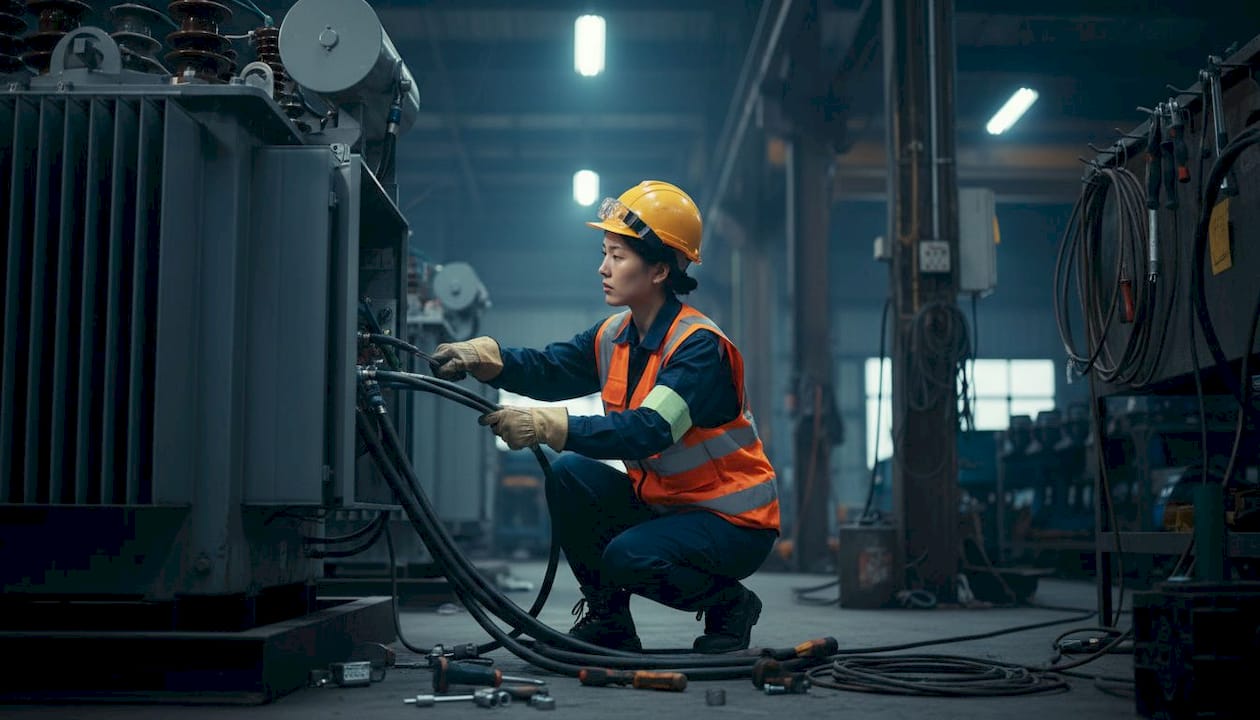
The skills gap between the two disciplines is significant. Industrial electricians regularly work with 3-phase power, large switchgear, and motor control centres essential for maintaining manufacturing and processing plant operations. Energy management and automation integration sit at the heart of their daily work.
Programmable Logic Controllers (PLCs) are a defining feature of industrial electrical work. These are computer-based systems that control machinery sequences and production processes. Industrial electricians must understand both the electrical and software sides of these systems. Troubleshooting often targets non-visible faults in PLCs and control systems under time-sensitive conditions, requiring deep electrical and software-interfacing expertise.
The safety demands are also categorically higher. Industrial electricians carry additional specialised safety certifications such as high-voltage handling and hazardous area awareness, which are not required in commercial electrical roles. These certifications reflect the genuine risk of working around live high-voltage equipment and explosive atmospheres.
Core skills and responsibilities of an industrial electrician include:
- High-voltage power distribution and switchgear maintenance
- 3-phase motor installation, testing, and fault-finding
- PLC programming, diagnostics, and repair
- Arc flash risk assessment and mitigation
- Lockout/tagout procedures for safe isolation of machinery
- Automation system integration and commissioning
- Preventive maintenance to protect production uptime
Pro Tip: When assessing an industrial electrician’s credentials, ask specifically about their arc flash training and whether they hold certification aligned with NFPA 70E or equivalent UK guidance. A qualified contractor will answer without hesitation.
The operational pressure in industrial settings is relentless. Industrial electricians experience urgent operational pressures to minimise production downtime, requiring advanced diagnostic skills for troubleshooting automation and motor controls. Every hour of unplanned downtime in a manufacturing plant carries a direct financial cost.
What are the key technical and compliance differences?
The technical gap between commercial and industrial electrical work is most visible in voltage levels and safety protocols. Commercial projects deal with lower-voltage loads designed for public occupancy safety, while industrial systems require meticulous load calculations to manage heavy machinery power requirements, 3-phase power, and industrial-grade switchgear. That difference in scale changes everything from cable sizing to protective device selection.
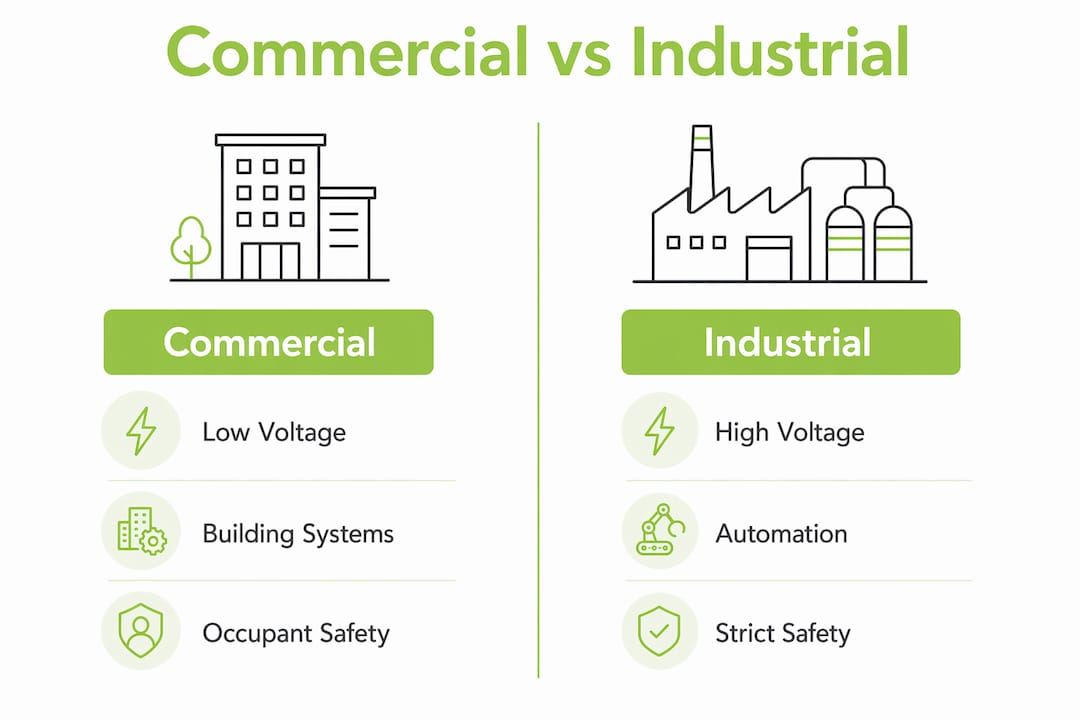
Safety compliance frameworks also diverge sharply. Industrial workers require training in lockout/tagout, arc flash protection, and compliance with NFPA 70E and OSHA regulations, which exceed commercial safety standards focusing on fire prevention and emergency systems. In the UK, industrial sites must also comply with the Electricity at Work Regulations 1989 and relevant HSE guidance for high-voltage environments.
| Technical factor | Commercial electrical work | Industrial electrical work |
|---|---|---|
| Typical voltage | Single-phase and light 3-phase | High-voltage 3-phase distribution |
| Primary systems | Lighting, HVAC, fire alarms, data | Motor controls, PLCs, switchgear |
| Safety focus | Occupant safety, building codes | Production safety, arc flash, lockout/tagout |
| Compliance standards | Building Regulations, BS 7671 | NFPA 70E, Electricity at Work Regulations 1989 |
| Downtime priority | Operational continuity for tenants | Production uptime for manufacturing |
| Certification level | Standard electrical licence | Additional high-voltage and hazardous area certs |
The core distinction is the objective. Commercial electricians protect building occupants and maintain daily operations, whereas industrial electricians protect production integrity and prevent costly downtime. Both objectives are legitimate and demanding. They simply require different training, tools, and mindsets.
Operational risks differ fundamentally between the two disciplines. Industrial electricians manage high-consequence failures affecting entire manufacturing chains, requiring sophisticated risk management compared to compliance-oriented commercial work. A fault in a commercial building might disrupt a floor of office workers. A fault in an industrial plant can halt an entire production line, with financial losses mounting by the minute.
Which electrician type should you choose?
Choosing between a commercial and industrial electrician is less about which is better and more about matching the specialism to your facility. Correct selection is essential to avoid costly downtime or safety non-compliance. Getting this wrong is not a minor inconvenience. It can mean regulatory penalties, insurance voidance, or serious injury.
Use this framework to guide your decision:
-
Identify your facility type. Offices, retail units, schools, healthcare premises, and hospitality venues all fall within the commercial category. Factories, processing plants, warehouses with heavy machinery, and refineries require industrial expertise.
-
Assess your electrical systems. If your site runs standard lighting, HVAC, and data networks, a commercial electrician covers your needs. If you operate 3-phase motor-driven machinery, automation systems, or high-voltage distribution, you need an industrial specialist.
-
Consider your compliance obligations. Commercial premises must meet BS 7671 (the IET Wiring Regulations) and building-specific codes. Industrial sites carry additional obligations under the Electricity at Work Regulations 1989 and, where relevant, DSEAR for hazardous atmospheres.
-
Evaluate the consequences of downtime. A commercial electrician prioritises safe, code-compliant work that keeps a building operational for its occupants. An industrial electrician is trained to restore production systems fast and safely, often under significant time pressure.
-
Look for overlap scenarios. Some facilities sit between the two categories. A large distribution centre with automated conveyor systems and office space may need both specialisms. In these cases, choosing a local electrician with experience across both environments, or a firm that can coordinate both, is the practical solution.
-
Verify credentials before committing. Ask for evidence of relevant certifications. A NICEIC-approved contractor, for example, has been independently assessed for technical competence and compliance. That approval is not self-declared. It is verified by an external body.
The choice between the two is fundamentally about specialisation. Industrial electricians specialise in automation and motor control. Commercial electricians focus on building codes and occupant safety. Neither discipline is a substitute for the other in the environments where they are genuinely needed.
Key takeaways
The single most important principle when choosing between a commercial and industrial electrician is matching the specialism to the environment, because the wrong choice creates safety risks and compliance failures that no amount of goodwill can fix.
| Point | Details |
|---|---|
| Environment determines specialism | Commercial electricians serve offices and public buildings; industrial electricians serve factories and production plants. |
| Voltage and systems differ | Industrial sites use high-voltage 3-phase power and PLCs; commercial sites use moderate loads for lighting and HVAC. |
| Safety standards diverge | Industrial work requires arc flash and lockout/tagout training beyond standard commercial compliance. |
| Downtime costs drive urgency | Industrial electricians prioritise production uptime; commercial electricians prioritise occupant safety and code compliance. |
| Credentials matter | Always verify NICEIC approval or equivalent certification before engaging any electrical contractor. |
What I have learned from 23 years of electrical work
Craig’s perspective on choosing between commercial and industrial electricians is shaped by two decades of hands-on experience across both environments.
The mistake I see most often is businesses assuming that any qualified electrician can handle any job. That assumption is understandable. An electrician is an electrician, right? Wrong. The gap between commercial and industrial electrical work is as wide as the gap between a GP and a surgeon. Both are doctors. Neither should do the other’s job unsupervised.
What newcomers consistently underestimate is the pace and pressure of industrial fault-finding. In a commercial building, a lighting fault is an inconvenience. In a manufacturing plant, a PLC fault at 2 AM on a night shift can halt production for an entire facility. The diagnostic process is completely different, and the stakes are categorically higher.
The other thing I would stress is the value of ongoing certification. The electrical industry does not stand still. Arc flash standards, automation protocols, and compliance frameworks update regularly. An industrial electrician who qualified ten years ago and has not kept their training current is a liability, not an asset. The same applies on the commercial side, where energy efficiency standards and building regulations continue to evolve.
My honest advice: before you engage any electrician for a significant project, ask two questions. First, what environments have you worked in recently? Second, what certifications do you hold and when were they last renewed? The answers will tell you everything you need to know about whether they are the right fit for your facility.
— Craig
Centralec-electrical: electrical expertise for your facility
Centralec-electrical has delivered professional electrical services across the South West for over 23 years, covering both commercial and specialist installation work. As a NICEIC-approved contractor, every project meets independently verified safety and compliance standards, with no hidden costs and a satisfaction guarantee on completed work.

Whether you manage a commercial property requiring an EICR, a retail fit-out needing full electrical installation, or a business looking at EV charger installation for your car park or fleet, Centralec-electrical brings the right specialism to the right project. Contact the team for a professional assessment of your facility’s electrical needs, and get clear, transparent advice on the services that match your requirements.
FAQ
What is the main difference between a commercial and industrial electrician?
A commercial electrician focuses on electrical systems in offices, retail, and public buildings, prioritising occupant safety and building code compliance. An industrial electrician specialises in high-voltage power distribution, motor controls, and automation systems in factories and production facilities.
Can a commercial electrician work on industrial sites?
Not without additional training and certification. Industrial sites require qualifications in high-voltage handling, arc flash protection, and lockout/tagout procedures that fall outside standard commercial electrical training.
Which electrician do I need for an office building?
A commercial electrician is the correct choice for an office building. They handle lighting, HVAC, fire alarms, data cabling, and compliance with building regulations and BS 7671.
What certifications should an industrial electrician hold?
An industrial electrician should hold certifications in high-voltage systems, hazardous area awareness, and arc flash safety, in addition to a standard electrical licence. Compliance with NFPA 70E and the Electricity at Work Regulations 1989 is the baseline for UK industrial sites.
How do I verify an electrician’s credentials in the UK?
Check whether the contractor holds NICEIC approval or is registered with an equivalent government-authorised competent person scheme. These approvals are independently verified and publicly searchable, giving you confidence that the electrician meets current safety and compliance standards.